NEW

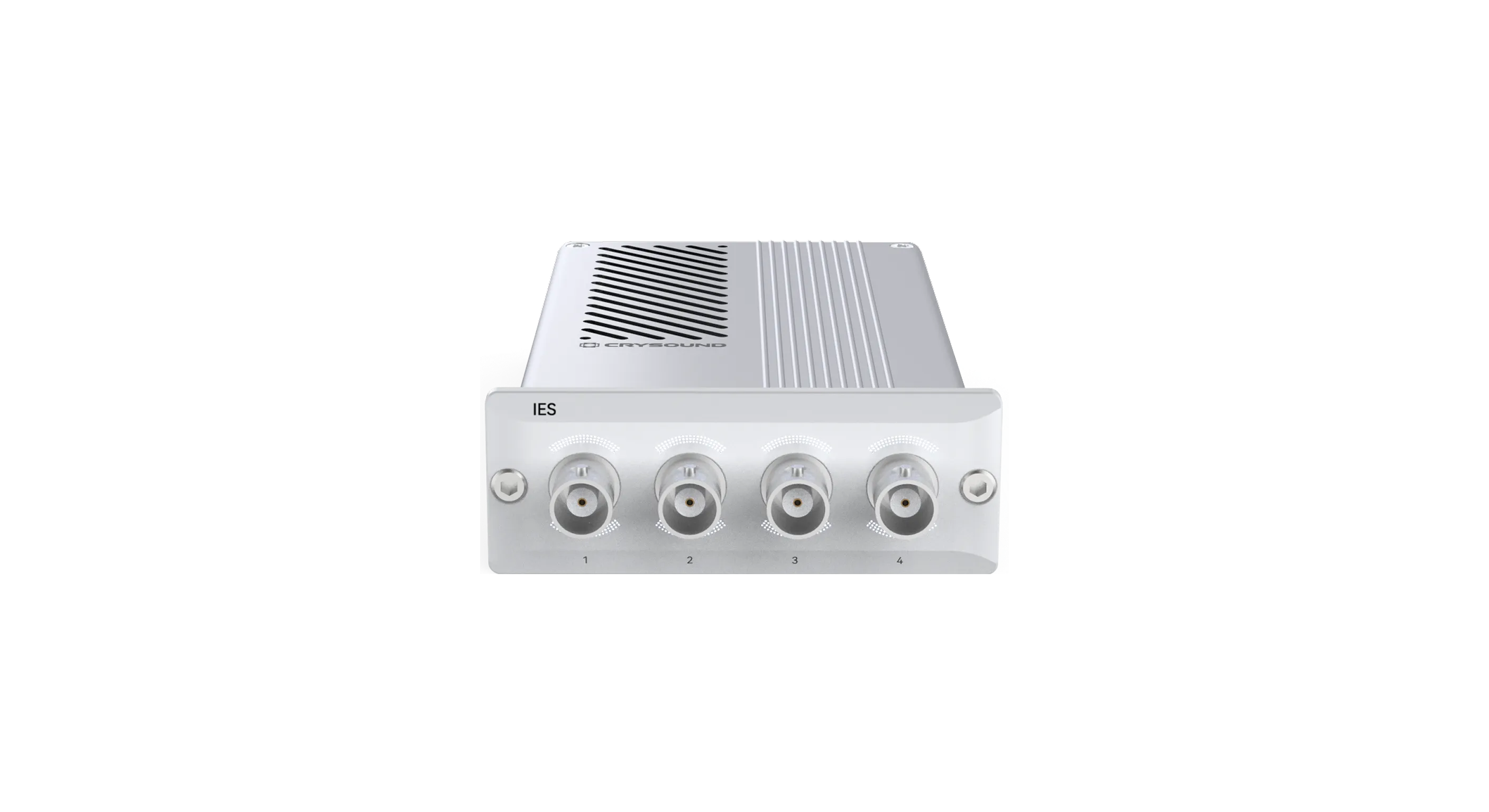
CRY5010 IEPE Analog In - IES

The CRY5010 IES analog input module targets sound, vibration and electroacoustic testing, with four IEPE/Voltage inputs for microphones, accelerometers and voltage sources. 32-bit resolution, 120 dB dynamic range, up to 204.8 kS/s sampling. Supports multiple ranges, AC/DC coupling, differential/single-ended input and TEDS - suited to lab R&D, product performance validation and multi-point testing.

Downloads
Product Highlights
Low Noise and Low Distortion, Preserving the Original Signal Detail

Low Noise and Low Distortion, Preserving the Original Signal Detail

At 0.7 Vp and 10 Vp ranges, THD+N ≤ −105 dB (1 kHz), minimizing noise and distortion in acquisition while preserving original signal detail - reliable data for spectrum analysis and performance evaluation.

Low Noise and Low Distortion, Preserving the Original Signal Detail
Wideband Response for Measurements across Frequency Bands

Wideband Response for Measurements across Frequency Bands

Up to 204.8 kS/s for high-frequency acoustic signals, with a 2 Hz AC-coupling cutoff that preserves low-frequency dynamics - covering both low-frequency vibration and high-frequency acoustic testing.

Wideband Response for Measurements across Frequency Bands
Flexible Input, Simplified Sensor Setup

Flexible Input, Simplified Sensor Setup

IEPE and voltage inputs with 4 mA / 24 V IEPE supply, connecting measurement microphones, accelerometers and voltage sources. TEDS support reads sensor information, reducing manual configuration.

Flexible Input, Simplified Sensor Setup
Low Crosstalk, Minimal Channel Interference

Low Crosstalk, Minimal Channel Interference

Channel crosstalk ≤ −130 dB (1 kHz), effectively reducing signal coupling between channels. When acquiring signals of different amplitudes at the same time, it limits the influence of a strong signal on weak responses in adjacent channels, improving signal contrast and the reliability of spectrum analysis.

Low Crosstalk, Minimal Channel Interference
Technical Specifications
Channel
4
ADC Resolution
32-bit
Sampling Rate
204.8 kS/s
Dynamic Range
120 dB
Coupling
AC / DC, Optional
Frequency Accuracy
± 2 ppm (-10 ℃~ 50 ℃)
Amplitude Accuracy
± 0.35% (15 ℃ ~ 30 ℃)
TEDS
Support
IEPE
4 mA / 24 V
Sync. Accuracy (Channel)
± 30 ns
Input Signal Type
Differential / Single-ended
Typical Power Consumption
3.5 W
THD + N
0.7 Vp: ≤ -105 dB @1 kHz
Crosstalk
≤ -130 dB @1 kHz
Noise Floor
0.7 Vp: ≤ 1.5 µVrms(-116.5 dBV) 20 Hz~20 kHz
Input Range
31.6 Vp
Impedance
9 kΩ
Frequency Flatness
DC: ± 0.008 dB (3.15 Hz~20 kHz)     ± 0.030 dB (20 kHz~50 kHz)   ± 0.1 dB (50 kHz~80 kHz) AC: ± 0.030 dB (20 Hz~20 kHz)
Main Features

Related Products

https://www.crysound.com.cn/b/acoustic-vibration-test-system-selection-sonodaq-opentest-vs-ni-pxie/

SonoDAQ vs NI PXIe: How to Choose the Right Data Acquisition System

When selecting a data acquisition system for acoustics, NVH, and vibration testing, it is not enough to compare sampling rate, ADC resolution, or channel count alone. The evaluation should also consider field deployment, synchronization, power supply, data storage, analysis workflow, and report delivery. This article compares the application boundaries of SonoDAQ + OpenTest and NI [...]
Typical applications of SonoDAQ PTP synchronization.

SonoDAQ PTP Multi-Device Synchronization Test: Deviation Remains Below 40 ns

The key to a multi-device data acquisition system is not simply the number of channels, but whether all acquired data share the same time base. In applications such as acoustic arrays, sound source localization, NVH analysis, and distributed vibration testing, even a small timing offset can affect phase relationships, time-of-arrival differences, and source localization accuracy. [...]

From Multi-Device Testing to a Unified Platform with SonoDAQ + OpenTest

In today's rapidly evolving electroacoustic product landscape, production line testing systems are no longer expected to simply "produce measurements." They must balance test capability, throughput, stability, and scalability. Core metrics such as frequency response, distortion, and sweep analysis remain essential. At the same time, more advanced requirements, such as anomalous sound detection, multi-channel synchronization, automated [...]

Sound Power Measurement Case Study: Repeatable Workflow in a Metrology Lab

In modern metrology labs, accurately measuring product noise requires more than just sound pressure values. This case study demonstrates how a metrology institute implemented a repeatable, multi-point sound power measurement workflow using SonoDAQ Pro and OpenTest, enabling reliable comparison of servers, fans, home appliances, and motors under different operating conditions. Learn how synchronized data acquisition, [...]

Get in touch

If you are interested or have questions about our products, book a demo and we will be glad to show how it works, which solutions it can take part of and discuss how it might fit your needs and organization.

Downloads Downloads
Quote 0
Quote
+86-571-88225128 +86-571-88225128
Experience Demo Experience Demo
Ask an Expert Ask an Expert