


The key to a multi-device data acquisition system is not simply the number of channels, but whether all acquired data share the same time base. In applications such as acoustic arrays, sound source localization, NVH analysis, and distributed vibration testing, even a small timing offset can affect phase relationships, time-of-arrival differences, and source localization accuracy.
This article presents the results of a PTP synchronization test performed on three SonoDAQ devices. It covers both daisy-chain and star network topologies, OpenTest synchronization accuracy monitoring, and 1PPS oscilloscope verification, providing a practical reference for evaluating synchronization consistency in multi-device, multi-channel data acquisition systems.
Test Results: Under the test configuration, the synchronization deviation of all acquisition channels relative to the CH1 reference channel remained within 40 ns. In addition, a 24-hour edge comparison of the 1PPS signals from two SonoDAQ devices showed a time difference of less than 30 ns. These results demonstrate that SonoDAQ's PTP synchronization performance is not only a specification on paper, but can also be monitored, verified, and consistently reproduced in real-world data acquisition systems.
Why Use PTP for Synchronized Data Acquisition?
PTP (Precision Time Protocol), commonly defined by the IEEE 1588 standard, establishes a unified time base among multiple devices over Ethernet. By exchanging timestamped messages between a master clock and slave clocks, PTP continuously calculates network delay and clock offsets, allowing each device to correct its local clock and maintain synchronization.
Compared with the more commonly known NTP (Network Time Protocol), PTP is much better suited for high-precision applications such as industrial measurement and data acquisition. In systems that support hardware timestamping, PTP significantly reduces uncertainty caused by network latency and software processing, enabling multiple acquisition devices to operate on a common time axis.

Flexible Network Topologies with SonoDAQ
SonoDAQ supports IEEE 1588 PTP high-precision time synchronization, enabling multiple acquisition devices to share a common time reference over standard Ethernet networks. From single-device multi-channel systems to distributed multi-device acquisition platforms, PTP reduces the need for dedicated synchronization and trigger cables, simplifying deployment and improving scalability.
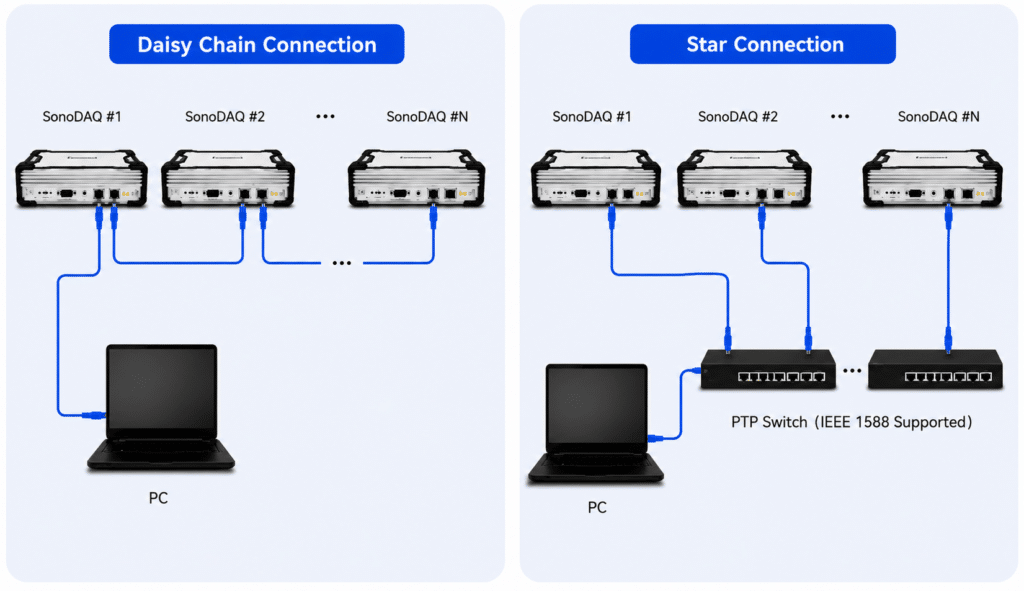
Depending on system size and installation requirements, SonoDAQ supports two common synchronization topologies:
- Daisy-chain topology for small- to medium-scale systems, allowing rapid device interconnection.
- Star topology using IEEE 1588-compliant PTP switches for large-scale, high-channel-count, or distributed measurement systems, providing greater flexibility and scalability.
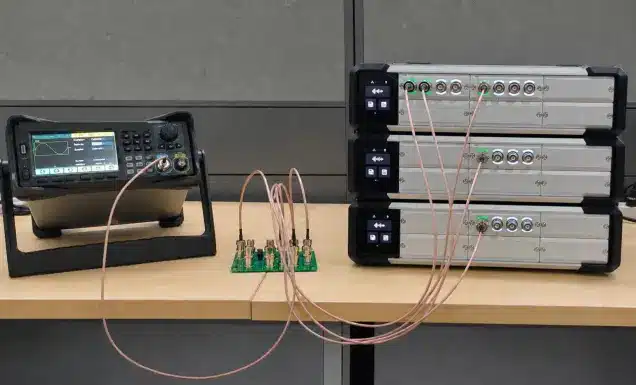
Test Setup: Three SonoDAQ Devices Monitored by OpenTest
To evaluate SonoDAQ's PTP synchronization performance, a synchronized acquisition system consisting of three SonoDAQ units was built. PTP synchronization was enabled in OpenTest, which continuously monitored synchronization status and accuracy.
The same test signal was routed to different channels, boards, and devices to evaluate synchronization performance under the most common multi-device acquisition scenarios.
Test Configuration
| Item | Configuration |
|---|---|
| Test Devices | SonoDAQ× 3 |
| Synchronization Method | IEEE 1588 PTP |
| Test Software | OpenTest |
| Reference Channel | CH1 |
| Verification Scope | Different channels on the same device; different boards on the same device; different SonoDAQ devices |
| Signal Input | Same test signal connected to CH1, CH2, CH3, CH4, and CH5 |
| External Validation | 1PPS signals from two SonoDAQ devices measured by oscilloscope |
| Result Representation | OpenTest displays synchronization deviation relative to CH1; oscilloscope displays 1PPS edge timing difference |
In this test:
- CH1 served as the reference channel.
- CH2 verified synchronization between channels on the same device.
- CH3 verified synchronization between different boards within the same device.
- CH4 and CH5 verified synchronization across different SonoDAQ devices.
OpenTest continuously displayed the synchronization deviation of each channel relative to CH1, allowing users to assess synchronization stability in real time.
Measured Results: Synchronization Deviation Below 40 ns
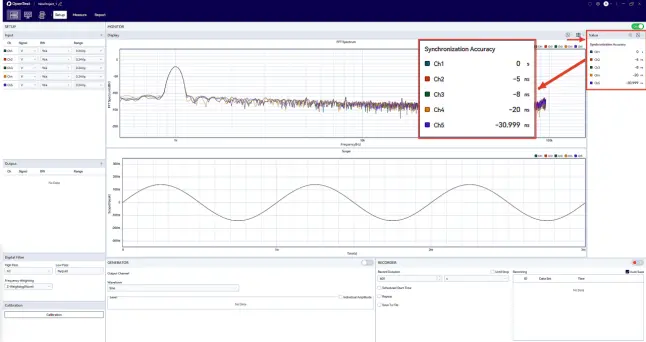
As shown in Figure 4, regardless of whether the comparison involved:
- Different channels within the same device,
- Different boards within the same device, or
- Different SonoDAQ devices,
the synchronization deviation displayed by OpenTest remained within 40 ns relative to the CH1 reference channel.
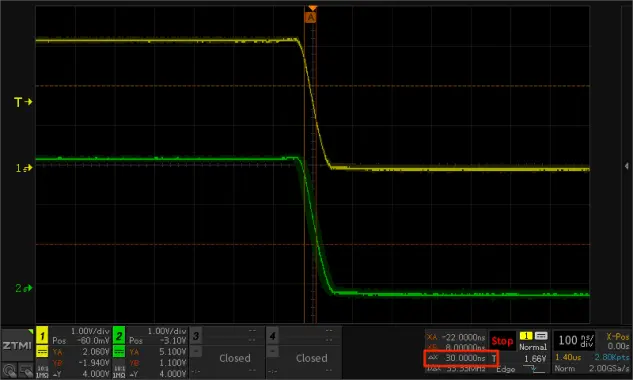
To further validate these results, the 1PPS outputs of two SonoDAQ devices synchronized via PTP were connected to Channel 1 and Channel 2 of an oscilloscope for edge-jitter comparison.
After 24 hours of continuous operation, the oscilloscope results shown in Figure 5 indicated that:
- CH1 served as the trigger reference.
- The persistence width of the CH2 edge remained within 30 ns.
This confirms that the synchronization performance is not merely a nominal specification, but can be independently monitored, validated, and reproduced through both OpenTest and oscilloscope measurements in a real acquisition system.
Summary of Test Results
| Verification Target | Channels / Signals | Purpose | Measured Result |
|---|---|---|---|
| Different channels on the same device | CH1 vs CH2 | Verify channel-to-channel synchronization consistency | < 40 ns |
| Different boards on the same device | CH1 vs CH3 | Verify cross-board synchronization consistency | < 40 ns |
| Different devices | CH1 vs CH4 / CH5 | Verify multi-device synchronization consistency | < 40 ns |
| External 1PPS validation | 1PPS signals from two SonoDAQ devices | Verify edge timing difference using oscilloscope | < 30 ns |
Note: The "< 40 ns" result refers to the synchronization deviation displayed by OpenTest relative to the CH1 reference channel under the specific test configuration described in this article. Actual synchronization performance may be affected by factors such as network topology, PTP switches, cabling, clock sources, and electromagnetic conditions. Verification under site-specific conditions is recommended for production deployments.
What This Means for Engineering Testing
In acoustic arrays, beamforming, and sound source localization, channel-to-channel timing errors directly affect phase relationships and time-of-arrival calculations. In NVH and vibration testing, time consistency across measurement points impacts frequency-domain analysis, correlation analysis, and event localization accuracy.
SonoDAQ's PTP synchronization capability helps ensure that multi-channel data is acquired on a common time axis, minimizing timing errors introduced by the acquisition system itself.
For distributed industrial monitoring, vehicle testing, railway testing, and large-scale machinery testing, PTP synchronization also reduces the need for long-distance synchronization and trigger cabling. Once a new acquisition node joins the same PTP network and synchronizes successfully, it can immediately become part of the existing measurement system, allowing seamless expansion from a single device to a distributed multi-device platform.
For users, the value of synchronization accuracy goes beyond achieving a better specification. It reduces acquisition-related error sources in sound source localization, phase analysis, and multi-point event analysis. With OpenTest's real-time synchronization monitoring, engineers can quickly determine whether the system is operating under reliable synchronization conditions and reduce the risk of discovering unusable data only after testing is complete.
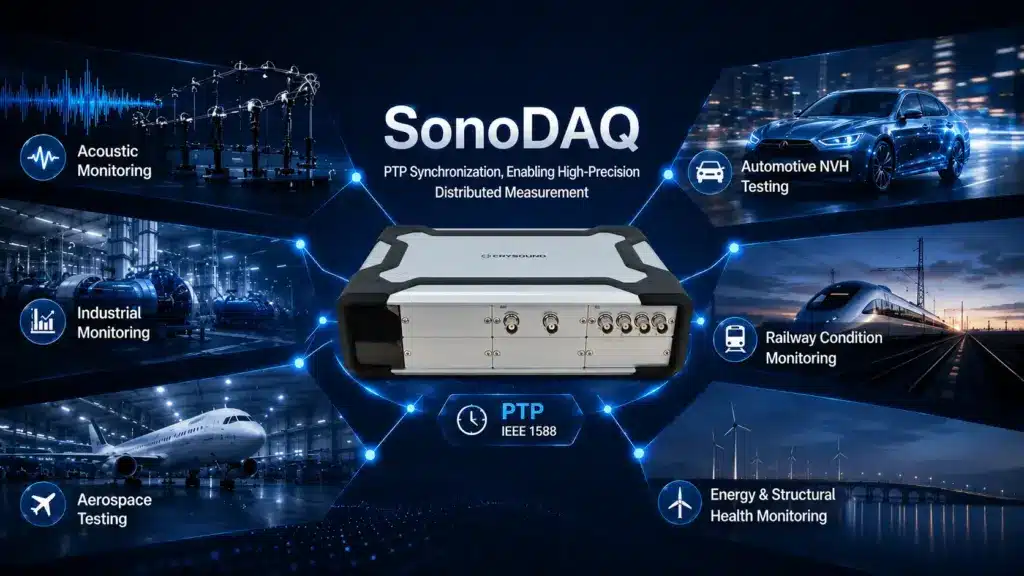
Typical Application Scenarios
| Application | Value of Synchronized Acquisition |
|---|---|
| Acoustic Arrays / Sound Source Localization | Minimizes timing-related impacts on phase relationships, time-of-arrival calculations, and localization accuracy |
| NVH and Vibration Testing | Improves consistency across measurement points for frequency-domain analysis, correlation analysis, and event localization |
| Distributed Industrial Monitoring | Reduces deployment complexity by eliminating long synchronization and trigger cables while enabling easy expansion |
| Vehicle and Railway Testing | Supports synchronized acquisition across multiple devices and locations for system-level data alignment |
| Large Equipment Testing | Enables smooth expansion from single-device acquisition to large multi-device, multi-channel test platforms |
Conclusion
PTP provides a unified time reference for multi-device data acquisition systems and serves as a key technology for achieving high-precision synchronized measurements.
With SonoDAQ and OpenTest, users can build synchronized acquisition systems through either daisy-chain or star-topology networking, monitor synchronization status in real time, and verify synchronization performance throughout the testing process.
Based on the results of this evaluation, SonoDAQ achieved synchronization deviations of less than 40 ns in multi-device, multi-channel acquisition scenarios. Independent verification through 1PPS oscilloscope measurements further confirmed the synchronization performance, providing a reliable foundation for acoustic testing, vibration measurement, sound source localization, NVH analysis, and distributed industrial monitoring applications.
Interested in synchronized acquisition solutions for acoustic arrays, NVH testing, or distributed vibration measurements? Contact us to obtain complete test reports, OpenTest demonstrations, or recommendations for multi-channel system configurations.


