


When evaluating the noise of an appliance, a single sound level meter reading only indicates how loud the sound is at one specific measurement location. It does not directly represent the inherent noise emitted by the product itself. This article begins by explaining the difference between sound pressure level and sound power level, clarifying why two values expressed in dB(A) cannot be used interchangeably. It then introduces the principles of sound power measurement, its typical application scenarios, and its value in product specifications, noise reduction development, product comparison, quality control, and certification testing.
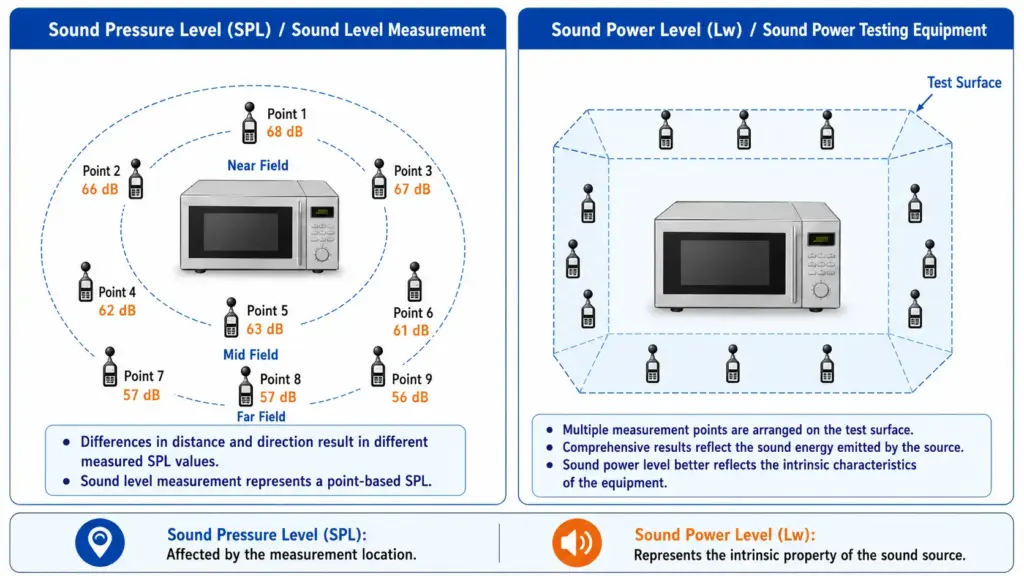
The fundamental difference between sound pressure level and sound power level is straightforward: sound pressure level answers the question, "How loud is it at this location?" while sound power level answers, "How much acoustic energy does this product radiate?"
Start by clarifying what the measurement represents
Many errors in appliance noise evaluation are caused not by inaccurate instruments, but by treating the sound pressure level at a specific location as the noise level of the product itself. For example, measuring 55 dB(A) at a distance of 1 m from a machine only indicates the sound pressure level at that measurement point. If the microphone is moved to a different distance, position, or room, the reading may change accordingly.
For this reason, relying solely on a single-point sound pressure measurement is not a fair basis for product specifications, engineering comparisons, production quality control, or certification testing. A more appropriate approach is to perform standardized sound power measurements, which minimize the influence of measurement distance, room acoustics, and background noise, allowing the sound power level to represent the product's inherent acoustic emission.
One Sentence to Distinguish the Two
Sound Pressure Level (Lp): The sound pressure measured at a specific location, representing how loud it sounds where you are standing.
Sound Power Level (Lw): The total acoustic energy emitted by a sound source, representing how much noise the equipment itself generates.
A useful analogy is a light bulb:
- Sound power is like the bulb's intrinsic light output.
- Sound pressure level is like the brightness perceived at a particular location.
Your perceived brightness changes depending on distance, room size, and reflections from walls. However, the bulb's actual light output remains unchanged.
What Is Sound Pressure Level?
Sound pressure is the fluctuation in air pressure caused by a sound wave. The physical quantity is denoted by p and measured in Pascals (Pa).
Because the range of sound pressures detectable by the human ear is extremely large, engineers typically use a logarithmic scale called sound pressure level (Lp):
Lp = 20 log10(p / p0)
Where:
- p = measured sound pressure (Pa)
- p₀ = reference sound pressure, typically 20 μPa
- Lp = sound pressure level (dB)
When A-weighting is applied to approximate the frequency sensitivity of human hearing, it is commonly written as LpA and expressed in dB(A).
The key point is that sound pressure level is a location-dependent quantity. It describes how much acoustic pressure exists at a specific point, distance, and environment.
It is therefore well suited for evaluating:
- Noise at a worker's position
- Noise near a user's ear
- Noise at a specific location inside a room
What Is Sound Power Level?
Sound power represents the total acoustic energy radiated by a source per unit time. The physical quantity is denoted by W and measured in watts (W).
Because sound power spans a very large range, it is also expressed logarithmically as the sound power level:
Lw = 10 log10(W / W0)
Where:
- W = sound power emitted by the source (W)
- W₀ = reference sound power, typically 10⁻¹² W (1 pW)
- Lw = sound power level (dB)
When A-weighting is applied, it is commonly written as LwA and may also be expressed in dB(A).
In everyday communication, people sometimes refer to sound power level simply as "sound power," but in product specifications the correct term is usually sound power level.
Sound power level is essentially a measure of the source's inherent noise emission capability. As long as the operating condition of the equipment remains unchanged, the sound power level should not change simply because the observer moves closer or farther away.
Why Can't the Two Be Used Interchangeably?
The unit dB is a logarithmic expression, not a unique unit tied to a single physical quantity.
Both sound pressure level and sound power level can be expressed in dB. After A-weighting, both may even appear as dB(A).
Therefore, when you see a value such as 55 dB(A), the first question should be:
Is it LpA or LwA?
| Item | Sound Pressure Level | Sound Power Level |
|---|---|---|
| Symbol | Lp / LpA | Lw / LwA |
| Physical Quantity | Sound Pressure (p) | Sound Power (W) |
| Base Unit | Pa | W |
| Level Unit | dB / dB(A) | dB / dB(A) |
| Answers the Question | How loud does it sound here? | How much sound energy does the product emit? |
| Distance Dependence | Strongly affected by distance | Should not change with measurement distance |
| Environmental Dependence | Affected by reflections and background noise | Standardized corrections improve comparability |
| Typical Use | Environmental and user-position noise | Product ratings, R&D, certification, benchmarking |
Why Isn't a Sound Level Meter Alone Enough?
A sound level meter is certainly useful. It quickly measures the sound pressure level at a given location.
However, when the goal is to evaluate the intrinsic noise performance of an appliance, a single-point SPL measurement can be heavily influenced by external conditions:
- Measurement distance: readings at 0.5 m and 1 m may differ significantly.
- Measurement position: front, side, and rear measurements may not match.
- Installation conditions: placement near walls, corners, or tabletops affects reflections.
- Room acoustics: offices, reverberation rooms, anechoic rooms, and semi-anechoic rooms produce different results.
- Background noise: higher ambient noise can mask the true noise of the product.
As a result:
- Sound pressure level answers the question: "How loud does it sound at this location?"
- Sound power level answers the question: "How much noise does the product itself generate?"
For product evaluation, the latter is usually more important.
How Is Sound Power Level Measured?
Sound power level is generally not measured directly at a single point.
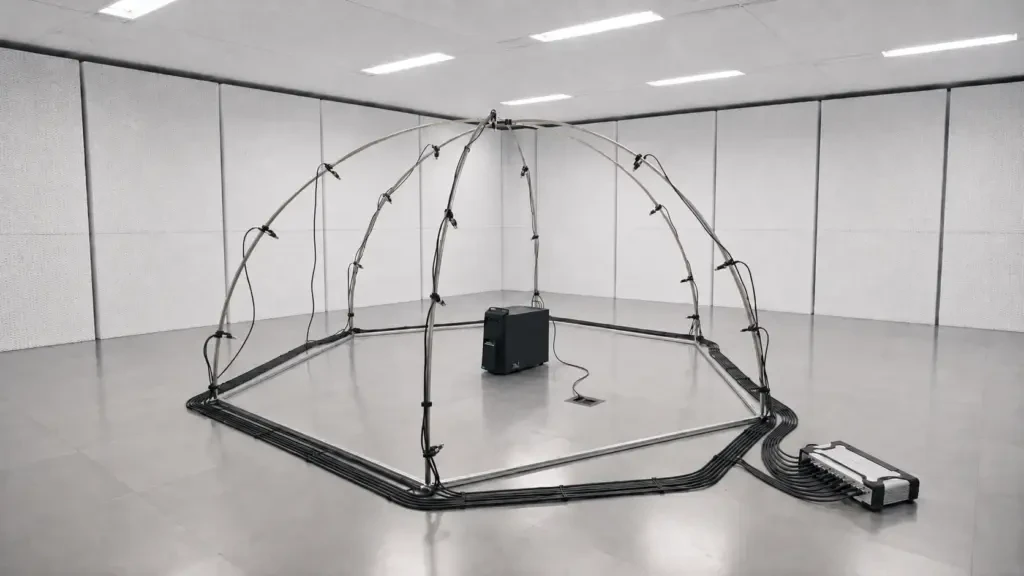
Instead, standardized test methods are used. A common approach involves placing multiple microphones around the equipment, measuring the average sound pressure level over a defined measurement surface, and applying corrections for background noise and environmental influences.
A simplified equation is:
Lw = Lp,avg + 10 log10(S / S0) - K1 - K2
Where:
- Lw = sound power level
- Lp,avg = average sound pressure level over the measurement surface
- S = measurement surface area (m²)
- S₀ = reference area (1 m²)
- K₁ = background noise correction
- K₂ = environmental correction
This illustrates an important principle:
Sound power measurement is not simply measuring another decibel value from a different position. It is a standardized process involving data acquisition, corrections, and calculations designed to minimize the influence of distance, room acoustics, and ambient noise.
Why Is Sound Power Level More Valuable for Appliances?
For products such as:
- Air conditioners
- Refrigerators
- Vacuum cleaners
- Fans
- Electric motors
- Compressors
- Kitchen appliances
- Office equipment
Manufacturers typically care about more than a single sound pressure reading.
They need a metric that is:
- Stable
- Repeatable
- Comparable
Noise Reduction Development:
Has a redesigned airflow path, impeller, motor, compressor, or enclosure actually reduced noise?
Product Version Comparison:
Is Version A genuinely quieter than Version B?
Production Quality Control:
Can noise variations caused by different suppliers or production batches be identified?
Certification Testing:
Are the reported noise values based on recognized test standards?
Product Marketing:
Can the published noise specification be trusted and compared fairly?
These are precisely the situations where sound power level excels.
Because it reflects the product itself rather than a temporary measurement location, it provides a more meaningful basis for comparison.
What Problems Does a Sound Power Measurement Solution Solve?
A professional sound power testing system typically includes:
- Multi-channel acoustic data acquisition
- Standardized microphone positioning
- Measurement surface management
- A-weighting and frequency spectrum analysis
- Background noise correction
- Environmental correction
- Sound power calculation
- Automated test report generation
This transforms testing from a simple single-point reading into a standardized evaluation process.
Benefits include:
- Meaningful comparisons between products, designs, and production batches
- Objective data to support noise reduction efforts
- Consistent metrics across R&D, quality assurance, certification, and marketing teams
- Reduced disputes caused by differences in measurement distance, room conditions, or background noise
When Should You Use Sound Pressure Level vs. Sound Power Level?
| Application | Recommended Metric | Reason |
|---|---|---|
| User perception at a specific location | Sound Pressure Level (LpA) | Concerned with perceived loudness at that position |
| Workplace and environmental noise assessment | Sound Pressure Level (LpA) | Concerned with exposure and environmental impact |
| Product noise specification | Sound Power Level (LwA) | Concerned with the source's intrinsic noise emission |
| Noise reduction R&D comparison | Sound Power Level (LwA) | Minimizes distance and environmental influences |
| Product model comparison | Sound Power Level (LwA) | Enables fair and repeatable comparisons |
| Production batch comparison | Sound Power Level (LwA) | Provides stable and consistent evaluation criteria |
Conclusion: Don't Just Ask What the Sound Level Meter Reads
Both sound pressure level and sound power level are important, but they answer different questions.
- Sound Pressure Level (Lp) describes the sound heard at a specific location.
- Sound Power Level (Lw) describes the total acoustic energy emitted by the equipment itself.
If the goal is to understand how noisy a particular location feels, measuring sound pressure level with a sound level meter is entirely appropriate.
However, for product development, quality control, model comparison, certification testing, and product specification, sound power level is the more scientific, stable, and comparable metric.
In one sentence: a sound level meter tells you how loud it is here, while sound power measurement tells you how noisy the product itself really is.
For more information about sound power testing, appliance noise evaluation, or CRYSOUND's acoustic measurement solutions, please fill out the contact form below. Our engineering team will be happy to help you select the most appropriate testing method and provide technical support for your specific application.


