


You are standing in a mechanical room where the AHU, pump, fan, valve group, and ductwork are all making noise at once. The complaint is simple: something is leaking, whistling, vibrating, or not performing as expected. The difficult part is knowing which physical point deserves hands-on testing first.
That is where acoustic imaging for HVAC inspections becomes useful. An acoustic camera turns airborne sound into a visible map, helping technicians move from a broad symptom to a testable point: a duct seam, pipe joint, valve body, fan assembly, bearing area, refrigerant line, gas escape point, partial-discharge point, or surface-discharge risk on electrical insulation.
Acoustic imaging for HVAC: a microphone-array inspection method that visualizes airborne sound sources on a visible image, helping teams localize likely leaks, abnormal noise, turbulent flow, mechanical issues, or PD-risk points before choosing the confirmation test.

inspection.
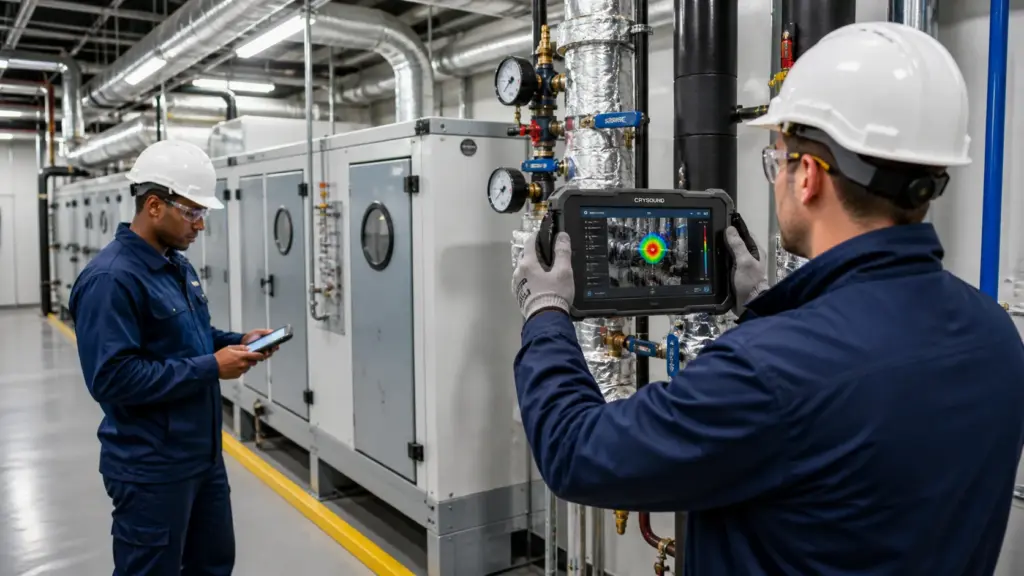
acoustic imaging inspection.
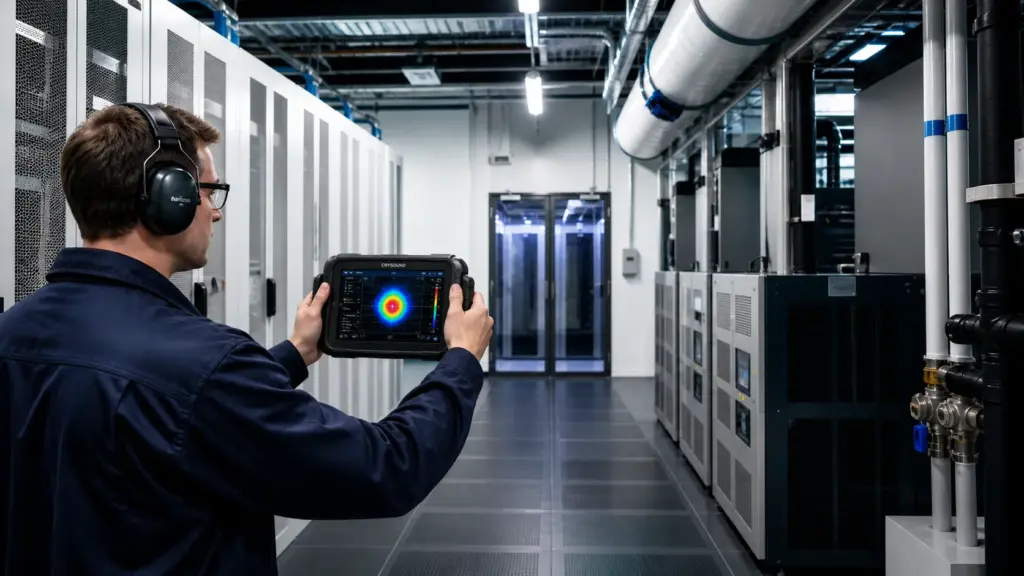
equipment

Figure 4. HVAC acoustic imaging workflows for duct leaks, gas leaks, partial-
discharge checks, and Ex-rated inspections.
Walkdown advantage
What Acoustic Imaging Changes in an HVAC Walkdown
The camera is most valuable when it changes the next action. Instead of checking every joint, panel, valve, and rotating asset one by one, the technician can scan a wider area, identify the strongest repeatable source, save visual evidence, and decide what should happen next.
Faster localization
Narrow a noisy room, roof, or ceiling void down to a physical point before checking every joint or opening panels.
Safer scanning
Inspect from a practical distance before approaching pressure lines, rotating machinery, electrical rooms, or hard-to-reach assets.
Better repair priorities
Rank leak-like sources, valve issues, abnormal airflow, and running assets before opening a work order.
Clearer reports
Give customers images, asset IDs, supported leak estimates, discharge-type evidence, infrared context, and before/after results.
It is the fast first layer: find the point, then verify it with the correct method.
For a pilot, rank environments by urgency, inspection value, and how quickly the result can become a maintenance action.
1 Data centers Cooling + PD risk
Best use: Use acoustic imaging where cooling uptime and electrical reliability meet.
Scan first: CRAC/CRAH units, fan walls, switchgear, cable boxes, bus connections, and insulation surfaces.
Output: Gas workflows support leak localization and loss estimates; electric workflows localize PD and help identify discharge type.
2 Large buildings and campus operations Comfort + energy
Best use: Turn repeated comfort, noise, and energy complaints into repairable points.
Scan first: Long duct routes, valve groups, rooftop units, AHUs, ceiling voids, and mechanical rooms.
Output: A visible source tied to a leak, loose panel, valve whistle, abnormal airflow point, or mechanical-room noise source.
3 Hospitals and healthcare facilities Non-contact walkdown
Best use: Support uptime, quiet operation, clean-area HVAC, and maintenance evidence without opening equipment first.
Scan first: Plant rooms, AHUs, exhaust systems, valve groups, supported gas routes, and nearby electrical rooms.
Output: Leak, airflow, PD, or thermal clues that help maintenance teams prioritize follow-up checks.
4 Industrial plants, cold-chain, and hazardous areas Gas + Ex-rated
Best use: Match the inspection route to process cooling, refrigeration rooms, gas lines, pumps, motors, and safety requirements.
Scan first: Refrigeration rooms, process cooling areas, gas-handling zones, industrial utilities, and rotating assets.
Output: Supported leak and loss estimates from gas workflows, plus ex-rated inspection options where hazardous-area rules apply.
5 HVAC service contractors and commissioning teams Report-ready evidence
Best use: Choose the right version for the route, scan, localize, estimate or classify when supported, then re-scan after repair.
Scan first: Customer complaint points, recently serviced zones, leak-prone fittings, airflow complaints, and abnormal noise sources.
Output: A visual punch list with before/after images or videos that customers can understand quickly.
HVAC Inspection Workflows
Use the route navigator below to match the HVAC problem to the right inspection workflow. Each route shows which acoustic imaging version fits the job, where to scan first, and what evidence can be recorded for the work order.
Field route navigator
Pick the route, then match the right acoustic imaging workflow.
CRY8124 Advanced Acoustic Imaging Camera
Air leak or duct hiss
Use
General HVAC walkdowns, duct-leak localization, airflow noise, and mechanical-room screening.
Scan first
Duct seams, flexible connectors, access panels, AHU connections, ceiling voids, rooftop units, and recently serviced sections.
Output
A visible source tied to a seam, panel, seal, or pressure boundary, with image/video evidence and re-scan proof.
CRY8124 Advanced Acoustic Imaging Camera
Refrigerant, compressed air, or supported gas route
Use
Gas and vacuum leak localization, leak-rate estimation, and cost-impact reporting for HVAC and utility routes.
Scan first
Chillers, heat pumps, VRF/VRV piping, cold rooms, threaded joints, welds, flanges, and valve manifolds.
Output
A localized leak-like point plus estimated leak rate, energy loss, and cost impact when parameters are entered.
CRY8124 Advanced Acoustic Imaging Camera + IA3104 Contact Ultrasound Sensor
Valve, damper, or internal-leak concern
Use
Screen suspicious valves or nearby assets first, then use contact ultrasound for internal valve-leak verification.
Scan first
VAV boxes, dampers, balancing devices, control valves, bypass lines, actuators, and nearby duct or pipe sections.
Output
A repeatable source around the control point, guiding checks for position, feedback, pressure, flow, or trend data.
CRY8124 Advanced Acoustic Imaging Camera
Fans, motors, belts, and bearings
Use
HVAC diagnostics, industrial noise source identification, and mechanical anomaly screening with infrared context when helpful.
Scan first
AHUs, exhaust fans, pumps, cooling towers, motors, bearing seats, belt drives, fan casings, and compressor areas.
Output
An evidence-backed suspect point around the fan, motor, belt, bearing, or casing for follow-up verification.
CRY8124 Advanced Acoustic Imaging Camera
Data center cooling and electrical risk
Use
Cooling-side leak and noise localization, PD localization, discharge-type recognition, and infrared-supported checks near critical assets.
Scan first
CRAC/CRAH units, fan walls, UPS rooms, switchgear, cable boxes, bus connections, insulators, and power equipment.
Output
Cooling-side clues plus PD localization, helping teams connect HVAC reliability issues with nearby electrical risk.
CRY8125 Advanced Ex Acoustic Imaging Camera
Hazardous refrigeration or industrial utility areas
Use
Leak, PD, and mechanical inspection where hazardous-area or explosion-protection requirements affect the route.
Scan first
Refrigeration rooms, energy rooms, process cooling areas, gas-handling zones, industrial utilities, and nearby HVAC assets.
Output
A localized leak, hiss, abnormal noise, or suspect source, with the device version matched to site access requirements.
A bright acoustic source is the starting point, not the final conclusion. The workflow below shows how to turn that first clue into usable maintenance evidence: name the symptom, scan under the right condition, confirm repeatability, capture context, choose the right mode, and re-scan after repair.

Figure 5. Interactive field-route navigator for selecting the acoustic imaging
workflow and documenting the result.
Pilot HVAC Walkdown Plan
Start with a focused pilot rather than trying to cover every HVAC issue on day one. A practical route includes one rooftop unit, one mechanical room, one valve group, one rotating asset, and one uptime-sensitive area such as a data center cooling aisle or a post-maintenance zone.
- Route: rooftop unit, mechanical room, valve group, rotating asset, and uptime-sensitive area.
- Metrics: time to localize, confirmed findings, repair priority, and before/after clarity.
- Deliverable: issue map, annotated images, verification notes, and actions to repair, schedule, monitor, or dismiss.
FAQ
Can acoustic imaging find HVAC refrigerant leaks?
It can help localize a leak-like sound source at a line, valve, fitting, weld, or joint, especially when pressure conditions produce a detectable high-frequency signature. The final refrigerant conclusion should still come from an approved refrigerant detector, pressure method, and site procedure.
For supported gases, the gas version can also estimate leak rate, energy loss, and cost impact when the right gas type, pressure, distance, and leak-hole parameters are entered. Refrigerant claims should follow the gases and procedures supported at the site.
Is it useful for low-pressure duct leakage?
Yes, but results depend on pressure difference, airflow, leak geometry, distance, and background noise. Acoustic imaging is best used to find suspicious leak points first, then confirm with airflow, pressure, visual, smoke, or repair re-scan evidence.
Can it diagnose bearing failure by itself?
No. It can help locate the abnormal sound source around a fan, motor, pump, belt, or bearing area. The fault type should be confirmed with vibration, temperature, current, speed, lubrication, and mechanical inspection.
Why include PD in a data center HVAC article?
Data center cooling reliability is tied to nearby electrical infrastructure. A walkdown around cooling equipment, UPS rooms, switchgear, cable boxes, insulators, and bus connections can include the electric version for PD localization, PRPD review, and discharge-type recognition. Infrared capability adds a second view when the same asset also shows heat or insulation stress.
Ready to evaluate an HVAC inspection route? If you are interested or have questions about our products, book a demo and we will be glad to show how it works, please fil out the Get in touch form below. We will be happy to support you.


