

1/1
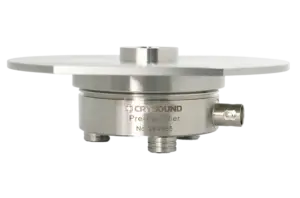
CRY3718-S05 Ear Simulator Set
The CRY3718-S05, compared to the CRY3718-S01, includes a circumaural headphone adapter (TA0701) compliant with IEC 60318-1 standards, making it suitable for R&D and production line testing of audiometer headphones and circumaural headphones.
The CRY3718-S05 features a BNC interface and supports IEPE power supply mode for convenient operation.
Downloads
Product Highlights
CRY3718-S05 Ear Simulator Set Typical Frequency Response
The graph (right) shows the frequency response curves obtained using the electrostatic excitation method.
Technical Specifications
Nominal Sensitivity
12.5 mV/Pa,-38 dB±2 dB re 1V/Pa
Frequency Response
100 Hz to 4 kHz ±1 dB (simulate human ear impedance); 20 Hz to 16 kHz (coupling cavity use)
Dynamic Range
23 dB to 146 dB
Standards
IEC 60318-1
Interface Type
BNC
Height
41mm (including connection adapter)
Diameter
61.0mm (including connection adapter)
Main Features
- Use of Ear Simulator Set Compliant with IEC 60318-1
- Compatibility
- Calibration
- Quality & Warranty
Related Products
CRY3711 Ear Simulator IEC60318-4
Nominal Sensitivity
12.5mV/Pa, -38±1.5dB re 1V/Pa
Frequency Response
100Hz to 10kHz ±1dB(Simulated human ear impedance)、 20Hzto 16kHz(Coupling cavity use)
Dynamic Range
23dB to 160dB
CRY3711-S01 Ear Simulator Set
Nominal Sensitivity
12.5mV/Pa, -38±1.5dB re 1V/Pa
Frequency Response
100Hz to 10kHz ±1dB(Simulated human ear impedance)、 20Hz to 16kHz(Coupling cavity use)
Dynamic Range
23dB to 146dB
CRY3717 IEC 60318-3 Coupler
Frequency Response
100Hz to 8kHz±2dB
Standards
IEC60318-3
Equivalent Volume
6cc
CRY3717-S01 Coupler Set
Nominal Sensitivity
50mV/Pa, -26±1.5dB re 1V/Pa
Frequency Response
100Hz to 8kHz±2dB
Dynamic Range
12dB to 134dB
CRY3718-S01 Ear Simulator Set IEC60318-1
Nominal Sensitivity
12.5mV/Pa, -38±1.5dB re 1V/Pa
Frequency Response
100Hz to 4kHz ±1dB(Simulated human ear impedance)、 20Hz to 16kHz(Coupling cavity use)
Standards
IEC 60318-1、 ITU-T P.57 Type 1
Measurement microphones are used in acoustic metrology, type-approval testing, and engineering measurements. Unlike general audio capture applications, measurement scenarios place far greater emphasis on consistency and traceability: the same microphone should deliver stable output when re-tested over time; variation within a production lot should be sufficiently small; and performance fluctuations between lots should remain controllable. [...]
A measurement microphone is not just any microphone - it is a precision acoustic sensor designed for traceable, repeatable sound pressure measurement. This guide covers how they work, the different types available, key specifications to compare, and how to select the right one for your application. What Is a Measurement Microphone? A measurement microphone is [...]
In day-to-day acoustic measurements, it's common to hear: "Insert the measurement microphone into the calibrator, press the button, and the microphone is calibrated." From an engineering and metrology perspective, that wording is an oversimplification. To place a sound calibrator correctly in the measurement chain, we should start with what it generates-and what it can (and [...]
In acoustic testing, acoustic metrology, and product noise evaluation, the term measurement microphone typically refers to a condenser measurement microphone. Its signal generation relies on a polarization electric field: sound pressure changes the capacitance, and the front-end circuitry converts this change into an electrical signal. Depending on how the polarization field is provided, measurement microphones generally [...]
Get in touch
If you are interested or have questions about our products, book a demo and we will be glad to show how it works, which solutions it can take part of and discuss how it might fit your needs and organization.