


Measurement microphone sensitivity is usually expressed in mV/Pa. It describes the voltage a microphone produces for a given sound-pressure input. Sensitivity affects weak-signal output, sound-pressure conversion, and how the microphone matches the rest of the measurement chain, but a higher value is not automatically better.
Understanding Measurement Microphone Sensitivity
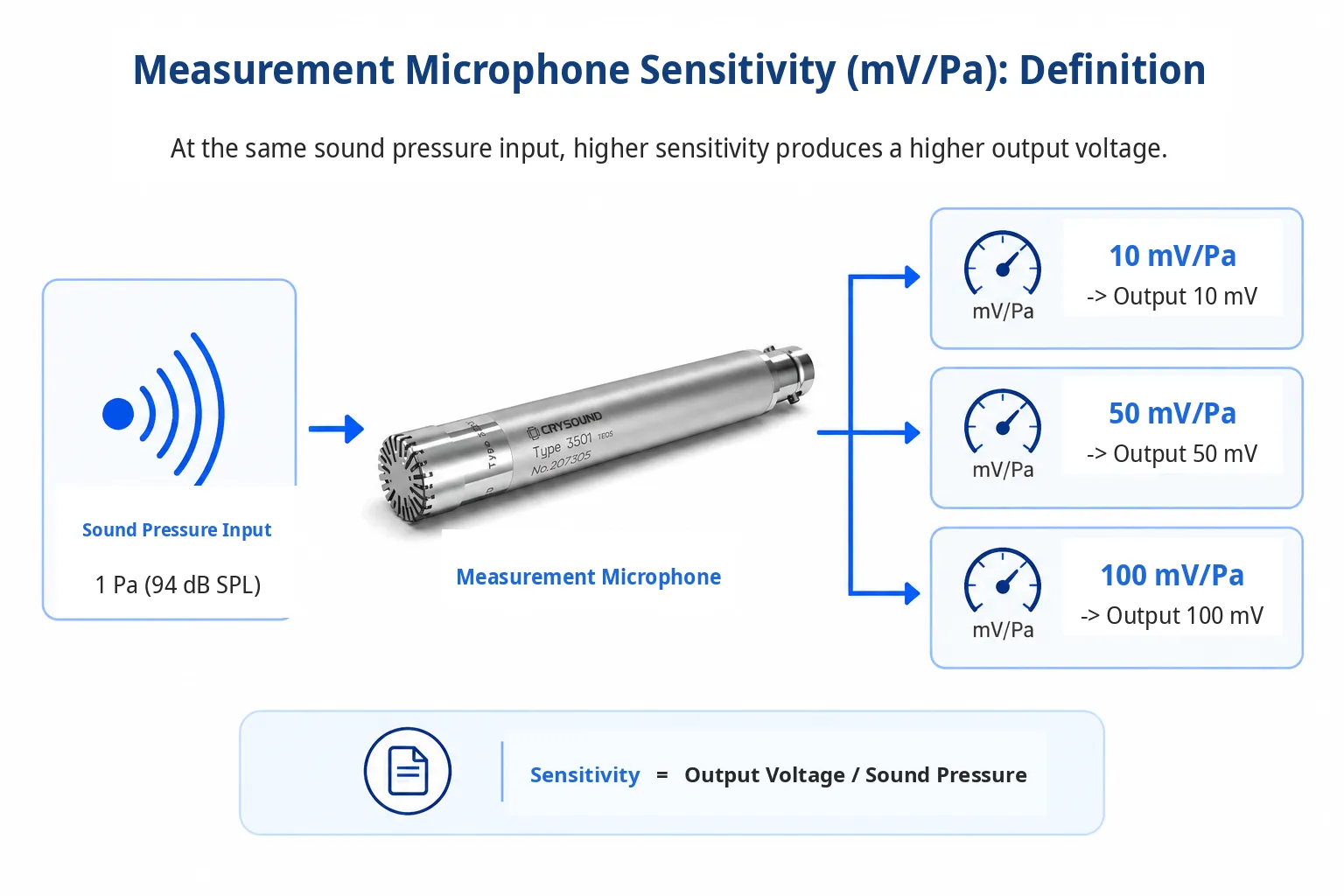
Microphone sensitivity describes the ability of a microphone to convert sound pressure into an electrical signal. For measurement microphones, the common unit is mV/Pa: the number of millivolts produced when the microphone receives a sound pressure of 1 Pa.
In acoustics, 1 Pa is approximately 94 dB SPL. A 10 mV/Pa microphone ideally produces 10 mV at this level, while 50 mV/Pa and 100 mV/Pa microphones produce approximately 50 mV and 100 mV.
A higher sensitivity therefore produces a larger voltage from the same acoustic input. However, sensitivity alone does not indicate a flatter frequency response, lower distortion, lower self-noise, or greater measurement accuracy.
How Does Sensitivity Affect Measurements?
Low-SPL measurements: weak-signal output and system noise
In a quiet environment or a weak-signal test, the voltage produced by the microphone may be very small. When the output is too low, input noise from the preamplifier and data acquisition system can have a greater influence on the result.
With other conditions unchanged, higher microphone sensitivity produces a larger voltage for the same sound pressure and reduces the relative contribution of downstream electronic noise. This is one reason why low-noise measurements often benefit from a high-sensitivity microphone.
High sensitivity is not the same as low self-noise. The lowest measurable sound also depends on microphone self-noise, preamplifier noise, environmental background noise, and the complete test chain.
For headphone self-noise, quiet-appliance, and other weak-signal tests, a microphone designed for low-noise measurement may be appropriate. The CRY3261-S02, for example, has a sensitivity of 450 mV/Pa and inherent noise as low as 6.5 dBA. The target SPL range should still be checked.
High-SPL measurements: output voltage and input-range matching
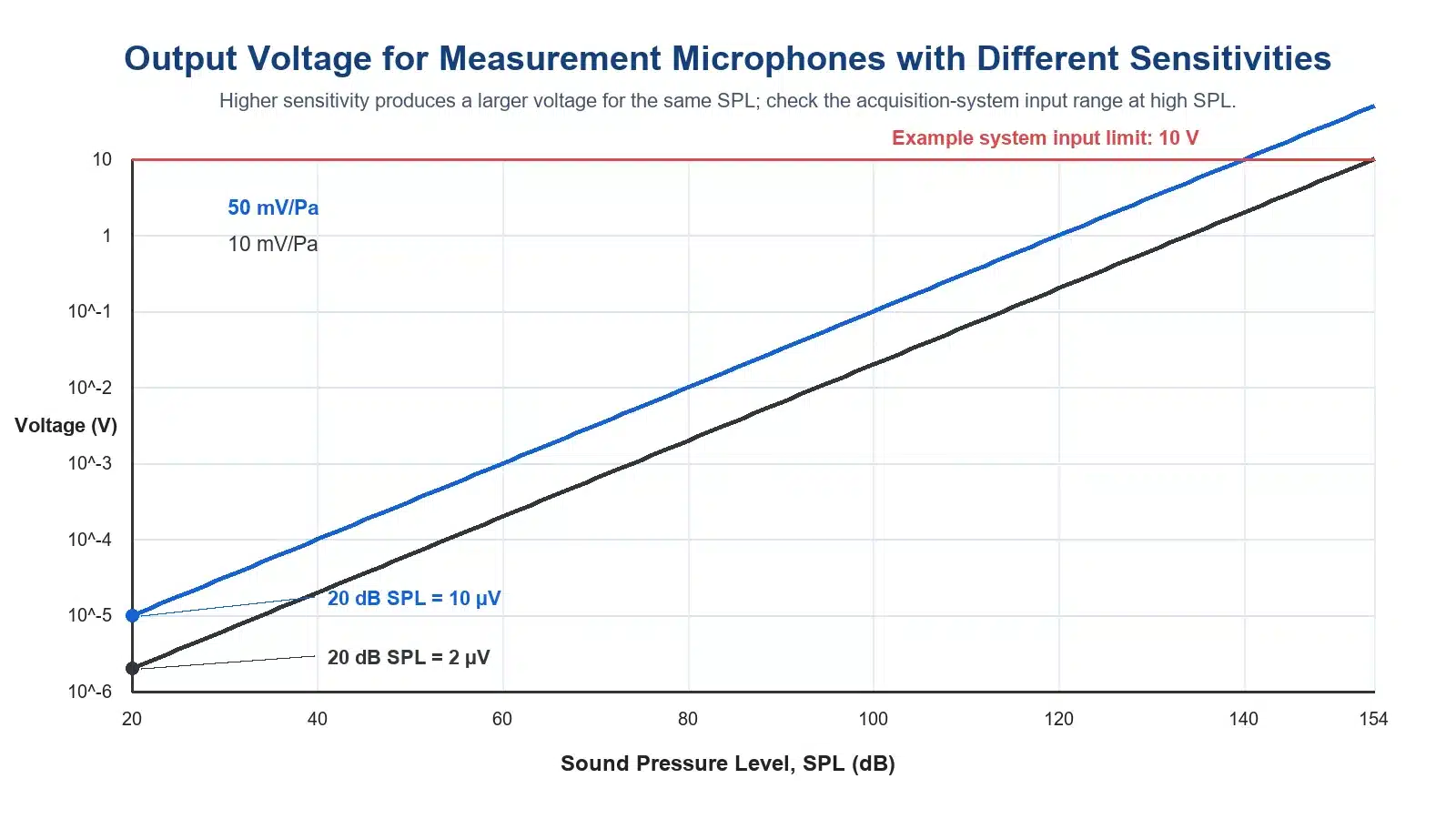
Preamplifiers and data acquisition systems have maximum input voltages. As sound pressure rises, a high-sensitivity microphone produces a larger output voltage and may reach the downstream input limit sooner.
Under ideal linear conversion, at 120 dB SPL (about 20 Pa), a 50 mV/Pa microphone produces about 1 V, while a 10 mV/Pa microphone produces about 0.2 V. At 140 dB SPL (about 200 Pa), the corresponding outputs are about 10 V and 2 V. This difference matters when the acquisition system has a limited input range.
The actual maximum measurable SPL cannot be calculated from sensitivity alone. Always check the microphone maximum SPL and distortion conditions together with the linear input ranges of the preamplifier and acquisition system.
For extremely high-SPL testing, a low-sensitivity model designed for such conditions may be required. The CRY3408-S01 has a sensitivity of 0.14 mV/Pa and supports measurements up to 180 dB SPL, subject to the specified operating and distortion conditions.
Sensitivity also affects sound-pressure conversion
Measurement software uses microphone sensitivity to convert the acquired voltage into sound pressure in pascals and then calculate sound pressure level relative to 20 µPa.
The sensitivity value entered in the software must therefore match the actual microphone sensitivity. An incorrect value causes the calculated SPL to be consistently high or low even when signal acquisition is otherwise normal.
Is Higher Microphone Sensitivity Always Better?
No. High and low sensitivities suit different applications. The important question is whether the sensitivity matches the expected SPL range and the input range of the measurement system.
Common misconceptions include assuming that higher sensitivity guarantees a flatter frequency response, lower self-noise, or greater accuracy. Sensitivity also cannot independently determine maximum SPL or dynamic range.
How Should Sensitivity Be Interpreted for a Test?
Estimate the minimum and maximum SPL
Start by estimating the lowest and highest sound pressure levels likely to occur. Quiet environments and weak sources require close attention to sensitivity and self-noise. High-level sources require close attention to maximum SPL, linearity, and the input range of the complete system.
Check the microphone and acquisition system together
After confirming the microphone sensitivity, check preamplifier noise, gain settings, and the acquisition-system input range. For general laboratory and routine acoustic measurements, the 50 mV/Pa CRY3203-S01 provides a practical balance across a broad range of common tasks.
Consider the other specifications
Sensitivity is only one part of microphone performance. Self-noise, maximum SPL, dynamic range, frequency response, frequency range, and environmental suitability should also be considered.
Summary
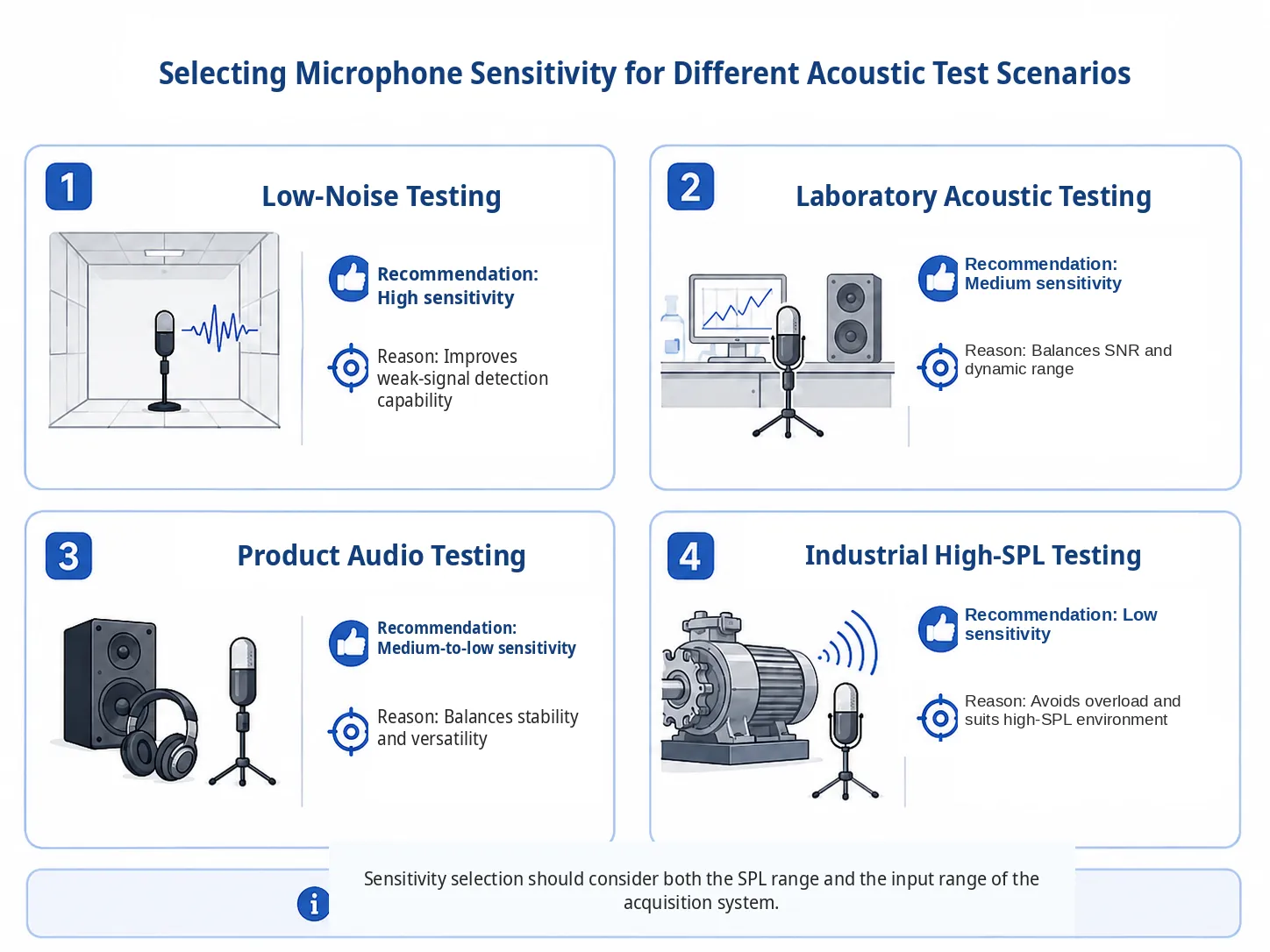
Measurement microphone sensitivity determines the output voltage produced by a given sound-pressure input. Higher sensitivity helps produce a larger signal from weak sounds, while lower sensitivity produces less voltage at high SPL and may better match a limited acquisition-system input range.
Reliable measurement requires the microphone, preamplifier, and data acquisition system to be evaluated as one chain. Define the expected SPL range first, then check sensitivity together with self-noise, maximum SPL, and input range.
Frequently Asked Questions
What is the difference between 50 mV/Pa and 10 mV/Pa?
At the same sound pressure, a 50 mV/Pa microphone produces five times the voltage of a 10 mV/Pa microphone. The practical choice also depends on self-noise, maximum SPL, and the acquisition-system input range.
Does high sensitivity mean lower microphone self-noise?
Not necessarily. Sensitivity describes sound-pressure-to-voltage conversion, while self-noise is determined by the microphone and the rest of the measurement chain.
Why must the sensitivity setting in software be accurate?
The software uses sensitivity to convert voltage into sound pressure. If the entered value does not match the microphone, the calculated SPL will be consistently high or low.
If you need help matching measurement microphone sensitivity to your acoustic test system, please complete the Get in touch form below.


