


In multichannel acoustic testing, entering microphone model numbers, sensitivities, and calibration data one channel at a time is slow and prone to error. TEDS allows a data acquisition system to read key parameters stored in a microphone or preamplifier, helping engineers configure channels faster and maintain consistent test settings. This article tests the CRYSOUND CRY3203-S01 measurement microphone set with three representative platforms - SonoDAQ, NI USB-4431, and B&K 3160-A-042 - to explain what TEDS does in practice, how interfaces affect compatibility, and why a TEDS-enabled sensor may sometimes fail to identify correctly.
What Is TEDS?
TEDS, or Transducer Electronic Data Sheet, is sensor parameter information defined by IEEE 1451.4. It is typically stored in a chip inside a measurement microphone or preamplifier and acts as an electronic nameplate that travels with the device.
When the device is connected to a TEDS-compatible data acquisition system, key information such as the model number, serial number, sensitivity, reference frequency, and calibration date can be read automatically or on demand and used to accelerate channel setup.
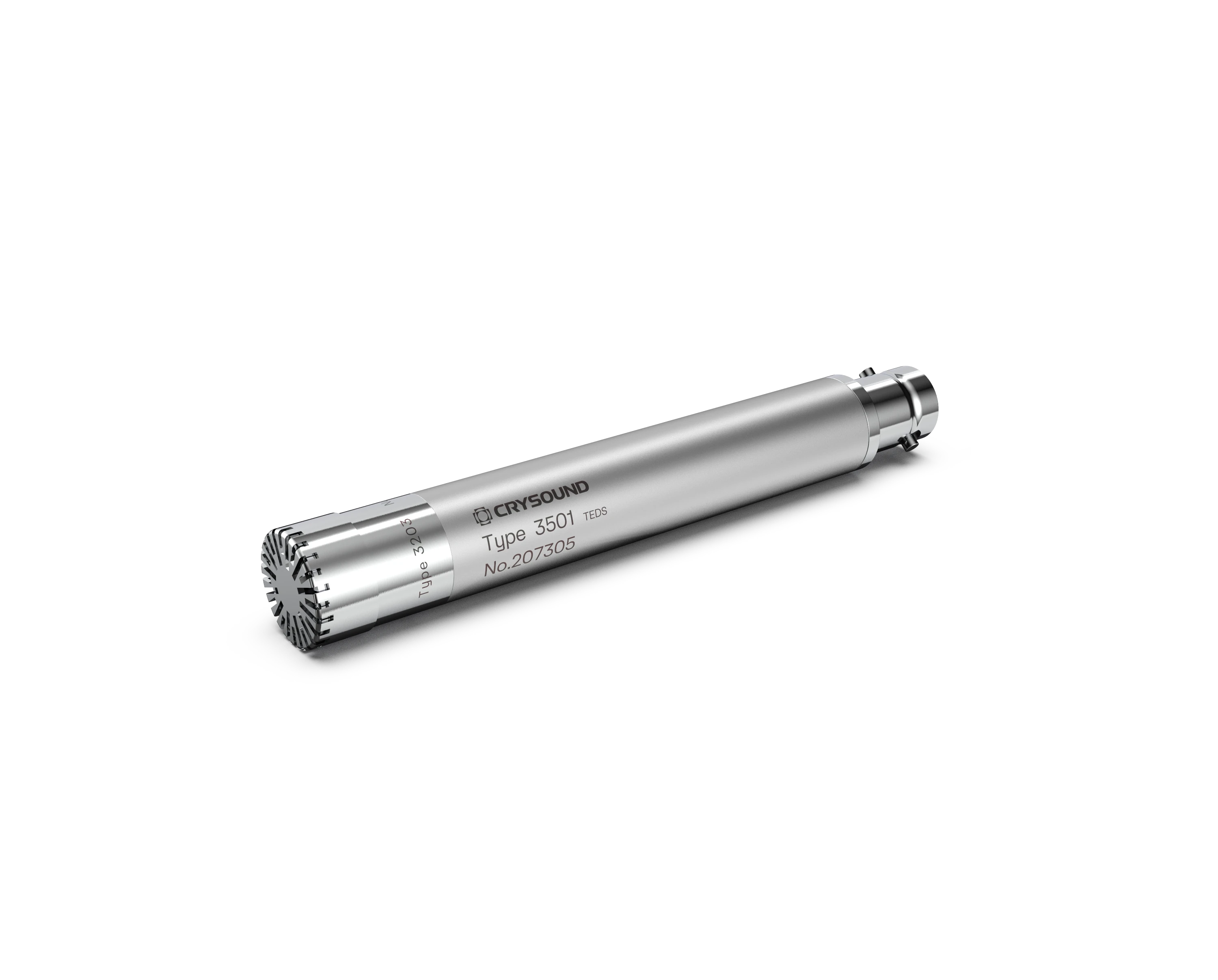
This test uses the CRYSOUND CRY3203-S01 free-field measurement microphone set. It combines a CRY3203 1/2-inch free-field prepolarized microphone with a CRY3501 1/2-inch IEPE preamplifier, uses a BNC connector, and supports IEEE 1451.4 V1.0 TEDS.

CRY5820 SonoDAQ Pro
How Does TEDS Improve Measurement Microphone Setup?
Automatic Channel Identification and Parameter Entry
On a TEDS-compatible acquisition system, the connected sensor can be identified automatically or through a manual scan. The system can then populate the corresponding channel with parameters such as model number, serial number, sensitivity in mV/Pa, calibration reference frequency, and polarization type.
For a 32-channel system, TEDS can configure all channels in a short time. A fully manual workflow requires engineers to look up, enter, and verify the parameters for every channel, which takes longer and creates more opportunities for error.
Fewer Manual Data Entry Errors
In multichannel tests, the risk of entering an incorrect sensitivity or calibration value increases with the channel count. With TEDS, model, serial number, sensitivity, and calibration information can be read directly from each device, making consistent channel configuration easier to maintain.
For recurring tests, shift handovers, or comparisons across laboratories, the value of TEDS is not limited to speed. It also reduces variation caused by manual data entry.
Easy Parameter Updates When Sensors Are Replaced
If a sensor is replaced during a test, for example with a microphone of a different sensitivity at the same measurement point, the system can read the new device's TEDS data and update the channel configuration without requiring another manual lookup and verification cycle.
Where Does TEDS Deliver the Greatest Value?
Acoustic Arrays and Multichannel Testing
When a system has dozens or hundreds of channels, manual sensor configuration is time-consuming and can lead to channel-to-sensor mapping errors. TEDS carries each sensor's key parameters into the channel setup, making it especially useful for microphone arrays, sound source localization, sound power testing, and synchronized multipoint measurements.
High-Volume Production Testing
Production lines often involve frequent sensor replacement, operator changes, and strict repeatability requirements. Automatic identification and parameter entry reduce operator-dependent variation. When a sensor is replaced, the system can load the new device parameters quickly and avoid batch-level measurement errors caused by outdated settings.
Calibration Traceability and Long-Term Records
For projects with periodic verification, equipment traceability, or certification requirements, TEDS can associate calibration dates, intervals, and related records with the device. Engineers can review this information directly in the test system and reduce the effort required to maintain separate calibration spreadsheets.
How Are IEPE, Connectors, and TEDS Different?
IEPE, the physical connector, and TEDS often appear in the same measurement chain, but they solve different problems.
| Item | Primary Function | CRY3203-S01 Specification |
|---|---|---|
| IEPE | Power supply and signal transmission | 2-20 mA constant current, 4 mA typical |
| Connector (BNC / LEMO) | Physical connection | BNC |
| TEDS | Parameter identification and retrieval | IEEE 1451.4 V1.0 |
When evaluating compatibility, do not stop at a general "TEDS supported" statement. Check four separate conditions: the IEPE power requirement, the connector type, whether the preamplifier actually contains readable TEDS memory, and whether the acquisition platform can read and parse the applicable template.
How Does TEDS Perform on Three Acquisition Platforms?
Without TEDS, the typical workflow is: replace the device, find its data sheet, enter the parameters manually, and verify the channel. With TEDS, the workflow becomes: connect, read, and populate.
SonoDAQ TEDS Readout
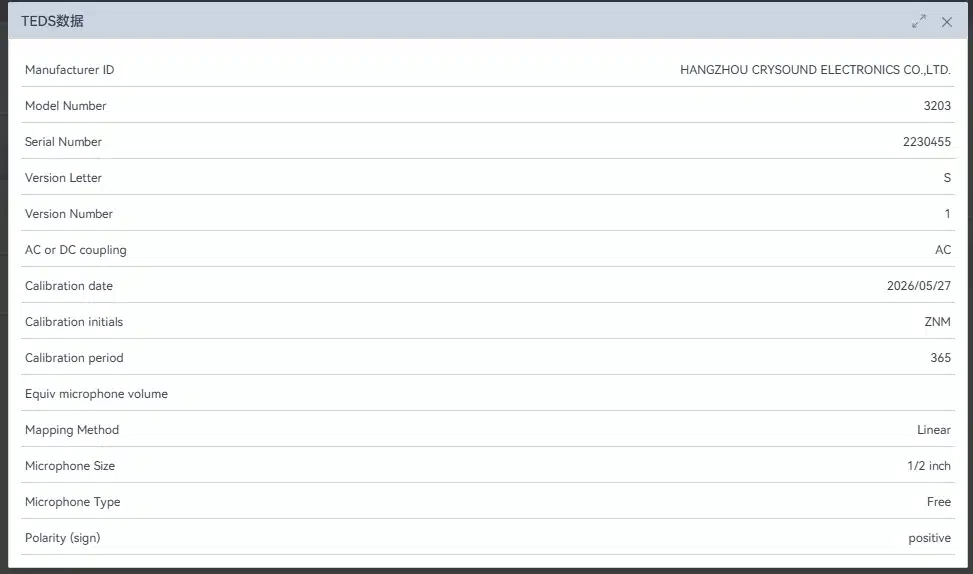
After the CRY3203-S01 is connected to SonoDAQ, the platform can read basic information including Model Number, Serial Number, Microphone Type, Microphone Size, and Template ID, then use the relevant values in channel configuration.
NI USB-4431 TEDS Readout
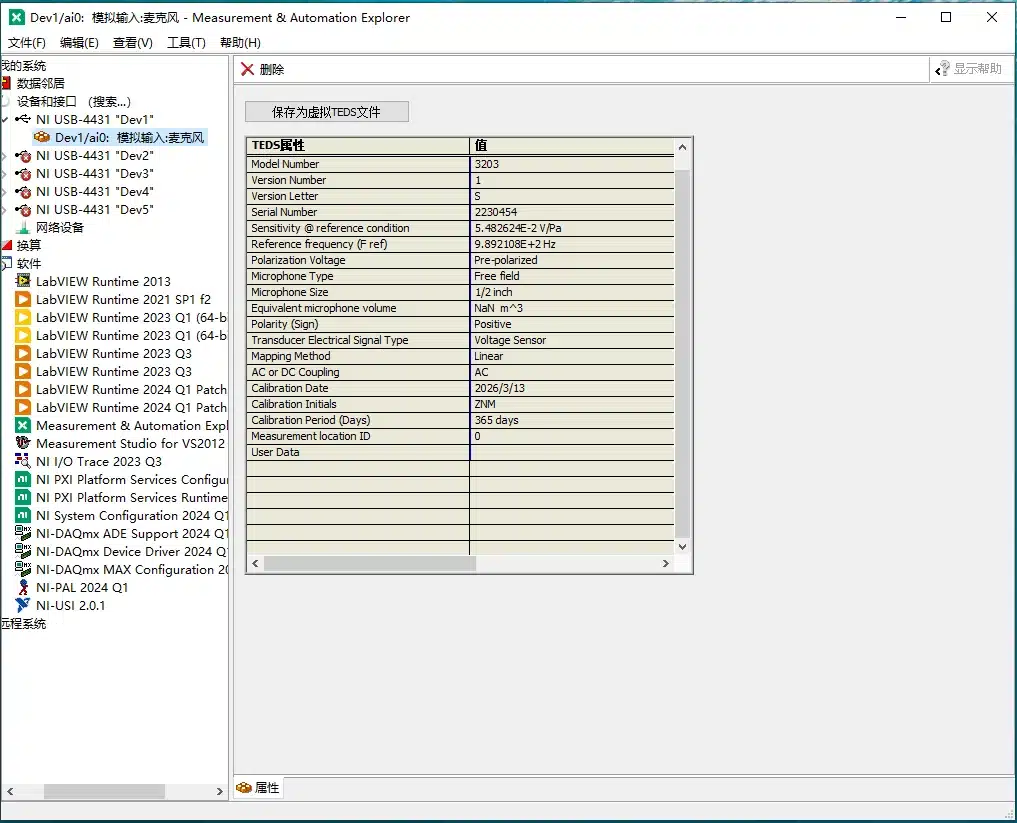
On the NI USB-4431 platform, the TEDS interface displays information such as Model Number, Serial Number, Microphone Type, Microphone Size, and Transducer Electrical Signal Type, allowing engineers to confirm microphone parameters quickly in an NI test environment.
B&K 3160-A-042 TEDS Readout
In the B&K 3160-A-042 channel configuration interface, TEDS data can populate the channel table directly, reducing the need to enter sensor sensitivity, calibration time, and other information manually.

Note on the B&K test: The B&K 3160-A-042 uses LEMO connectors, while the CRY3203-S01 uses BNC. The B&K platform was therefore verified with a CRY3285 free-field externally polarized microphone and CRY3511 preamplifier with a LEMO connector.
Why Can a TEDS-Enabled Device Fail to Read?
If TEDS identification fails in the field, check the measurement chain in the following order.
- Confirm that the device explicitly supports TEDS. Use the product specification rather than the device appearance.
- Verify connector and power compatibility. BNC and LEMO implementations may use different TEDS signal arrangements. An adapter or a device with the correct connector may be required.
- Confirm that the acquisition platform provides a TEDS read command. Some platforms require a manual scan instead of reading data immediately after connection.
- Check the data format and template version. IEEE 1451.4 V0.9 and V1.0 use different template structures, and vendor-specific extensions may also vary.
- Inspect cable length, intermediate modules, and channel settings. The 1-Wire protocol may fail over very long cables or complex adapter chains.
Acquiring a valid waveform and reading TEDS automatically are separate functions. A normal signal does not guarantee that the sensor parameters can be identified and imported.
TEDS Readout Comparison Across Three Platforms
| Platform | Basic Information | Measurement Parameters | Calibration Information | Direct Channel Configuration |
|---|---|---|---|---|
| SonoDAQ | Supported | Supported | Supported | Supported |
| NI USB-4431 | Supported | Supported | Supported | Supported |
| B&K 3160-A-042 | Supported | Supported | Supported | Supported |
The test results show that the CRY3203-S01 provides complete TEDS information on both SonoDAQ and NI USB-4431. For applications that require a LEMO interface, the CRY3285 and CRY3511 combination has also been verified to populate TEDS data directly on the B&K platform.
How Can You Confirm TEDS Compatibility?
If a microphone or preamplifier data sheet lists IEEE 1451.4 or TEDS, verify that the acquisition platform, connector type, and TEDS template version are compatible. In multichannel acoustic testing, production-line testing, and long-term repeat measurements, this check can substantially reduce the cost of parameter entry and verification.
To review the CRY3203-S01 specifications or confirm a TEDS configuration for your current acquisition platform, visit the CRYSOUND website or contact our technical team for product selection, compatibility verification, and demonstration support.
FAQ
Does IEPE support automatically mean TEDS support?
No. IEPE provides power and signal transmission, while TEDS provides parameter identification. Successful TEDS readout requires compatible sensors or preamplifiers, connectors, cables, and acquisition hardware.
Why does the same microphone use different TEDS workflows on different platforms?
Platforms may use different TEDS access points, template parsers, and channel configuration logic. Some scan automatically, while others require a manual read command. Some write values directly into the channel table, while others display the template for review first.
Can BNC and LEMO connectors affect TEDS readout?
Yes. BNC and LEMO connectors differ physically and may use different TEDS signal arrangements. Even when the sensor supports TEDS, an incompatible connector, adapter cable, or platform channel can allow normal signal acquisition while preventing TEDS identification.
If you are interested or would like to learn more information, please fill out the form below to Get in touch with us.
To review the CRY3203-S01 specifications or confirm TEDS compatibility with your current acquisition platform, please complete the Get in touch form below. Our engineering team can help with configuration recommendations, compatibility checks, and live demonstrations.


