


The use of acoustic imaging cameras is expanding because more teams now face the same operational problem in very different settings: they know something is wrong, but they still need to locate the source quickly, from a safe distance, and with enough visual evidence to act on it. That pattern shows up in compressor rooms, substations, EV assembly lines, composite shops, hazardous areas, and engineering labs alike.
What makes acoustic imaging useful across industries is not that it replaces every existing test. It is that it helps narrow the search space. When a technician, engineer, or reliability team can see where airborne sound energy is concentrated, troubleshooting usually becomes faster, more repeatable, and easier to document.
This article is an application map rather than a product roundup. It covers the 10 workflows where acoustic imaging cameras tend to create the clearest operational value, then compares which deployment model fits which kind of job. If you want a fundamentals refresher first, start with What Is an Acoustic Camera? and How Acoustic Imaging Works.
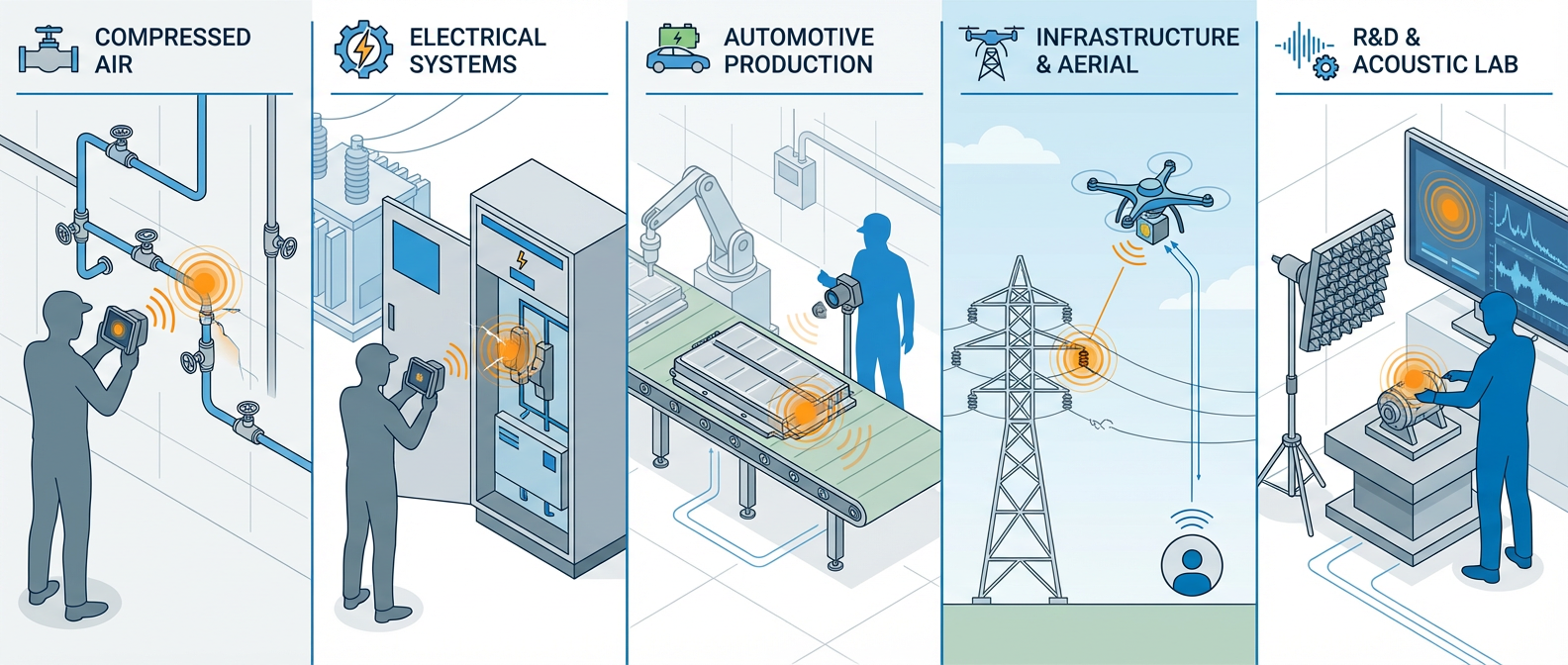
What acoustic imaging cameras do best
Acoustic imaging camera: a microphone-array-based inspection tool that turns airborne sound into a visual map, helping teams localize likely leak paths, discharge sources, abnormal noise, or other acoustic anomalies more efficiently.
In practice, acoustic imaging is strongest when teams need three things at once: localization, scan efficiency, and visual confirmation. Instead of checking one point after another, the operator can scan a wider area and see where sound energy is likely concentrated. That changes the troubleshooting workflow in a meaningful way, especially when manual search time is more expensive than the final validation step.
That last point matters. Acoustic imaging does not replace every certified or process-critical confirmation method. In leak-tightness work, teams may still rely on pressure decay, tracer gas, or immersion testing. In electrical maintenance, they may still need established diagnostic and safety workflows alongside acoustic surveys. The value of acoustic imaging is often that it makes those workflows faster by showing where to investigate next.
Interpretation also matters. Reflections, beamforming artifacts, and site geometry can influence what appears on the display, especially in reflective or crowded environments. That is one reason it helps to pair practical application knowledge with basic method knowledge, such as the guidance in Acoustic Imaging False Positives: Reflections, Beamforming Artifacts, and How to Avoid Them.
How to read this top 10 list
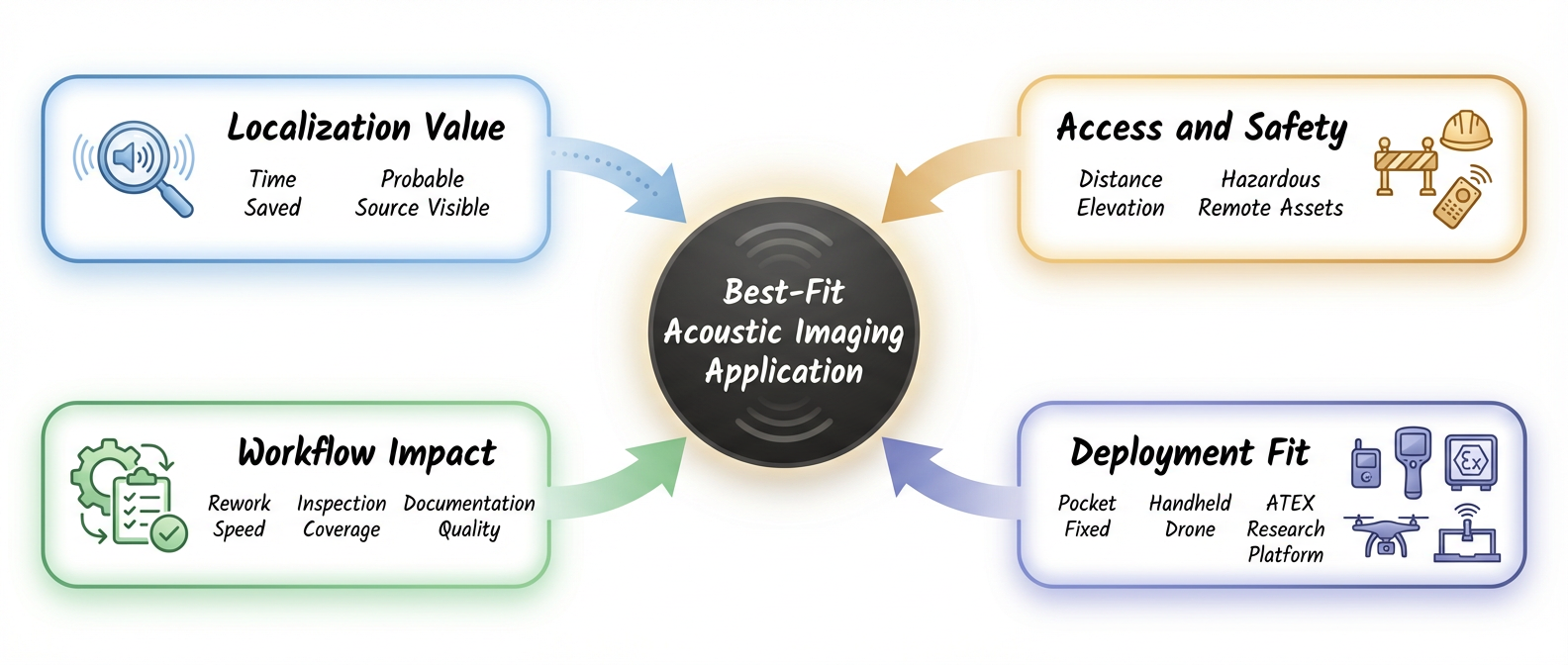
This list is not ranked by market size. It is organized around where acoustic imaging usually produces the clearest workflow benefit. We used four filters:
- Localization value: Does seeing the probable source area save meaningful troubleshooting time?
- Access and safety: Is distance, elevation, or environment making direct inspection harder?
- Workflow impact: Does the result improve rework speed, inspection coverage, or documentation?
- Deployment fit: Is there a clear match between the use case and a handheld, ATEX, fixed, drone-mounted, or research-oriented system?
That framing helps keep the discussion practical. Acoustic imaging is not equally useful for every sound-related task. It tends to win where conventional methods can confirm that a problem exists, but still leave the team asking where the issue actually is.
The top 10 applications
1. Compressed air leak detection
Compressed air remains the most widely understood acoustic imaging use case because the problem is so common and the cost of delay is easy to explain. U.S. Department of Energy guidance is often cited to show that industrial compressed-air leaks can account for a meaningful share of wasted system output. In many plants, the challenge is not proving that waste exists. It is finding the exact leak path across overhead piping, machine interfaces, valves, couplings, and hard-to-reach fittings.
That is why acoustic imaging works so well here. It lets maintenance and energy teams scan noisy utility areas more quickly than a point-by-point routine alone. A handheld system such as the CRY8124 Advanced Acoustic Imaging Camera fits broad plant surveys especially well, while rugged day-to-day utility work can also align with the CRY2623 class. For a companion ROI angle, see How Much Are Air Leaks Costing Your Plant?.
2. Partial discharge inspection in substations and switchgear
Partial discharge is one of the clearest examples of why safe-distance localization matters. In switchgear rooms, substations, and other energized environments, technicians may already know that an abnormal condition needs investigation, but still need a safer and faster way to narrow the likely source area. Acoustic imaging helps by overlaying probable ultrasonic activity onto the visual scene, making surveys easier to interpret and easier to communicate across teams.
Acoustic imaging is especially valuable here because a handheld survey can reduce search time and help teams prioritize the next inspection step. On supported systems, the workflow can go one step further by combining localization with PRPD-based pattern review or partial discharge type recognition, which helps teams distinguish common fault patterns such as corona, surface discharge, and suspension discharge. For more context, see Leveraging Acoustic Imaging for Effective Partial Discharge Detection. In hazardous or higher-risk environments, the conversation may naturally extend to the CRY8125 ATEX Acoustic Imaging Camera.
3. Automotive leak-tightness and EV sealing diagnostics
In automotive production, the operational question is often not whether an assembly failed. It is where the probable leak path is hiding along a long seal line, enclosure edge, or interface between multiple parts. That is why acoustic imaging has become increasingly useful in EV battery pack sealing, door and window sealing checks, e-axle housings, and other leak-tightness workflows where retest loops are expensive.
Acoustic imaging fits this environment because it shortens the path from failed result to likely repair area. Engineers can use it as a localization layer before repeating formal validation steps tied to customer, product, or ingress-protection requirements. That distinction matters: the camera helps narrow the search, but does not replace the final qualification workflow. CRYSOUND's live EV content leans more toward the engineering side in EV NVH Testing Challenges: Why Acoustic Cameras Are Becoming Essential, but the same localization logic applies to sealing diagnostics.
4. Vacuum leak testing for rail, wind, and composites
Vacuum workflows are painful when the surface area is large and manual leak hunting forces a slow search over long seal paths. That is why acoustic imaging is especially practical in rail manufacturing, wind turbine blade fabrication, composite bagging, and other large-structure workflows where the team needs to find the suspect area quickly rather than confirm the whole part one section at a time.
The benefit is operationally simple: faster localization means fewer trial-and-error checks and less unnecessary rework. This is one of the areas where acoustic imaging is easiest to justify because the part geometry is often large enough for scan efficiency to matter immediately. CRYSOUND already has published examples in Visualized Vacuum Leak Testing for Trains and Wind Turbine Blade Vacuum Bag Integrity Test in 10 Minutes.
5. Hazardous-area gas leak detection
Gas leak inspection in hazardous areas changes the buying conversation because safety distance, site rules, and certification become part of the workflow itself. In these environments, acoustic imaging stands out because it is non-contact and visual, which can make leak localization easier to execute and easier to document than purely manual search routines.
This is not a category where loose wording helps. Teams still need to match the inspection method to the site classification and operating practice. That is why hazardous-area workflows should be discussed with certification nuance rather than as a generic "faster leak detection" claim. When the environment requires that kind of fit, the CRY8125 ATEX Acoustic Imaging Camera becomes the natural product reference, supported by the background in Introducing CRY8125: The First Acoustic Imager with TUV-Certified ATEX & IECEx Certificates.
6. Food and beverage utility inspection
Food and beverage plants depend on utility systems that are easy to overlook because the production line gets most of the attention. Compressed air, vacuum, pumps, valves, and supporting utilities can all create hidden waste or recurring maintenance friction if small problems take too long to localize. That makes acoustic imaging a practical fit during routine maintenance windows, especially when teams want a non-invasive scan before deciding where to intervene.
The right framing here is utility diagnostics, not sweeping claims about the whole production environment. Acoustic imaging can help teams inspect compressed air and related support systems more efficiently, which matters when downtime windows are tight and unnecessary disassembly is costly. As a current bridge, readers evaluating this use case can follow the general utility workflow in How Much Are Air Leaks Costing Your Plant? and the method primer in What Is an Acoustic Camera?. Those pages do not make this a food-specific deep dive, but they do give the clearest live path from category interest to practical next evaluation.
7. Pharmaceutical and cleanroom utility diagnostics
Controlled environments put more pressure on maintenance teams to make deliberate decisions. If a utility-related issue may be affecting the surrounding process, the team often wants better evidence before it escalates from suspicion to hands-on intervention. That is where acoustic imaging can be useful in pharmaceutical and cleanroom-adjacent utility workflows: it supports faster localization while helping teams avoid turning every investigation into a broad manual search.
This application is less about dramatic field imagery and more about inspection discipline. Visual localization can help maintenance teams document what they found, reduce repeat checks, and plan a cleaner next step. That said, the method should still be positioned as a practical troubleshooting aid. It does not replace environmental monitoring, process controls, or site-specific compliance procedures. For readers coming from this category, the best current live bridge is to use What Is an Acoustic Camera? for method fit, then How Acoustic Imaging Works and the CRY2623 128-Mic Industrial Acoustic Imaging Camera path for a more practical handheld workflow view.
8. Drone-based inspection for elevated and remote assets
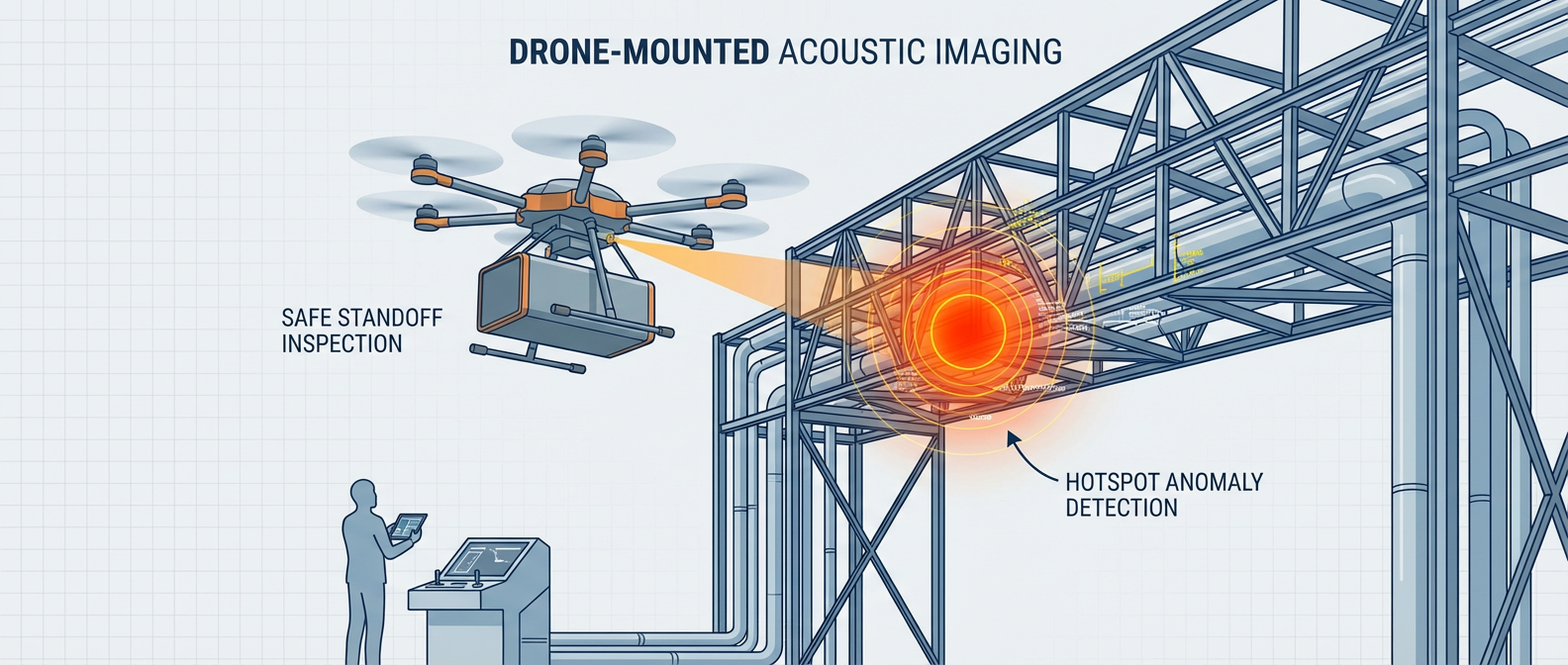
Some of the strongest acoustic imaging use cases appear when the main bottleneck is access. Elevated power assets, flare stacks, pipe racks, roofs, and other remote structures can require lifts, scaffolding, or specialized access planning before a technician can even start to troubleshoot the problem. In those cases, a drone-mounted acoustic imaging workflow can change the economics of inspection by bringing localization capability closer to the target much earlier.
The value is not just speed. It is better decision-making before the site commits to a larger intervention. A system such as the CRY2626G Drone-Mounted Acoustic Imaging Camera fits that elevated-inspection story directly. The closest current live reference is CRYSOUND's UAV Solution for Partial Discharge Inspection. As always, deployment still depends on local flight rules, site permissions, and operator readiness.
9. Fixed 24/7 monitoring for critical assets
Periodic handheld surveys are useful, but they only capture the condition of the asset when someone is present. That becomes a limitation when faults are intermittent, early warning matters, or the site wants more continuous visibility into critical utility areas. In those situations, fixed acoustic imaging becomes a different category of value from handheld inspection.
Instead of asking whether a technician can localize a problem during a scheduled route, the site can ask whether it benefits from a persistent acoustic watchpoint with alarms, trends, and earlier anomaly awareness. That is where a system such as the CRY2623M Fixed Acoustic Imaging Camera fits most naturally. This section is intentionally a category overview rather than a deep implementation guide, because the broader fixed-monitoring content cluster is still developing, but the workflow is already important enough to include in the map.
10. NVH troubleshooting and acoustic R&D
Acoustic imaging is not limited to maintenance and leak work. It also plays a meaningful role in NVH troubleshooting, engineering diagnostics, and acoustic research, where teams need to understand which component, surface, or operating condition is driving a noise problem. In these workflows, the value is not just finding "the leak." It is identifying which source deserves deeper analysis next.
That expands the category in a useful way. It shows that acoustic imaging can support vehicle engineering, product development, lab investigations, and more flexible algorithm-driven workflows. For field-oriented engineering teams, the flagship handheld class still makes sense. For more advanced experimental work, the CRY8500 Series SonoCam Pi Acoustic Camera is the better reference point. Related live reading includes EV NVH Testing Challenges: Why Acoustic Cameras Are Becoming Essential and An Open Platform For Intelligent Sound Imaging.
Which deployment model fits which application?
The most useful buying question is not "Which acoustic imaging camera is best?" It is "Which deployment model matches the way our team actually works?" Some teams need a flagship handheld for broad cross-industry troubleshooting. Others need a pocket-sized device for one-per-person rollout, hazardous-area certification, continuous monitoring, elevated access, or a more flexible research platform.
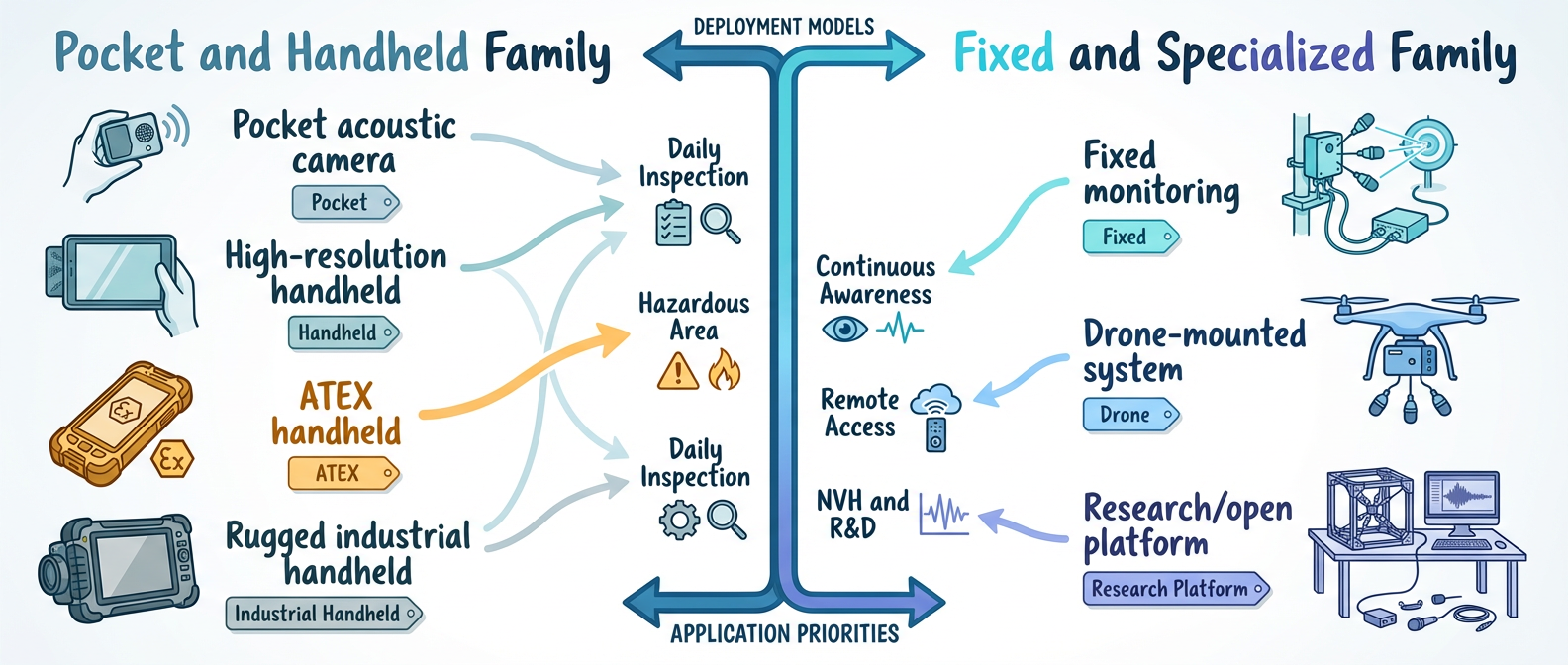
CRYSOUND Application-to-Deployment Map: use the quick-fit framework below to narrow the deployment model before comparing detailed specifications.
The table below keeps that decision practical without forcing readers through a long spec-by-spec comparison.
| Workflow | Recommended deployment | Best for |
|---|---|---|
| Broad troubleshootingField diagnostics | High-resolution handheldCRY8124 | Compressed air, automotive sealing, vacuum leak testing, and general plant diagnostics. |
| One-per-person inspectionRoute-based checks | Pocket acoustic cameraCRYSOUND POCKET (CRY8024) | Compressed air, gas and vacuum screening, PD screening, and HVAC or building-system troubleshooting. |
| Hazardous-area workClassified-zone surveys | ATEX/IECEx handheldCRY8125 | Gas leaks and partial discharge surveys where certification requirements shape the workflow. |
| Rugged utility routesPlant maintenance rounds | Industrial handheldCRY2623 | Utility inspections, food and beverage plants, and general industrial reliability work. |
| Continuous awarenessCritical-asset watch | Fixed monitoringCRY2623M | Critical utility rooms, substations, and intermittent fault watchpoints between manual surveys. |
| Elevated or remote accessHard-to-reach assets | Drone-mounted systemCRY2626G | Pipe racks, remote assets, and elevated PD or leak surveys where access is the bottleneck. |
| Engineering and R&DFlexible analysis | Research / open platformCRY8500 Series SonoCam Pi | NVH troubleshooting, acoustic R&D, and custom algorithm development in lab or engineering environments. |
No single recommendation in that map should be read as a hard boundary. The point is to align the tool with the workflow. A general industrial buyer might start with a handheld system, while teams running large-scale routine inspections may prefer a pocket model because portability, training speed, and one-per-person deployment matter more than maximum performance. Utility operators may move directly toward fixed or drone-enabled deployment because access and persistence matter more than mobility alone.
Next step
Need a faster way to narrow the right deployment model?
Start by comparing a flagship handheld and a pocket workflow, or ask our team for a recommendation based on your inspection environment, access constraints, and reporting needs.
FAQ
Which industries use acoustic imaging cameras most often?
The most common applications today include compressed air leak detection, partial discharge inspection, leak-tightness troubleshooting, hazardous-area gas leak inspection, elevated asset inspection, and NVH or engineering diagnostics. Adoption is strongest where troubleshooting time is expensive or safe-distance localization matters.
Are acoustic imaging cameras only for leak detection?
No. Leak detection is one of the clearest and most common use cases, but acoustic imaging is also used for partial discharge surveys, elevated inspections, fixed monitoring, NVH troubleshooting, and research workflows. The common thread is source localization, not one single industry.
Can acoustic imaging cameras detect partial discharge?
They can detect and localize likely ultrasonic partial discharge sources on energized assets. On supported systems, the workflow may also include PRPD-based pattern review or partial discharge type recognition to help distinguish common PD patterns such as corona, surface discharge, and suspension discharge.
When should you choose a fixed acoustic camera instead of a handheld model?
A fixed system makes sense when periodic surveys are not enough. That usually means the site cares about early warning, intermittent faults, or continuous awareness around critical assets between manual inspections.
What matters most when choosing an acoustic imaging camera for your application?
Start with the workflow. Ask whether you need broad handheld coverage, one-per-person pocket deployment, hazardous-area certification, rugged field use, continuous monitoring, elevated access, or research flexibility. Once that is clear, resolution, frequency range, and reporting features become easier to evaluate in context.
Conclusion and next step
The strongest acoustic imaging applications are the ones where better localization changes the economics of troubleshooting. When teams can move faster from "something is wrong" to "the likely source is here," they spend less time searching, make follow-up work more targeted, and create clearer inspection records.
That is why the top 10 list spans so many industries. The pattern is consistent even when the assets are different: acoustic imaging becomes more valuable when access is hard, time is costly, and visual evidence improves the next decision.
Ready to match the right acoustic imaging workflow to your operation? Request a Demo →
If you are comparing deployment models first, the next conversation is usually about pocket versus handheld, handheld versus fixed, hazardous-area versus general industrial, or drone-enabled versus ground-based inspection.


