


Product Highlights
High-Precision Multi-Channel Synchronized Data Acquisition
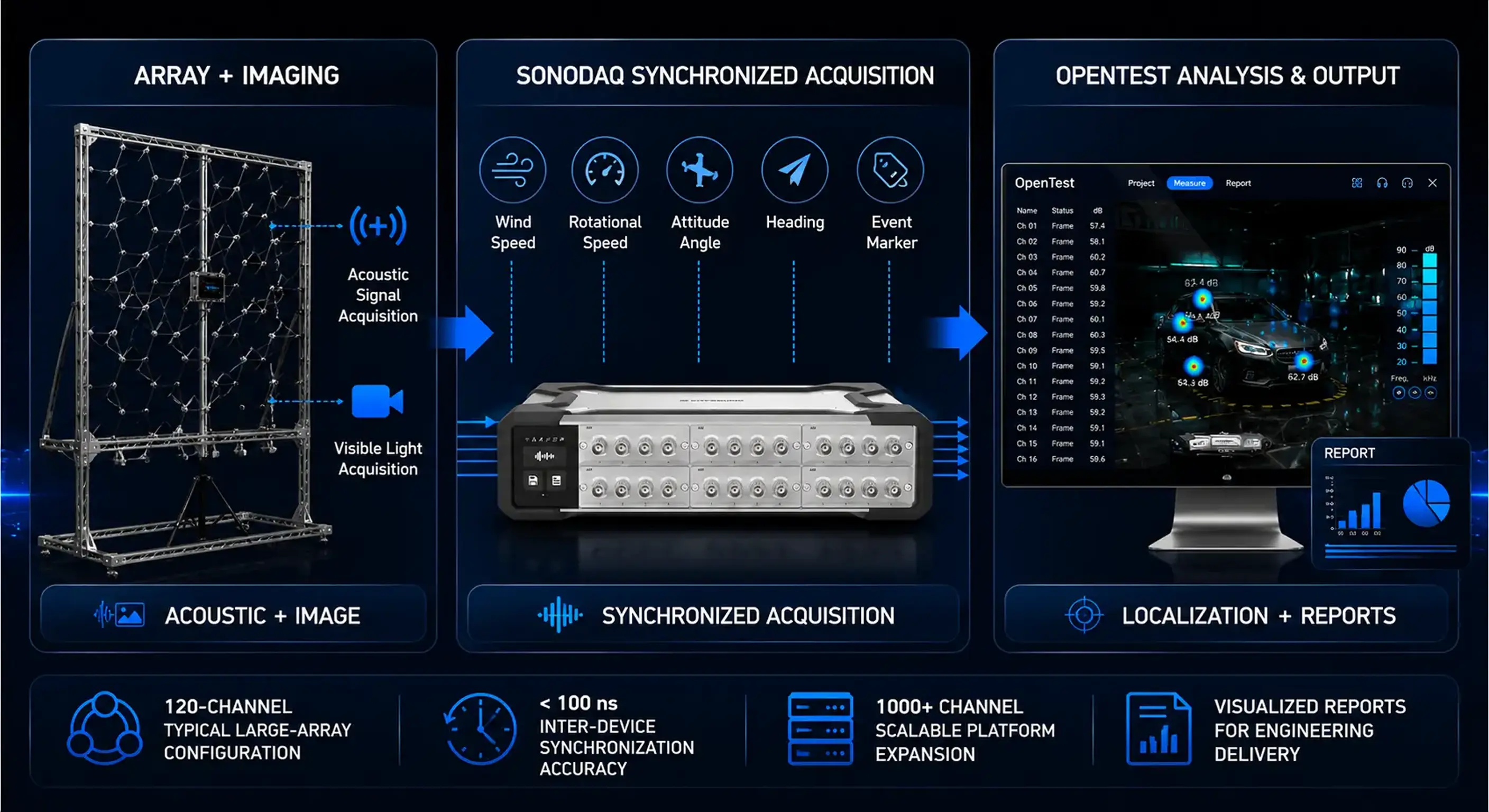
Designed to meet the stringent requirements for channel and phase consistency in large-array acoustic imaging, SonoDAQ adopts PTP (Precision Time Protocol) as a unified time reference, enabling highly accurate multi-channel synchronized acquisition and seamless multi-device expansion. All acquisition channels are precisely aligned on the same time axis, ensuring reliable data synchronization across the entire measurement system. With an inter-device synchronization accuracy of better than 100 ns, SonoDAQ provides a stable and dependable foundation for sound source localization, phase analysis, and acoustic beamforming.
Synchronization accuracy: < 100 ns
Reliable and consistent data acquisition
Intuitive Acoustic Imaging for Noise Source Localization
Unlike conventional wind tunnel aerodynamic testing, which primarily focuses on performance metrics such as lift, drag, and pressure distribution, this solution further integrates acoustic imaging to provide a more comprehensive evaluation. By overlaying acoustic heat maps onto live camera images, the system intuitively visualizes the spatial distribution of noise sources, clearly highlighting areas of dominant acoustic radiation.
This enables engineers not only to determine how loud the noise is, but also to quickly identify where the noise originates. Such visualized localization significantly improves fault identification efficiency and provides a more direct basis for noise reduction, structural optimization, and comparative design evaluation.
Visualized Noise Source Localization
Irregular Array Design
The system adopts an irregular microphone array configuration to reduce the risk of spatial aliasing commonly associated with regular array geometries in specific directions. This design effectively suppresses side lobes and grating lobes, minimizing their impact on sound source localization accuracy.
Compared with conventional regular arrays, the irregular array improves main lobe resolution in acoustic maps, making dominant noise sources easier to distinguish and identify.
In complex low-speed wind tunnel acoustic environments, this optimized array design enhances the stability and reliability of sound source localization, providing a more dependable basis for subsequent noise analysis and design optimization.
Enhanced Main Lobe Resolution in Acoustic Maps
Synchronized Multi-Physics Data Acquisition
The data acquisition system features a modular architecture that supports the flexible integration of a wide range of sensors, including acoustic, vibration, wind speed, rotational speed, attitude angle, temperature, humidity, and barometric pressure sensors. This enables synchronized acquisition and unified recording of both acoustic signals and wind tunnel operating parameters.
Each acoustic measurement is automatically associated with its corresponding test conditions and operating parameters, ensuring clear traceability throughout the testing process. This synchronized data framework facilitates test reproducibility, multi-condition comparison, root cause analysis, and design optimization validation.
Flexible integration of multiple sensor types
Clear and comprehensive test condition identification
Wideband, High-Dynamic-Range Data Acquisition
The system provides a wide frequency range from 1 Hz to 100 kHz, enabling the acquisition of diverse signals ranging from low-frequency structural vibrations to high-frequency acoustic details. It is well suited for applications such as wind noise analysis, tonal noise (whistling), abnormal noise (rattle/squeak), structural response measurements, and high-bandwidth signal analysis.
Powered by a 32-bit ADC architecture and Quad-ADC Fusion Technology, the system delivers an ultra-high dynamic range of up to 170 dB. This allows it to accurately capture both low-level weak signals and high sound pressure, large-amplitude signals within a single measurement, eliminating the need for multiple gain settings.
1 Hz-100 kHz wide frequency coverage
Up to 170 dB dynamic range
OpenTest Integrated Analysis Software
OpenTest brings together real-time waveforms, FFT spectrum analysis, 1/3-octave analysis, sound pressure level (SPL) trends, sound source localization, acoustic heat maps, and operating condition data within a single software environment. This integrated platform enables engineers to efficiently complete the entire testing workflow, from real-time monitoring and data analysis to result interpretation.
The software also supports chart export and automated report generation, seamlessly connecting data acquisition, acoustic analysis, imaging, and documentation into a unified workflow for engineering testing and project delivery.
Integrated end-to-end testing workflow
Chart export
Automated report generation
Scalable Platform Architecture
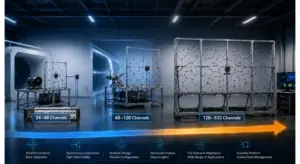
The system features a scalable platform architecture that allows users to expand channel capacity in stages according to project requirements and budget, ensuring a smooth transition from feasibility studies to a full-scale acoustic testing platform.
Phase 1 - Small-Scale Validation (24-48 Channels)
Establish an initial testing platform to verify the wind tunnel environment, optimize microphone array configuration, and evaluate preliminary acoustic imaging performance.
Phase 2 - Project-Level Capability (64-128 Channels)
Expand the system to support routine wind tunnel testing projects, delivering frequency spectrum analysis, sound source localization maps, operating condition comparisons, and comprehensive test reports.
Phase 3 - Large-Scale Acoustic Platform (256+ Channels)
Build an institutional-level aeroacoustic testing platform with more than 256 channels, enabling high-resolution acoustic imaging while establishing standardized testing workflows, report templates, and a long-term acoustic database.
24-48 channel small-scale validation
Scalable to 256+ channel large-array platform
Typical 120-Channel Acoustic Imaging Configuration
A typical 120-channel acoustic imaging system consists of measurement microphones, an acoustic calibrator, a custom microphone array frame, the SonoDAQ Pro data acquisition system, an IED input module, and OpenTest analysis software. Together, these components provide a complete solution covering system calibration, acoustic data acquisition, synchronized recording, sound source localization, and automated report generation.
The configuration is ideally suited for low-speed wind tunnel aeroacoustic testing, enabling accurate vehicle and component noise source localization as well as comparative analysis under multiple operating conditions.
Low-speed wind tunnel aeroacoustic testing
Vehicle and component noise source localization
Multi-condition comparative analysis
CRY3203-S01 Free-Field Microphone Set, 1/2", 50mV/Pa
CRY5820 SonoDAQ Pro
CRY3018 Sound Calibrator
OpenTest


