

1/1
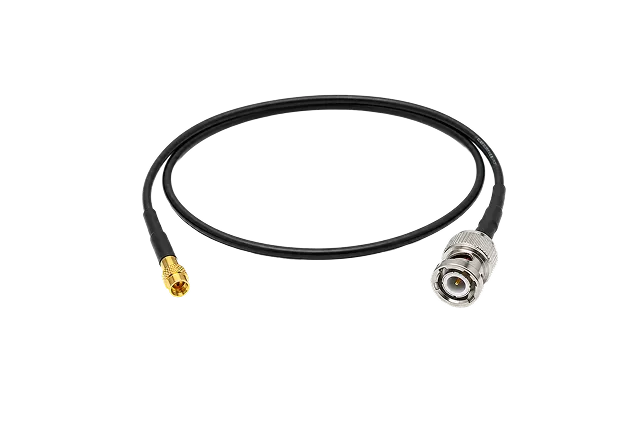
Microdot (M5, 10-32 UNF) Straight-to-BNC RF Cable
Specifications:
Microdot (M5, 10-32 UNF) Straight-to-BNC RF Cable - RG174 Cable, 1.5 m, Ø2.5 mm
Microdot (M5, 10-32 UNF) Straight-to-BNC RF Cable - RG174 Cable, 2 m, Ø2.5 mm
Microdot (M5, 10-32 UNF) Straight-to-BNC RF Cable - RG174 Cable, 3 m, Ø2.5 mm
Microdot (M5, 10-32 UNF) Straight-to-BNC RF Cable - RG174 Cable, 5 m, Ø2.5 mm
Microdot (M5, 10-32 UNF) Straight-to-BNC RF Cable - RG174 Cable, 20 m, Ø2.5 mm
Downloads
Product Highlights
Technical Specifications
Main Features
Related Products
CRY3103 Free-field Microphone, 1", Prepolarized, 100 mV/Pa
Field Type
Free-field
Sensitivity
100 mV/Pa, -20 dB±2 dB re 1 V/Pa
Frequency Response
4 Hz to 12 kHz ±2 dB
CRY3212 Pressure-field Microphone, 1/2", Prepolarized, 37.5 mV/Pa
Field Type
Pressure-field
Sensitivity
37.5 mV/Pa, -28.5 dB±2 dB re 1V/Pa
Frequency Response
3.15 Hz to 16 kHz ±2 dB; 3.15 Hz to 20kHz +2~-5 dB
In acoustic measurements (SPL, frequency response, noise, reverberation, etc.), large errors often come not from instrument accuracy, but from a mismatch between the assumed sound field and the actual one. What a microphone reads as sound pressure is not strictly equivalent across different fields-especially at mid and high frequencies, where the microphone dimensions become comparable [...]
In multichannel acoustic testing, entering microphone model numbers, sensitivities, and calibration data one channel at a time is slow and prone to error. TEDS allows a data acquisition system to read key parameters stored in a microphone or preamplifier, helping engineers configure channels faster and maintain consistent test settings. This article tests the CRYSOUND CRY3203-S01 [...]
In acoustic testing, acoustic metrology, and product noise evaluation, the term measurement microphone typically refers to a condenser measurement microphone. Its signal generation relies on a polarization electric field: sound pressure changes the capacitance, and the front-end circuitry converts this change into an electrical signal. Depending on how the polarization field is provided, measurement microphones generally [...]
In day-to-day acoustic measurements, it's common to hear: "Insert the measurement microphone into the calibrator, press the button, and the microphone is calibrated." From an engineering and metrology perspective, that wording is an oversimplification. To place a sound calibrator correctly in the measurement chain, we should start with what it generates-and what it can (and [...]
Get in touch
If you are interested or have questions about our products, book a demo and we will be glad to show how it works, which solutions it can take part of and discuss how it might fit your needs and organization.