


Wearable audio devices are becoming smaller, smarter, and more complex. From TWS / OWS earbuds, bone-conduction earphones, hearing aids, smart glasses, and smart watches or smart bands, modern wearable devices can no longer be judged only by whether their acoustic output follows a frequency response curve.
In real production environments, a device may pass frequency response testing but still deliver a poor user experience. It may have abnormal distortion, noise, air leakage, microphone sensitivity drift, unstable ANC performance, inconsistent left-right balance, poor acoustic sealing, or mechanical abnormal sound caused by assembly issues.
Therefore, production line audio testing for wearable devices must go beyond traditional frequency response testing. A complete end-of-line audio test system should verify not only speaker acoustic output, but also microphone performance, abnormal sound detection, noise reduction functions, acoustic leakage, signal path behavior, electrical performance, and production consistency.
This article explains what should be tested in wearable audio production, why frequency response alone is not enough, and how manufacturers can build a more reliable automated audio test process.
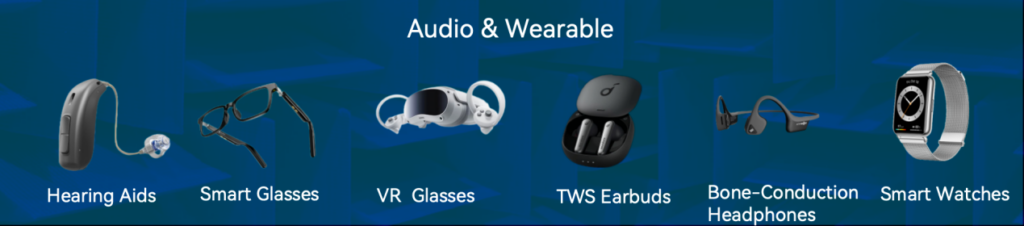
Figure 1. Common Wearable Audio Devices for Production Testing
Why Wearable Audio Testing Is More Challenging Than Traditional Speaker Testing
Compared with traditional speakers or simple audio modules, wearable devices are more difficult to test.
First, the acoustic structure is extremely compact. Small changes in speaker position, sound outlet design, acoustic mesh, enclosure sealing, pressure relief vents, adhesive application, or assembly process can affect SPL, low-frequency response, distortion, and noise performance.
Second, wearable devices are usually used close to the ear or body. Users are more sensitive to small defects such as slight Buzz noise, left-right loudness imbalance, high noise floor, or abnormal microphone pickup. These issues can directly affect perceived product quality.
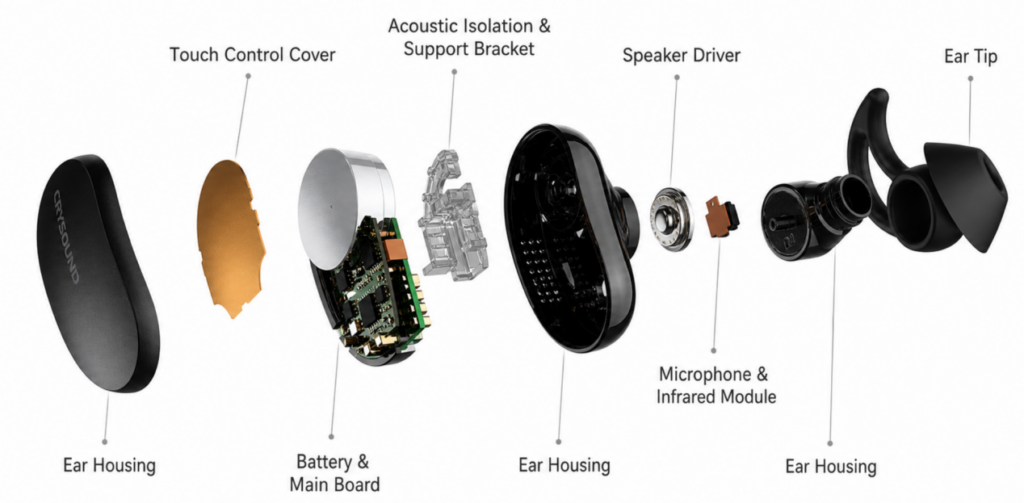
Third, many wearable devices integrate multiple acoustic components. A TWS earbud may include a speaker, feedforward ANC microphone, feedback microphone, voice microphone, pressure relief vent, acoustic mesh, and DSP algorithm. Smart glasses or AR/VR devices may also include open-ear speakers, microphone arrays, bone-conduction sensors, and spatial audio algorithms.
Finally, wearable audio performance depends strongly on wearing condition and sealing. A product that performs normally in free-field conditions may behave very differently when placed in an artificial ear, coupler, or simulated wearing fixture.
For these reasons, production testing should focus on the real acoustic performance of the finished product after assembly, rather than only on individual component specifications.
Frequency Response Is Important, But Only the Starting Point
Frequency response remains one of the most important audio test items in production. It shows how evenly the device reproduces sound across the frequency range and helps identify issues such as speaker damage, blocked sound outlets, poor acoustic sealing, incorrect tuning, or component variation.
For wearable devices, frequency response testing is commonly used to check:
- Speaker output consistency
- Left-right balance in earbuds or stereo wearable devices
- Low-frequency leakage caused by poor sealing
- High-frequency loss caused by blocked acoustic mesh
- Unit-to-unit consistency against a golden sample
- Production tolerance against upper and lower limit curves
However, frequency response alone cannot detect every problem. A device may have an acceptable frequency response but still produce audible buzzing. It may have normal SPL but poor microphone pickup. It may pass the speaker test but fail ANC performance. It may look normal in a short sweep but show abnormal distortion under higher output levels.
Therefore, frequency response should be treated as one part of a broader production audio quality control process.
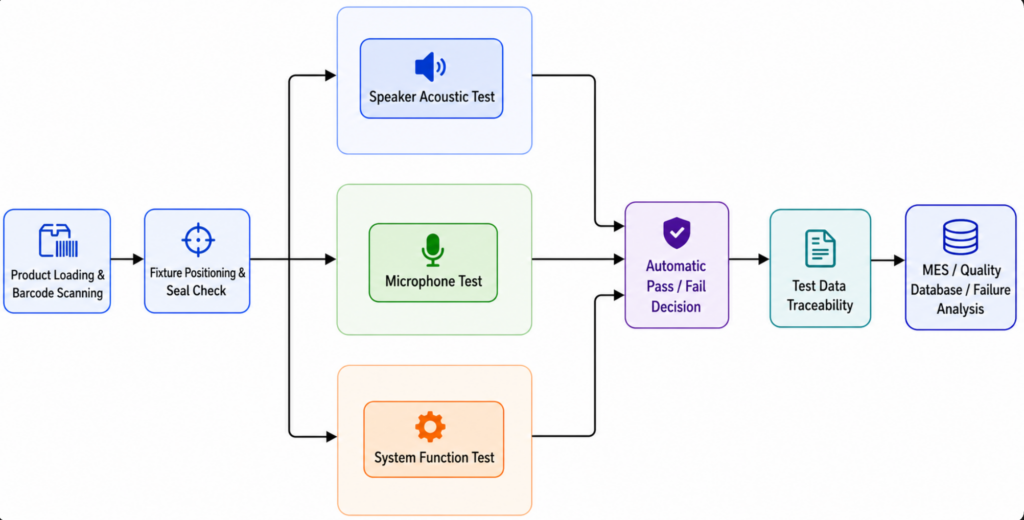
Production Audio Test Workflow for Wearable Devices
Key Audio Test Items for Wearable Devices
A complete production line audio test solution for wearable devices should normally cover the following test categories.
1. Sound Pressure Level and Output Sensitivity
Sound pressure level, or SPL, measures how loud the device can play under defined test conditions. For wearable products, SPL testing is important because users expect consistent loudness across devices, channels, and production batches.
Typical production checks include SPL at specific frequencies, average SPL over a defined frequency band, maximum output level, left-right output balance, and speaker sensitivity deviation from golden sample.
For TWS earbuds, neckband earphones, smart glasses, and hearing-related devices, SPL consistency directly affects perceived loudness, user comfort, and stereo image stability. If SPL is too low, the cause may be speaker damage, blocked acoustic outlet, poor assembly, leakage, or incorrect gain setting. If SPL is too high, it may indicate wrong component selection, calibration error, or tuning mismatch.
2. Total Harmonic Distortion
Total Harmonic Distortion, or THD, measures unwanted harmonic components generated when the device reproduces sound. In production testing, THD is useful for identifying defective speakers, damaged diaphragms, mechanical rubbing, air leakage, or nonlinear acoustic behavior.
Wearable devices are especially sensitive to distortion because their speaker units are small and often operate close to their mechanical limits. A miniature speaker may look normal in frequency response but show abnormal distortion at certain frequencies or output levels.
THD testing is commonly performed together with swept-sine measurement. The test system plays a controlled signal, records the acoustic output using a measurement microphone or coupler, and calculates distortion components across the frequency range.
Typical production indicators include THD curve, THD at key frequencies, THD above defined SPL level, abnormal distortion peaks, and comparison against golden sample limits. For wearable products, distortion testing is not only about sound quality. It is also an effective way to detect early mechanical and assembly defects.
3. Rub & Buzz and Abnormal Sound Detection
Rub & Buzz is one of the most important production tests for small speakers and wearable audio devices. It detects abnormal noises caused by mechanical defects, loose parts, diaphragm rubbing, debris, poor bonding, or resonance problems.
A wearable device may pass frequency response and SPL tests but still produce annoying buzzing, rattling, clicking, or scraping sounds. These defects are often highly noticeable to users and may result in returns or complaints.
Rub & Buzz testing is particularly important for TWS earbuds, open-ear earbuds, smart glasses, bone-conduction devices, AR/VR headsets, miniature speaker modules, and hearing enhancement devices.
In automated production testing, Rub & Buzz is usually detected through high-resolution acoustic analysis during a sweep or stepped tone signal. The system identifies abnormal nonlinear components, transient noise, or high-order distortion signatures that are not visible in a normal frequency response curve.
A good Rub & Buzz test should be fast, repeatable, and sensitive enough to detect real defects while avoiding excessive false failures.
4. Microphone Sensitivity and Frequency Response
Most wearable devices include one or more microphones. These microphones may be used for voice pickup, calls, noise reduction, ANC, transparency mode, voice assistant interaction, environmental sound detection, or beamforming.
Production line microphone testing should verify microphone sensitivity, microphone frequency response, signal-to-noise ratio, microphone polarity or phase, microphone channel mapping, noise floor, and microphone array consistency.
For products with multiple microphones, channel mapping is especially important. A device may contain feedforward ANC microphones, feedback microphones, voice microphones, and environmental microphones. If one microphone is swapped, blocked, poorly sealed, or incorrectly connected, the product may still power on but fail in real use.
Microphone testing can be performed using a calibrated sound source, acoustic test chamber, artificial mouth, or dedicated microphone test fixture. The key is to create a stable acoustic field and compare measured microphone output against defined limits.
5. Active Noise Cancellation and Transparency Mode Testing
Active Noise Cancellation, or ANC, is now common in earbuds, headphones, smart glasses, and some wearable communication devices. Testing ANC in production is more complex than testing a basic speaker or microphone because ANC depends on the interaction between speaker, microphone, fit, sealing, DSP algorithm, and acoustic leakage.
Production ANC testing may include noise reduction depth, ANC performance at key frequency bands, feedforward and feedback microphone function, transparency mode gain and response, left-right ANC consistency, abnormal noise during ANC operation, and seal-related performance variation.
For high-volume manufacturing, the goal is usually not to reproduce a full laboratory-grade ANC evaluation on every unit. Instead, production testing should verify whether the ANC system functions correctly and whether the measured performance falls within acceptable limits.
A practical approach is to use controlled noise playback in a test fixture or acoustic box, measure residual sound or microphone response, and compare results with production thresholds derived from golden samples and process capability studies.
6. Environmental Noise Cancellation Testing
Environmental Noise Cancellation, usually abbreviated as ENC, is mainly used to improve call quality, voice command performance, and uplink voice transmission quality. Unlike ANC, which mainly improves the environmental noise heard by the user, ENC focuses on whether the microphone pickup is clear and whether the device can suppress background noise in noisy environments.
For TWS earbuds, smart glasses, AR/VR headsets, and wearable communication devices, ENC performance usually depends on multi-microphone arrays, beamforming, echo cancellation, wind-noise suppression, DSP algorithms, and the Bluetooth uplink audio path. If microphone channels are mapped incorrectly, sensitivity deviation is too large, sound ports are blocked, algorithm parameters are wrong, or firmware configuration is abnormal, the product may still play sound normally, but voice calls may have low voice level, excessive noise, intermittent pickup, muffled sound, or abnormal pickup direction.
In production, ENC testing mainly compares the difference between ENC ON and ENC OFF states.
In mass production, it is usually not necessary to perform a complete subjective call evaluation on every unit. A more practical method is to use an artificial mouth in an acoustic test box or dedicated fixture to play standard speech or speech simulation signals while adding controlled background noise. The device's uplink audio output is then captured through Bluetooth, USB, or a test interface and compared with Golden Sample data or production limits.
A reliable ENC production test solution should focus on verifying whether the microphone array is working correctly, whether the algorithm is enabled correctly, whether the uplink audio path is stable, and whether the noise suppression effect meets production consistency requirements.
7. Acoustic Leakage and Sealing Test
For in-ear and semi-in-ear wearable devices, acoustic sealing strongly affects low-frequency response, ANC performance, and user experience. Poor sealing may be caused by housing gaps, mesh defects, venting issues, damaged ear tips, poor assembly, or fixture misalignment.
Acoustic leakage can lead to low bass output, poor ANC depth, inconsistent left-right response, higher distortion, poor repeatability in production testing, and customer complaints about weak sound or poor noise cancellation.
Production leakage testing can be performed by analyzing low-frequency response, pressure behavior, or acoustic transfer characteristics under controlled fixture conditions.
For earbuds and hearing-related devices, using an artificial ear, ear simulator, or well-designed acoustic coupler is critical. The fixture must provide repeatable placement and sealing, otherwise the test system may confuse fixture variation with product defects.
8. Polarity, Phase, and Channel Matching
Polarity and phase errors are simple but serious defects. If the speaker polarity is reversed, the product may still produce sound, but stereo image, bass response, ANC behavior, and spatial audio performance may be affected.
For wearable devices with left and right channels, channel matching is also critical. Users can easily notice imbalance in loudness, tone, or noise floor between two earbuds or two speaker paths.
Production tests should check speaker polarity, microphone polarity, left-right SPL balance, left-right frequency response matching, phase consistency, and channel routing or mapping.
For multi-speaker or spatial audio wearable products, phase and channel matching become even more important because sound field rendering depends on accurate timing and acoustic consistency.
9. Impedance and Electrical Audio Checks
Although acoustic testing is essential, electrical checks are still important in production. Speaker impedance, current consumption, signal path integrity, and electrical connection quality can help detect soldering defects, open circuits, short circuits, wrong components, or unstable assemblies.
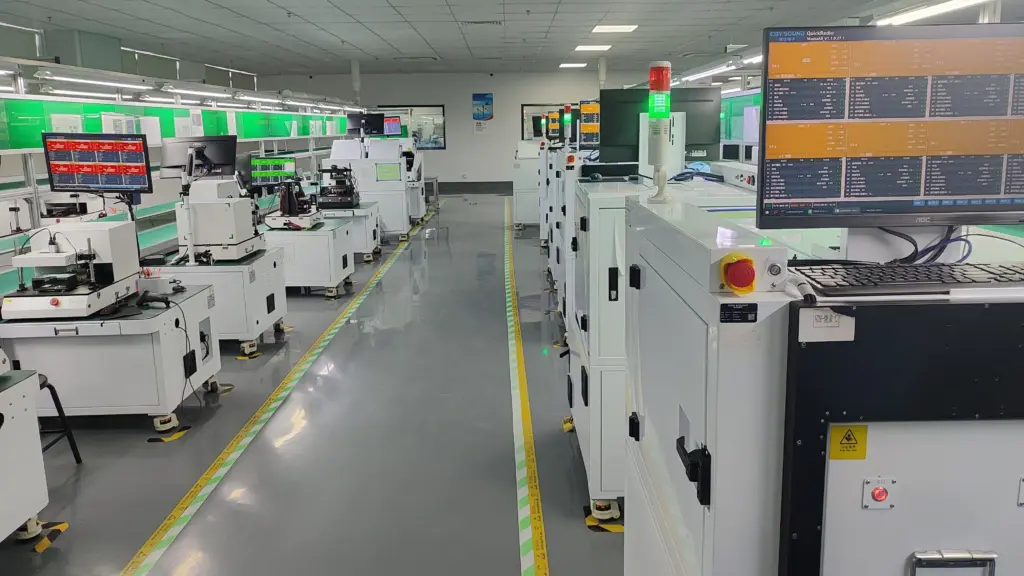
Typical electrical audio tests include speaker impedance, DC resistance, open/short detection, current consumption during playback, amplifier output check, audio signal path verification, and connector or contact reliability.
For compact wearable devices, electrical and acoustic tests are often combined in one automated station to reduce cycle time and improve traceability.
10. Bluetooth Audio and Functional Audio Test
Many wearable devices rely on wireless audio transmission. This introduces another layer of production risk. Even if the acoustic components are normal, the product may fail due to Bluetooth pairing issues, codec configuration, audio latency, firmware settings, or unstable wireless audio path.
Production functional audio testing may include Bluetooth pairing and connection, audio playback verification, recording path verification, voice call path test, codec or profile confirmation, latency check, button or touch-control audio function, and prompt tone or voice prompt verification.
Not every production line needs a full wireless performance test on every unit, but basic functional audio verification is often necessary for finished wearable products.
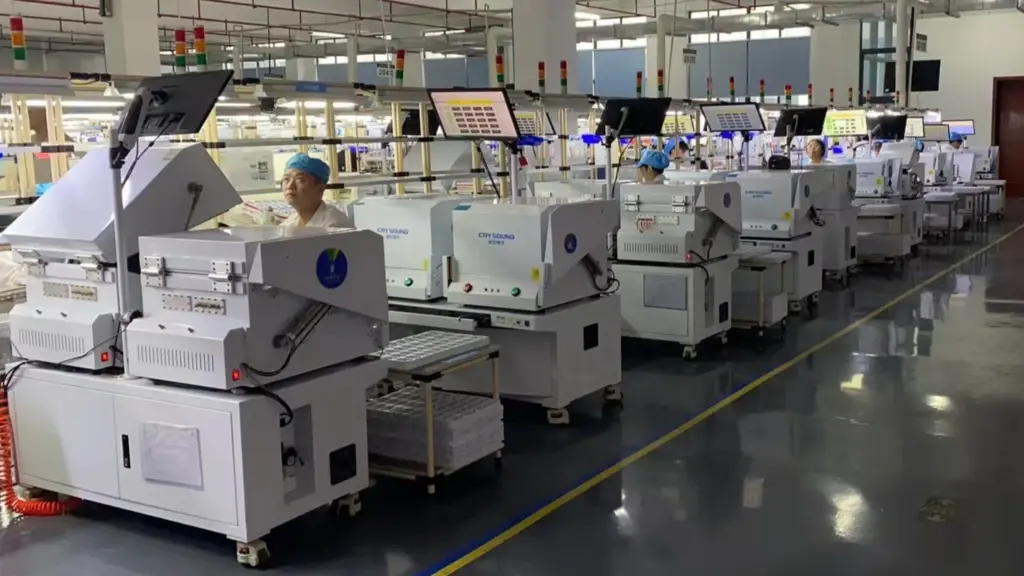
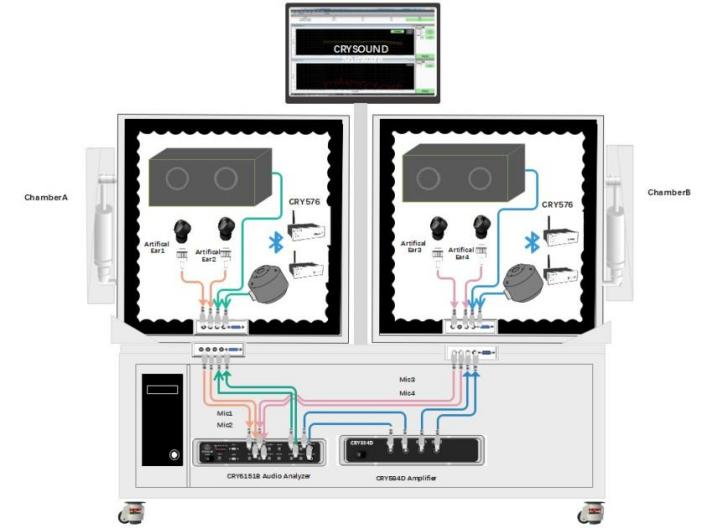
Recommended Test Setup for Production Wearable Audio Testing
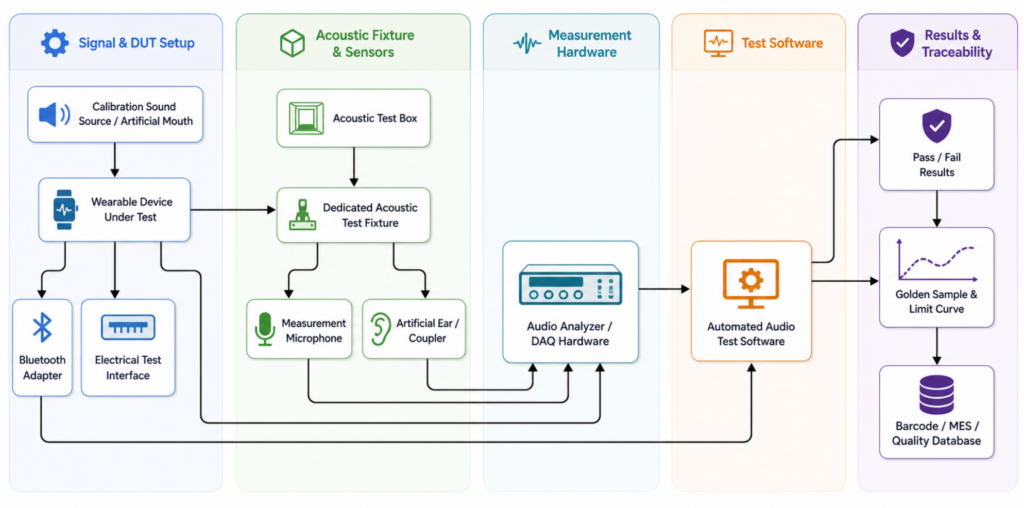
| Component | Purpose |
| Measurement microphone | Captures acoustic output from speakers or sound leakage |
| Artificial ear / ear simulator / coupler | Simulates wearing condition and improves test repeatability |
| Acoustic test box or chamber | Reduces environmental noise and improves measurement stability |
| Calibrated sound source / artificial mouth | Provides controlled sound input for microphone testing |
| Audio analyzer or data acquisition hardware | Generates test signals and records acoustic/electrical responses |
| Bluetooth adapter | Establishes the Bluetooth connection path and supports Bluetooth audio testing |
| Automated test software | Controls test sequence, analyzes results, and provides pass/fail judgment |
| Fixture and positioning mechanism | Ensures stable product placement and sealing |
| Barcode / MES integration | Links test results to serial number, batch, operator, and production line |
| Golden sample management | Provides reference curves and tolerance limits for production control |
For wearable devices, fixture design is often as important as the measurement instrument itself. Poor fixture repeatability may cause false failures, unstable test results, and unnecessary production line troubleshooting.
How to Define Pass/Fail Criteria
One of the most difficult parts of wearable audio production testing is setting the right pass/fail limits. If the limits are too loose, defective products may pass. If the limits are too strict, good products may be rejected, reducing yield and increasing manufacturing cost.
A practical pass/fail strategy usually includes:
- Golden sample measurement: select verified good samples and measure their acoustic and electrical performance under stable test conditions.
- Upper and lower tolerance curves: define acceptable production limits for frequency response, SPL, THD, microphone sensitivity, and other parameters.
- Process capability analysis: use production data to evaluate variation, Cpk, yield, and failure distribution.
- False fail and false pass control: review failed units and customer complaint data to adjust limits without hiding real defects.
- Fixture repeatability validation: confirm that test variation comes from the product, not the fixture or environment.
For wearable devices, pass/fail limits should not be copied directly from engineering lab targets. Production limits must consider measurement repeatability, cycle time, fixture tolerance, and real manufacturing variation.
Common Production Problems Detected by Audio Testing
A well-designed production audio test system can detect many common defects, including blocked speaker outlet, blocked microphone port, poor acoustic mesh bonding, speaker diaphragm damage, loose internal component, housing air leakage, wrong speaker or microphone model, reversed polarity, left-right channel imbalance, abnormal ANC behavior, Bluetooth audio path failure, firmware or DSP configuration error, poor soldering or connector contact, excessive distortion, and buzzing or rattling noise.
Many of these problems are difficult to identify through visual inspection alone. Automated audio testing provides a more objective and traceable way to control product quality.
Balancing Test Coverage and Cycle Time
Production line testing must always balance quality coverage and cycle time. A test process that is too simple may miss important defects. A test process that is too complex may slow down production and increase cost.
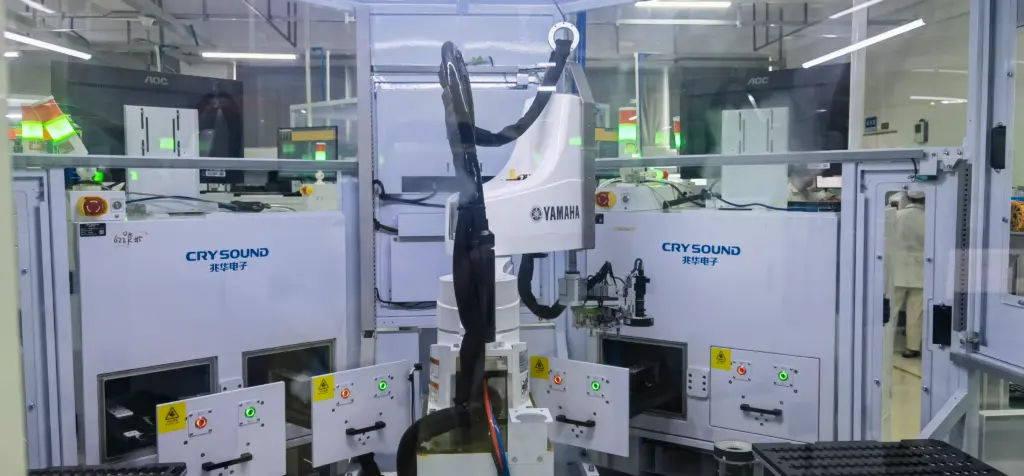
For wearable devices, manufacturers usually need to define different levels of testing: component-level acoustic testing, semi-finished product testing, final assembly testing, end-of-line functional audio testing, and sampling-based advanced performance testing.
High-risk items such as speaker output, microphone function, Rub & Buzz, polarity, and leakage should often be tested on every unit. More complex tests, such as full ANC curve analysis or extended Bluetooth performance evaluation, may be used in selected stations or sampling processes depending on production requirements.
The best solution is not always the longest test sequence. The best solution is the one that catches real production defects reliably within an acceptable cycle time.
Building a Traceable Audio Quality System
Modern wearable audio production requires more than pass/fail results. Manufacturers need traceable data that can support process control, failure analysis, supplier management, and continuous improvement.
A production audio test system should ideally record serial number or barcode, test time and station ID, operator or line information, frequency response curves, SPL and sensitivity values, THD and Rub & Buzz results, microphone test results, ANC or leakage test results, pass/fail judgment, failure code, golden sample version, and fixture calibration status.
With this data, engineering and quality teams can identify trends, compare production lines, detect fixture drift, analyze supplier variation, and reduce customer return risk.
How CRYSOUND Supports Wearable Audio Production Testing
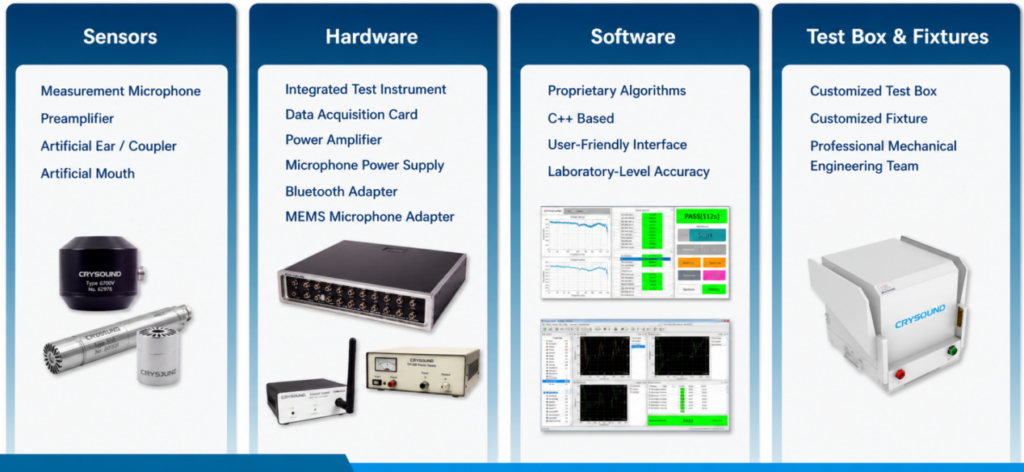
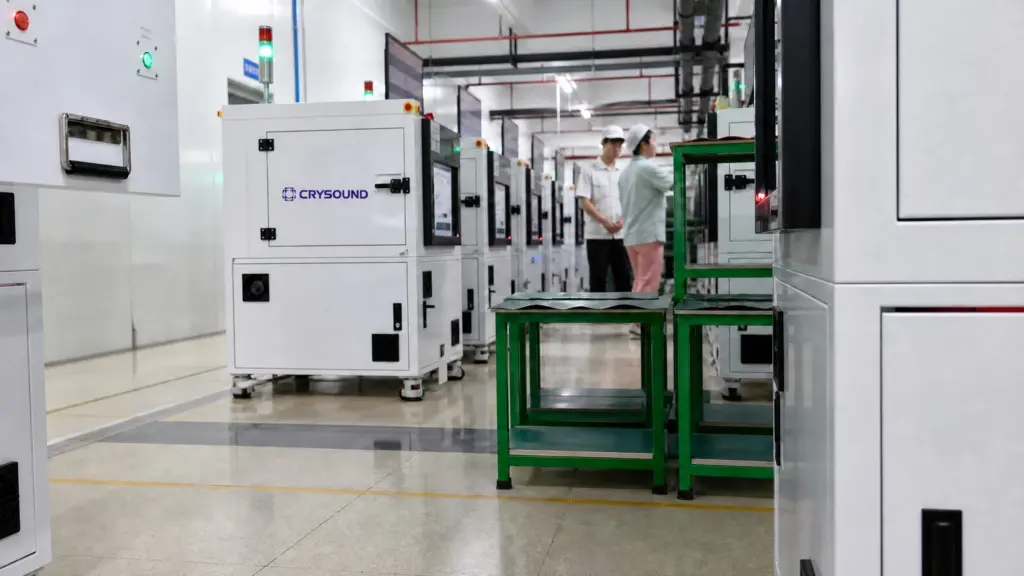
CRYSOUND provides acoustic measurement microphones, acoustic test systems, data acquisition hardware, and automated test software for production line audio testing. For wearable device manufacturers, CRYSOUND can support the design of complete test stations covering speaker output, microphone performance, Rub & Buzz detection, leakage evaluation, ANC-related checks, and automated pass/fail traceability.
Depending on the product type and production process, CRYSOUND can help configure measurement microphones and acoustic sensors, artificial ear or coupler-based test fixtures, acoustic test boxes, multi-channel data acquisition, automated audio test software, production line test sequences, barcode and data traceability, golden sample and tolerance curve management, and integration with MES or factory quality systems.
For earbuds, smart glasses, hearing-related devices, AR/VR products, and other wearable audio devices, the goal is not only to test more parameters. The goal is to build a repeatable, efficient, and production-ready audio quality control process.
Conclusion
Frequency response is still a critical test item for wearable audio devices, but it is no longer enough. Modern wearable products combine speakers, microphones, ANC algorithms, compact acoustic structures, wireless audio paths, and complex assembly processes. Each of these factors can introduce production variation and potential quality risks.
A reliable production line audio test system should cover frequency response, SPL, THD, Rub & Buzz, microphone performance, ANC and ENC functions, leakage, polarity, impedance, Bluetooth audio, and traceable pass/fail data.
For manufacturers of TWS earbuds, smart glasses, AR/VR headsets, hearing-related devices, bone-conduction products, and wearable communication modules, moving beyond frequency response is essential for improving product consistency, reducing field failures, and protecting brand reputation.
If you are building or upgrading a wearable audio production test station, CRYSOUND can help you design a complete acoustic test solution from measurement hardware to automated software and production data traceability. Please fill out and submit the Get in Touch form below should you require further information.


