


In today's rapidly evolving electroacoustic product landscape, production line testing systems are no longer expected to simply "produce measurements." They must balance test capability, throughput, stability, and scalability.
Core metrics such as frequency response, distortion, and sweep analysis remain essential. At the same time, more advanced requirements, such as anomalous sound detection, multi-channel synchronization, automated test sequences, and standardized reporting-are becoming increasingly common.
The challenge is that many production test systems were never designed holistically. Instead, they've grown incrementally alongside product iterations. Each new requirement often introduces another device, script, or subsystem. While this approach works in the short term, over time, the system itself becomes a bottleneck.
For teams aiming to improve long-term efficiency and consistency, the key question is no longer "What additional equipment do we need?", but rather "Is it time to evolve our test system into a unified platform?"
The Real Bottleneck: System Architecture, Not Individual Devices
In a mature electroacoustic production line, testing systems typically handle multiple responsibilities:
- Core acoustic measurements: frequency response, distortion, sweeps, SPL
- Engineering validation & troubleshooting: multi-channel comparison, waveform review, spectral analysis
- Automated execution: fixed test sequences, pass/fail logic, report generation
- New product introduction (NPI): rapid adjustment and expansion
When these capabilities rely on separate devices, software tools, and interfaces, several issues inevitably arise:
- Fragmented testing capabilities and increasing system complexity
- Reconfiguration required for each new product introduction
- Limited reusability across stations and rising maintenance overhead
- Longer debugging chains that offset efficiency gains
In short, many bottlenecks don't stem from missing capabilities, but from a lack of architectural cohesion
From "Adding Devices" to "Building Platforms"
Traditionally, new requirements are addressed by layering additional functionality onto existing systems. While effective in the short term, this approach rarely reduces long-term complexity.
As testing evolves from single-domain acoustic validation to multi-functional, integrated workflows, production lines increasingly require: Not isolated upgrades, but converged platforms that unify acquisition, analysis, execution, and reporting.
This is where platform-based testing systems deliver real value.
Importantly, platformization does not replace modularity-it refines it. Modules are no longer just feature add-ons; they operate within a unified architecture, enabling flexibility without fragmentation.
SonoDAQ + OpenTest: Converging Multi-Device Workflows into a Unified Platform
Within this framework, the roles of SonoDAQ and OpenTest extend beyond standalone tools:
- SonoDAQ → A unified, scalable data acquisition front-end
- OpenTest → A unified environment for test execution, analysis, and reporting
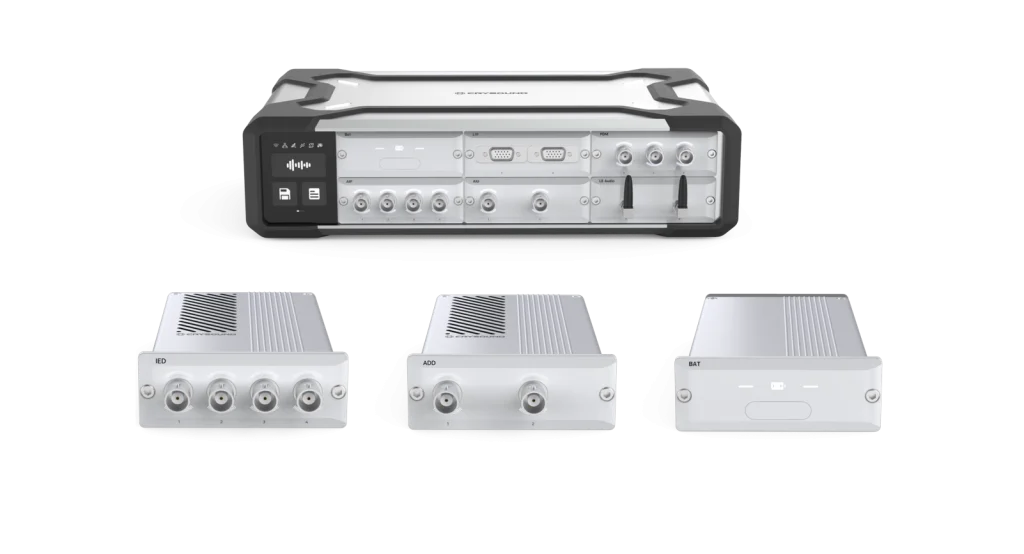
Hardware: Scalable, Multi-Modal Acquisition
SonoDAQ Pro features a modular architecture:
- 4-24 channels per unit, scalable to 1000+ channels
- Supports diverse signal types:
- Acoustic
- Vibration
- Strain
- Thermocouple
- Charge
- Voltage / Current
For test scenarios involving acoustics + vibration + other physical domains, this eliminates the need for multiple independent acquisition chains.
Software: Unified Workflow and Analysis
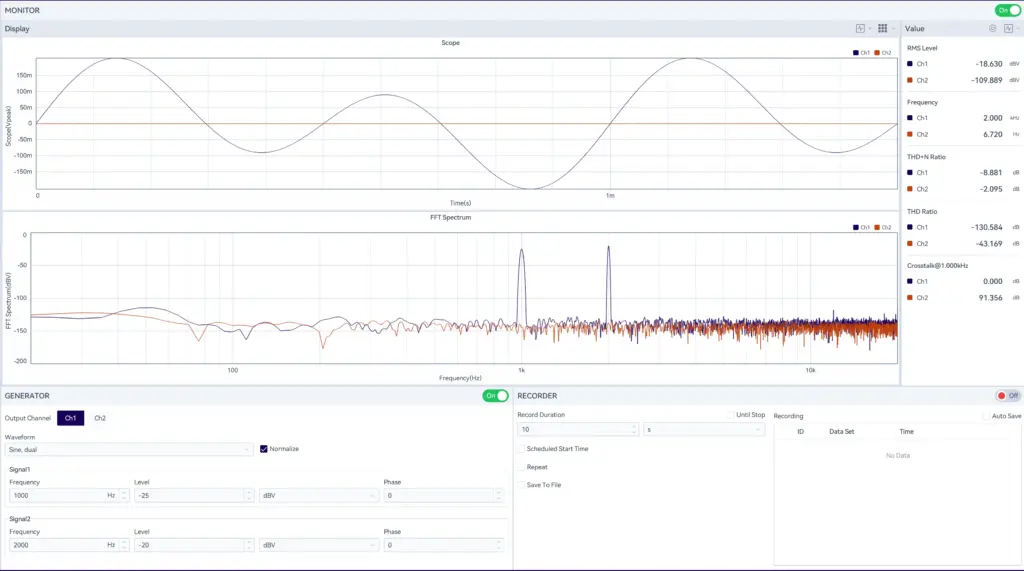
OpenTest provides:
- Measurement Mode
- Analysis Mode
- Sequence Mode
Along with built-in capabilities such as:
- Real-time waveform visualization
- FFT and spectral analysis
- Octave analysis
- Sweep measurements
- Sound power and SPL calculations
The key advantage:
Data acquisition, test execution, analysis, and reporting are consolidated into a single workflow, rather than distributed across disconnected tools.
What Does a Platform-Based Test System Change?
1. A More Cohesive System Architecture
Traditional systems resemble layered "patchwork engineering."
A platform-based approach allows teams to organize around:
- A unified acquisition front-end
- A centralized software environment
- Standardized execution and reporting structures
This significantly reduces long-term maintenance complexity.
2. Easier Standardization of Test Processes
Production testing is not just about measurement-it's about:
- Process stability
- Result consistency
- Replicability across stations
With OpenTest's sequence, analysis, and reporting capabilities, teams can:
- Codify standard workflows
- Reuse logic across stations, products, and projects
This "standardize first, extend later" model is far more sustainable than building isolated setups per project.
3. Clearer and More Scalable Expansion
Platform-based systems don't require full feature coverage upfront. Instead, they provide a scalable foundation.
- SonoDAQ enables expansion in channel count and measurement domains
- OpenTest supports integration with additional hardware
New capabilities can be added incrementally, without breaking architectural consistency.
4. Flexible Migration and Integration
Upgrading to a platform does not mean discarding existing investments.
OpenTest supports multiple interfaces and ecosystems:
- openDAQ, ASIO, WASAPI, Core Audio, NI-DAQmx
- Plugin development via Python, MATLAB, LabVIEW, C++
This allows teams to:
- Start with software and workflow unification
- Gradually transition hardware
- Avoid disruptive, all-at-once replacements
5. When Does Platformization Make Sense?
Not every test scenario requires a full platform approach. However, the value becomes clear when:
• Multi-Test Integration Is Increasing
When frequency response, distortion, sweep, and SPL tests must run within tighter cycle times, unified workflows become critical.
• Multi-Station or Multi-Product Complexity Is Growing
As production scales, maintaining fragmented systems becomes increasingly costly.
• Testing Expands Beyond Pure Acoustics
When requirements extend to:
- Anomalous sound detection
- NVH (Noise, Vibration, Harshness)
- Synchronous multi-domain analysis
A platform architecture ensures clarity and scalability.
6. Enabling Multi-Station Integration Through Modular Platform Design
The real value of a modular SonoDAQ platform is not in individual modules, but in how they can be combined to consolidate multiple test stations into a single system.
In many production lines, different test items are traditionally split across separate stations-RF audio, acoustic performance, power behavior, and digital interface validation. With SonoDAQ, these can be integrated into unified "combined stations" (multi-test cells):
TWS / Earbud End-of-Line Combined Test Station
By combining Bluetooth/BLE + Analog I/O + Battery/CHG modules, a single station can complete:
- Wireless audio transmission (BT)
- Acoustic measurements (frequency response, distortion)
- Power and charging behavior validation
→ Eliminating the need for separate RF, acoustic, and power test stations
Smart Device (Phone / Tablet) Audio + Interface Test Station
Using PDM + HDMI/DSIO + Analog I/O, the system can cover:
- Digital microphone input (PDM)
- Speaker output and acoustic response
- Digital audio path validation (HDMI or internal interfaces)
→ Enabling full audio path verification within one synchronized workflow
Automotive Audio + NVH Combined Station
With A2B + Analog + Vibration (LVI) + Sync/Trigger modules, the platform supports:
- Distributed microphone array acquisition (A2B)
- Speaker playback and acoustic measurement
- Vibration correlation (BSR / NVH)
→ Replacing separate acoustic and vibration systems with a time-aligned, unified setup
7. From "Test Systems" to "Test Infrastructure"
For many manufacturing teams, electroacoustic testing is evolving from: "Temporary setups built around individual projects" to: "Long-term test infrastructure that supports reuse, scalability, and continuous improvement"
In this shift, modularity also evolves: Not just for adding features, but for integrating capabilities within a unified architecture
If you're interested, please fill out the Get in Touch form below.


