


Anomalous Sound EoL Testing helps robot manufacturers identify actuator defects before final assembly or shipment. This article explains the limits of manual inspection and presents CRYSOUND's automated Sound and Vibration testing workflow, system architecture, use cases, and production-line integration options for finger motors, joint modules, and reducers.
Why Anomalous Sound Detection Matters in Volume Production
Embodied AI is moving from lab demos to volume production. Flagship platforms such as Tesla Optimus, Unitree H1 and Deep Robotics Jueying X20 are ramping up, and China alone has formed over 1,600 robotics industry clusters. Yet the industry faces a stark reality: while software can already run world models and VLA algorithms, hardware quality is becoming the bottleneck.
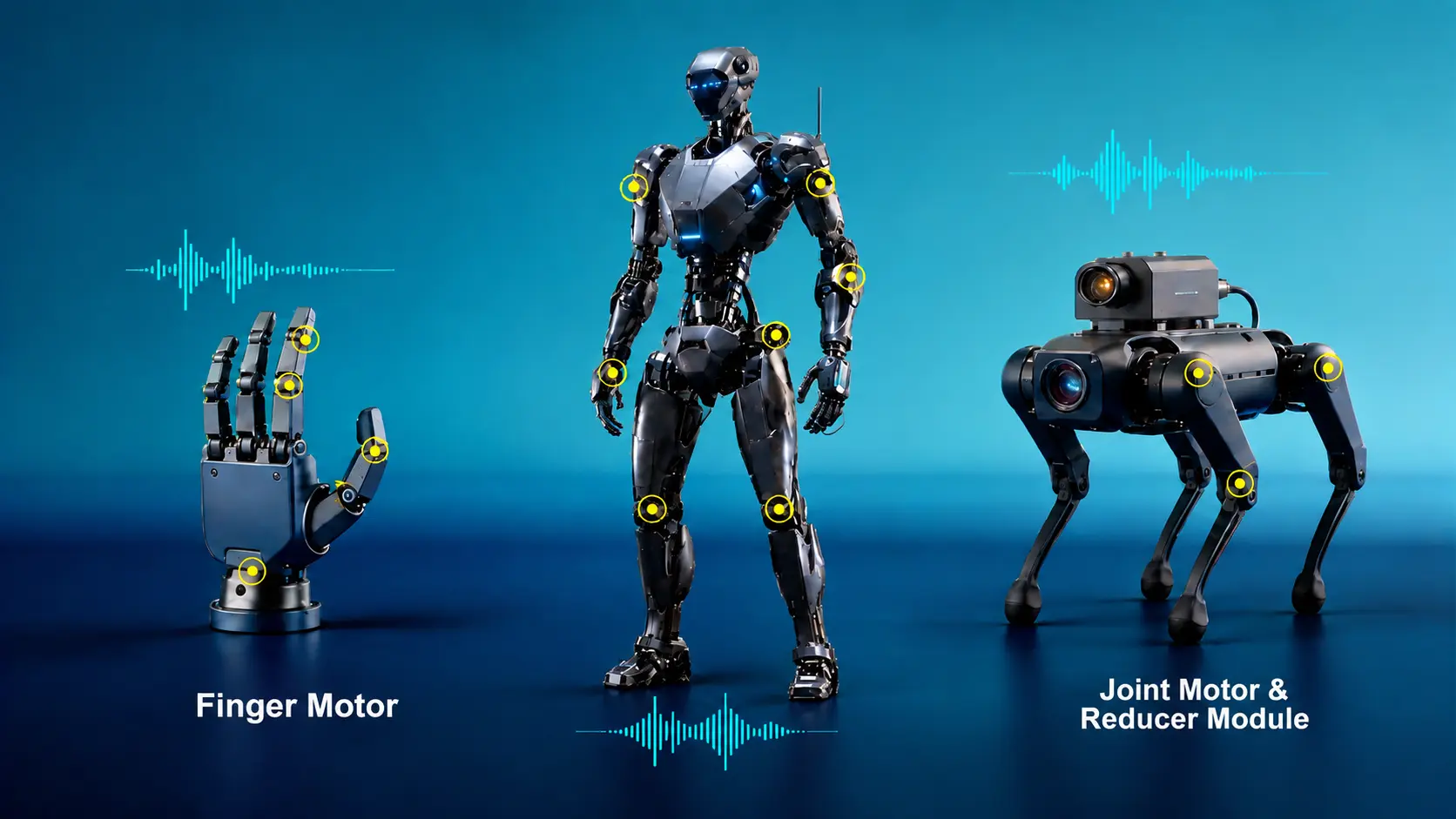
On the production line, abnormal joint-motor noise, reducer whine, high-frequency noise from dexterous hands and joint vibration in quadruped robots are audible yet hard to isolate. They represent one of the biggest hurdles between shipment and end-user acceptance. Anomalous Sound is far from trivial - it is a leading trigger for returns, batch recalls and OEM complaints.
Pain Points of Traditional Anomalous Sound Inspection
As core actuators move into high-speed, high-precision applications, abnormal start-stop noise in joints, gear-meshing impact in reducers and ultra-weak noise from dexterous hands have become critical quality bottlenecks. Manual auditory inspection can no longer keep pace with production ramp-up:
- Inconsistent accuracy: Judgment criteria vary with inspector experience, fatigue and shift handoff. After four hours of continuous listening, judgment consistency may decline during long listening shifts.
- Transient events easily missed: The anomalous sound window during joint start-stop is extremely short. Conventional Leq methods miss many events, raising miss rates during ramp-up.
- Multi-source noise hard to isolate: Gear meshing, motor whine, encoder friction and drive resonance overlap. Single-method spectral analysis cannot reliably separate these coupled sources.
- No standardized testing or data management: Manual listening cannot meet takt-time requirements or build automated data trails, constraining capacity and quality management.
- Defects surface only in the field: Products with Anomalous Sound may reach downstream assembly or end users, driving complaints, returns, warranty repairs or batch recalls - raising costs and eroding brand trust.
Core Value of CRYSOUND's Anomalous Sound EoL Testing Solution
Founded in 1996, CRYSOUND has focused on acoustic testing for 30 years. In motor Anomalous Sound EoL Testing, the company has built deep acoustic expertise and deployed automated solutions across key embodied-AI actuator categories, including finger-joint motors, joint motors and joint modules. Core value includes:
- Automated anomalous sound detection with pass/fail judgment - eliminating subjectivity, fatigue and inconsistent standards in manual listening.
- AI-driven analysis powered by unsupervised deep learning - addressing missed detections and false rejections that lead to quality complaints.
- Fused acoustic-vibration testing - overcoming the limitation of single-microphone setups that often cause misidentification of fault sources.
- Parallel multi-station testing for Anomalous Sound and electrical performance - boosting UPH for high-takt production lines.
- Fast changeover and recipe management - reducing redundant equipment investment across multi-product lines.
- Native MES integration and data traceability - retaining complete quality records for OEM and brand audit requirements.
Target Customers and Use Cases
Target Customers
- Humanoid robot and quadruped robot OEMs with vertically integrated motor supply chains.
- Tier 1 suppliers of joint modules and reducers, covering motor manufacturing through final assembly.
- Tier 2 suppliers of dexterous-hand and finger-joint motors serving multiple robotics brands.
- Embodied-AI companies in production ramp-up requiring 100% EoL anomalous sound screening.
Typical Use Cases
| Device Under Test | Typical Product | Anomalous Sound Test Focus |
|---|---|---|
| Finger-joint motor (coreless) | Micro motor for dexterous hands | Ultra-weak noise, transient events and high-frequency whine |
| Joint module (reducer + motor) | Humanoid robot joint | Gear-meshing impact and coupled multi-source anomalous sound |
| Quadruped robot joint motor | Quadruped robot joint | High-speed operating noise, vibration signatures and durability consistency |
| Gear reducer | Harmonic / planetary reducer | Gear-meshing noise and bearing abnormalities |
Solution Architecture
System Architecture
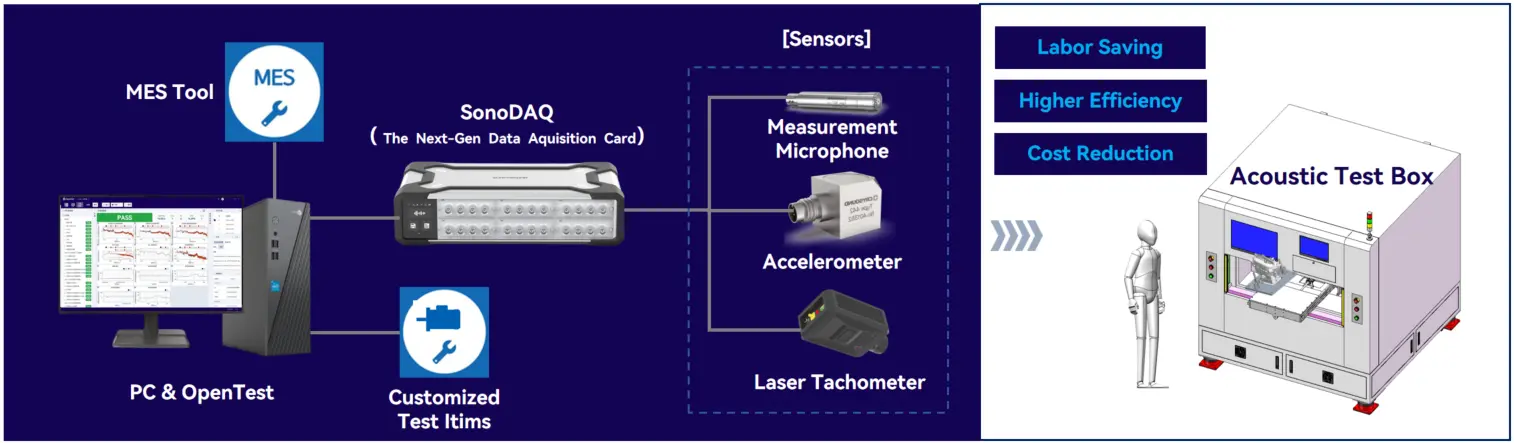
CRYSOUND's solution follows a four-stage workflow: precision acoustic-vibration acquisition → multidimensional signal analysis → AI-based judgment → closed-loop data traceability. The full test process is completed automatically within production-line takt time:
- Precision acquisition: The DUT (device under test) is placed inside an Acoustic Test Chamber. High-precision sensors capture sound and vibration across the full 20 Hz-20 kHz band while synchronously acquiring current, voltage and other electrical parameters.
- Multidimensional analysis: The system combines FFT spectrum analysis, octave analysis, transient anomalous sound detection and sound quality analysis (SQA) to characterize acoustic features from multiple dimensions.
- AI judgment: An unsupervised deep-learning model detects anomalous sound, automatically classifies pass and fail units, and supports online learning for new noise patterns.
- Closed-loop traceability: Test data is statistically analyzed, automatically stored, and integrated with MES for complete per-unit traceability.
Core Advantages
1. Proprietary algorithms: Overcoming the limitation of traditional SPL and FFT methods that cannot reliably identify anomalous sound.
| Anomalous Sound Type | Traditional Method | CRYSOUND Algorithm |
|---|---|---|
| Millisecond-scale transient noise during start-stop or reversal | Missed due to time-averaging window | Proprietary transient detection; stable capture at 48 kHz sampling |
| 1-20 kHz noise, incl. reducer meshing in the 1-5 kHz band | Hard to judge via simple SPL or spectrum thresholds | Proprietary SQA and frequency-band energy-ratio comparison |
| Multi-source coupling: motor + reducer + drive | Operators cannot reliably distinguish sources | AI-based anomaly model configured with representative baseline samples |
| Previously unseen noise patterns in new batches | Cannot handle reliably | Online learning with automatic clustering of new patterns |
2.Key system specifications: Covering joint-motor noise, reducer whine, high-frequency dexterous-hand noise and quadruped-robot vibration.
| Metric | Typical Value | Industry Significance |
|---|---|---|
| Frequency range | 20 Hz-20 kHz | Full audible range |
| Sampling rate | 48 kHz | Meets transient detection requirements |
| Dynamic range | 160 dB | Covers a wide range of motor noise levels |
| Test accuracy | ±0.05 dB | Far exceeding human auditory discrimination |
| MTBF | >20,000 h | Supports 24×7 continuous line operation |
| Miss rate | <0.1% | Far below the 3-5% miss rate of manual inspection |
3.Vertically integrated hardware and software: Fully configurable for standardized or custom delivery, ensuring long-term reliability and ease of use.
| In-House Module | Selectable Model | Description |
|---|---|---|
| Measurement microphone | CRY3203-S01; free-field, prepolarized, low self-noise, high dynamic range; 3.15 Hz-20 kHz, 50 mV/Pa | Accurate acoustic acquisition for anomalous sound testing |
| Accelerometer | CRY433; single-axis; 0.5 Hz to 8 kHz, 100 mV/g | Wide dynamic range and broad peak coverage |
| Data acquisition | CRY5810 SonoDAQ LT; multichannel synchronous acquisition; 204.8 kHz sampling | Efficient synchronous measurement of acoustic, vibration and voltage signals; up to 24 channels per unit |
| Acoustic Test Chamber | Manual and pneumatic models; background noise <15 dB(A), insertion loss >60 dB(A) | Multiple configurations for production-line integration |
| Test platform | OpenTest platform with sequence mode, automatic judgment, report output, MES integration and traceability | Proprietary anomalous sound algorithms plus AI judgment model |
Results and Deliverables
The system automatically outputs end-to-end test results, meeting audit requirements for quality inspection, quality management, product records and data traceability:
- Sound power testing: Supports sound-pressure-based determination of sound power in accordance with ISO 3744 and ISO 3746 when the required measurement environment and setup conditions are met.
- Time-frequency analysis: FFT spectra across 20 Hz-20 kHz identify motor order harmonics, gear-meshing frequencies and bearing defect frequencies, while visualizing SPL distribution by band.
- Octave analysis: Provides 1/1- and 1/3-octave analysis to separate acoustic signals by frequency band for noise-source analysis and noise-reduction work.
- RMS time-domain curve: High-resolution RMS variation captures transient energy bursts during motor start-stop, reversal and speed changes at millisecond resolution.
- Loudness analysis: Psychoacoustic models calculate steady-state loudness (sone) and critical-band distribution (bark), providing an objective basis for perceived smoothness.
- Sound quality analysis (SQA): Computes loudness, sharpness, roughness, fluctuation strength and tonality to quantify perceived sound quality and flag hidden defects where overall level passes but sound character is anomalous.
- Transient Anomalous Sound analysis: Short-time impact-energy detection and envelope analysis locate non-stationary events such as gear knocks, bearing defects and reversal impacts.
- Unsupervised deep learning: Autoencoder and contrastive-learning anomaly models require no large labeled defect dataset, handling coupled multi-source noise and ultra-weak signals.
- Automatic judgment: Multidimensional pass/fail with configurable thresholds and multi-level defect classification for 100% automated grading on production lines.
- Statistical reports: Dashboards for total tests, pass/fail counts, yield and cycle time, filterable by batch and product model.
- WAV audio archive: Raw audio stored in lossless WAV format, structured by product ID and batch for offline replay, diagnostic review and AI model iteration.
- Data traceability: Each product retains a complete test record - acoustic features, judgment result and timestamp. Native MES integration supports full audit traceability.
Customer Case Studies
Finger Motor Anomalous Sound EoL Testing - Customer Value
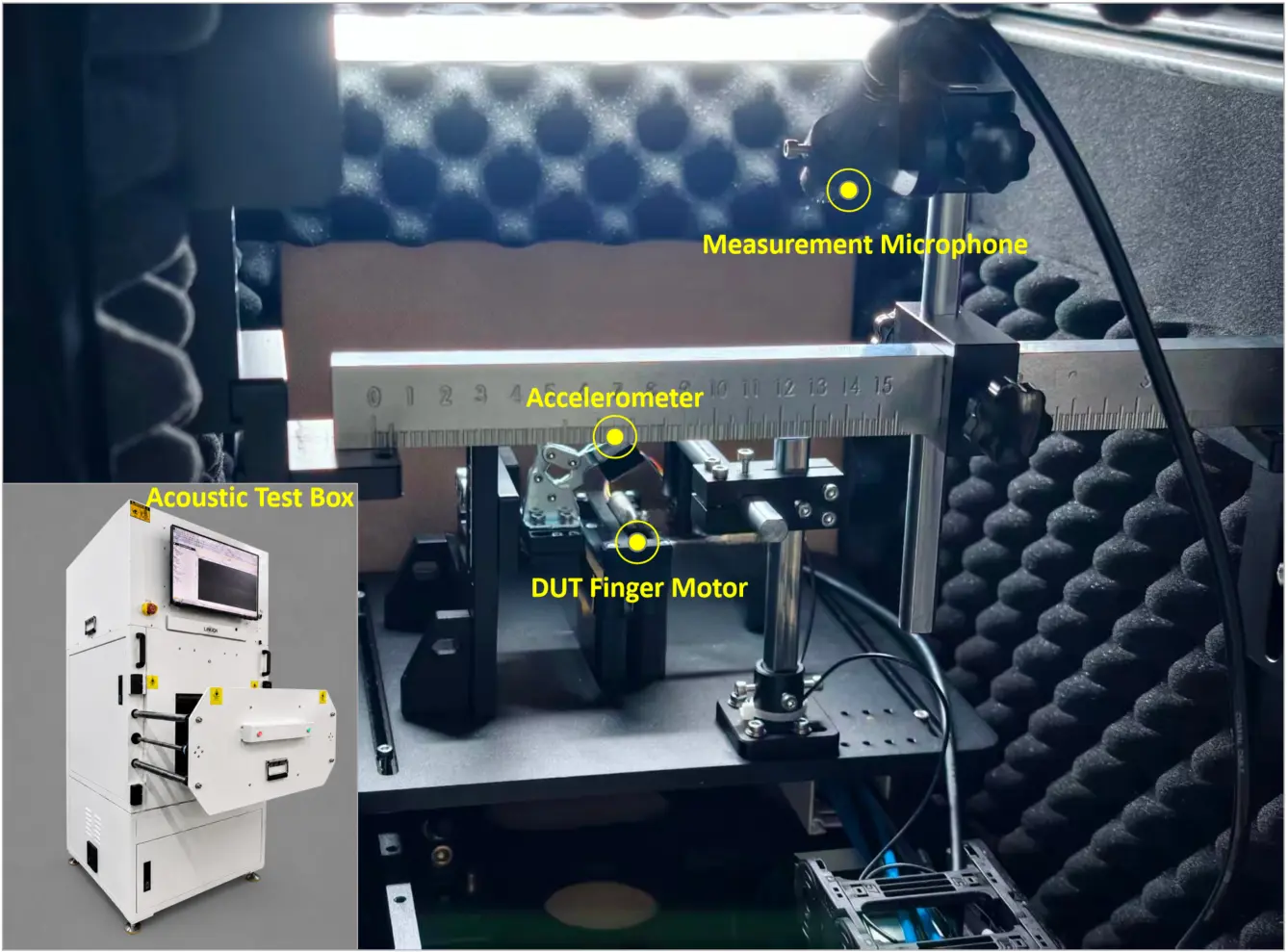
- Machine-based inspection replaces manual listening: The system quantitatively evaluates anomalous sound signatures from miniature finger motors, eliminating subjective hearing bias and establishing unified, traceable QC criteria.
- Dual-channel acquisition: Accelerometers and measurement microphones synchronously capture vibration and acoustic data, completing multidimensional analysis in a single fixturing cycle.
- Integrated vertical acoustic-test-box design: Built-in operation screen and door mechanism allow direct production-line embedding without a separate acoustic environment, reducing site modification cost.
- One-button workflow: Load product, close door, run automatic test, receive result. Each station eliminates one to two permanent QC headcount.
- MES integration and traceability: Test data is pushed to the quality-management platform in real time, supporting the customer's quality-control workflow.
Reducer Module Anomalous Sound EoL Testing for Quadruped Robots - Customer Value
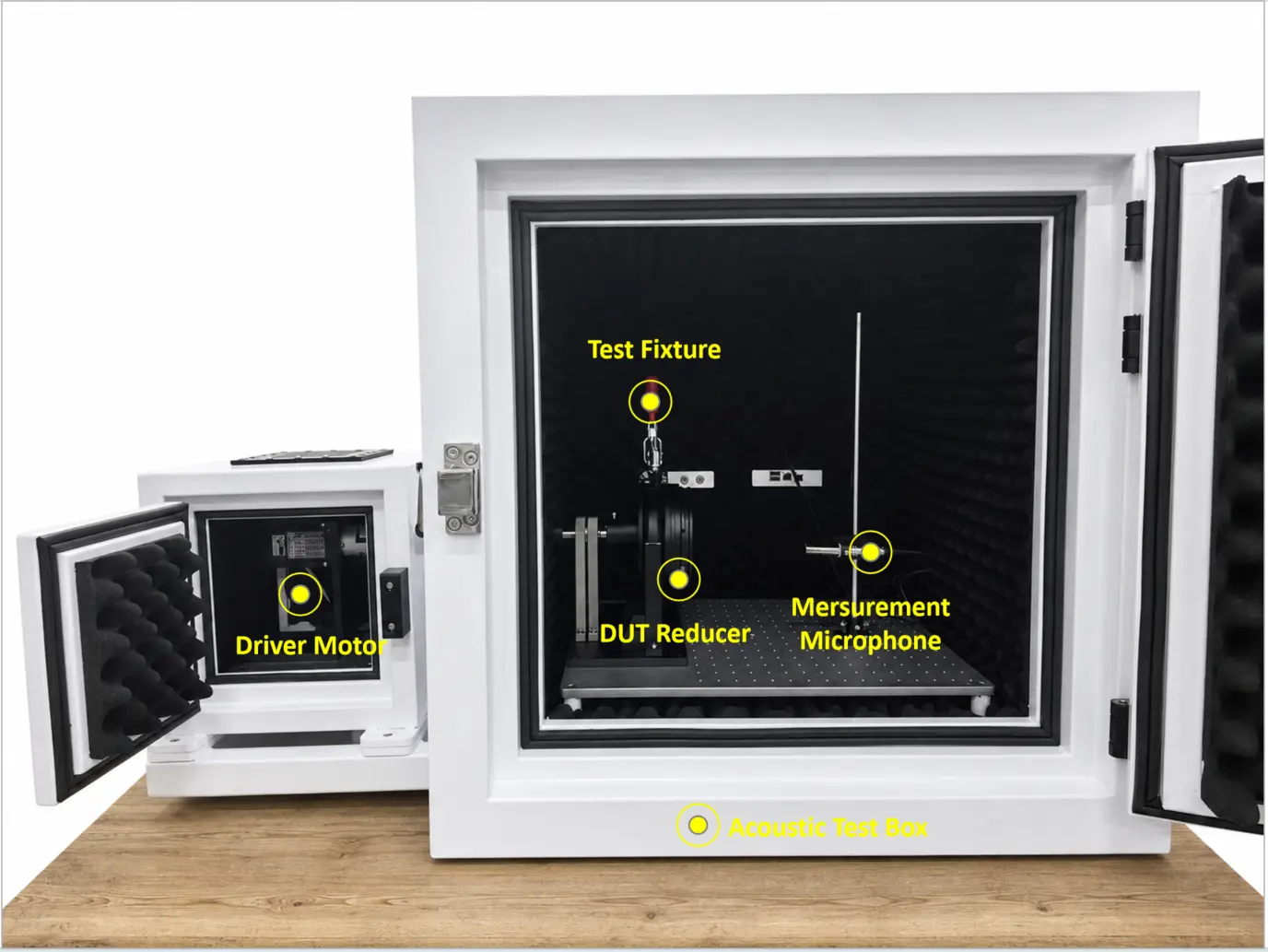
- Replacing subjective judgment: Measurement microphones acquire reducer operating noise for quantitative analysis, creating unified judgment criteria for precision robot-joint QC.
- Acoustically isolated test environment: An enclosure with internal sound-absorbing foam effectively attenuates ambient factory noise, enabling capture of weak anomalous sound signals from low-noise reducers.
- Modular fixture design: Loading and test fixtures adapt quickly to different joint-reducer specifications, minimizing redundant equipment investment across product variants.
- Complete acoustic data archive: Every product receives a full acoustic record, helping satisfy quality-audit requirements and improve production-line standardization.
Why CRYSOUND
- 30 years of acoustic expertise: Since 1996, CRYSOUND has focused on acoustic testing, building deep technical capability and broad industry experience.
- Full-stack in-house R&D: Measurement microphones, accelerometers, data-acquisition hardware, Acoustic Test Chambers and test software - all developed in-house for system compatibility and long-term reliability.
- Leading AI algorithms: Proprietary transient anomalous sound detection and unsupervised deep learning address multi-source coupling and ultra-weak noise that conventional Leq/FFT methods cannot handle.
- Industry-leading miss rate: AI-driven judgment reduces the miss rate to below 0.1%, far below the 3-5% typical of manual listening.
- Production-line proven: Deployed across multiple mass-production scenarios including coreless motors and joint modules, with coverage extending to automotive electronics and smart appliances.
Frequently Asked Questions (FAQ)
Q: What types of anomalous sound can this solution detect?
A: Reducer gear-meshing impact, motor whine, bearing abnormalities, encoder friction, transient start-stop noise and more. The system uses multi-algorithm fusion - FFT, transient analysis, SQA and AI - for comprehensive coverage.
Q: Can the test takt time meet mass-production requirements?
A: The solution provides a standardized process with automated Acoustic Test Chambers and parallel multi-process testing. The test flow is customized by device type to minimize cycle time and maximize UPH.
Q: How much training data does the AI model need?
A: The system uses unsupervised deep learning - no large labeled defect dataset required. With as few as 100 good-unit samples, online learning continuously improves accuracy, and new product batches adapt quickly.
Q: How can this solution be integrated into an existing production line?
A: The solution is delivered as an integrated standalone workstation - Acoustic Test Chamber, acquisition system and software. Fixtures are customized to match existing line interfaces, and the software natively supports MES integration, shortening the integration cycle.
Q: Can the Acoustic Test Chamber withstand factory ambient noise?
A: Acoustic Test Chamber background noise ≤20 dB(A) under external noise ≤80 dB(A), with sound insulation >60 dB. This effectively attenuates ambient factory noise, preserving measurement accuracy.
Q: How long does deployment typically take?
A: Standard solutions: 3-6 weeks from requirement confirmation to line launch, including fixture customization, software debugging and on-site commissioning. Custom solutions: schedule confirmed during early evaluation.
Q: How is long-term test accuracy maintained?
A: The system supports periodic spot checks and regular calibration with the CRY3016 sound calibrator. With MTBF >20,000 hours, it supports 24×7 continuous operation. Test accuracy of ±0.05 dB far exceeds human auditory precision.
Solution Consultation
Need a reliable Anomalous Sound EoL Testing solution for your robot actuators? CRYSOUND can recommend a test configuration based on your product architecture, takt time, and production-line requirements. To discuss your application, please complete the Get in touch form below.


