Acoustic cameras turn invisible sound into visible images. This guide explains how they work, where they're used, and how to choose the right one for your application.
What Is an Acoustic Camera?
An acoustic camera is a device that locates and visualizes sound sources in real time. It combines a microphone array — typically 64 to 200+ MEMS microphones arranged in a specific pattern — with a video camera and signal processing software. The result is a color-coded overlay on a live video feed, showing exactly where sound is coming from and how loud it is.
Think of it as a thermal camera, but for sound instead of heat. Where a thermal camera shows hot spots in red, an acoustic camera shows loud spots — pinpointing the exact location of a leak, a faulty bearing, or an electrical discharge that you can't see with your eyes.
The technology was originally developed for aerospace and automotive NVH (Noise, Vibration, and Harshness) testing. Today, it has expanded into industrial maintenance, energy utilities, manufacturing quality control, and building acoustics.
How Does an Acoustic Camera Work?
The Microphone Array
At the core of every acoustic camera is a microphone array — a precisely arranged set of MEMS (Micro-Electro-Mechanical Systems) microphones. The number of microphones directly affects performance:
- 64 microphones: Entry-level, suitable for general-purpose sound source localization
- 128 microphones: Professional-grade, better resolution and dynamic range
- 200+ microphones: High-end, capable of detecting subtle sources in noisy environments
The spatial arrangement of these microphones matters as much as the count. Common configurations include circular, spiral (Fibonacci), and grid patterns. Each has trade-offs: spiral arrays offer good broadband performance, while grid arrays are better for near-field measurements.
Beamforming: The Core Algorithm
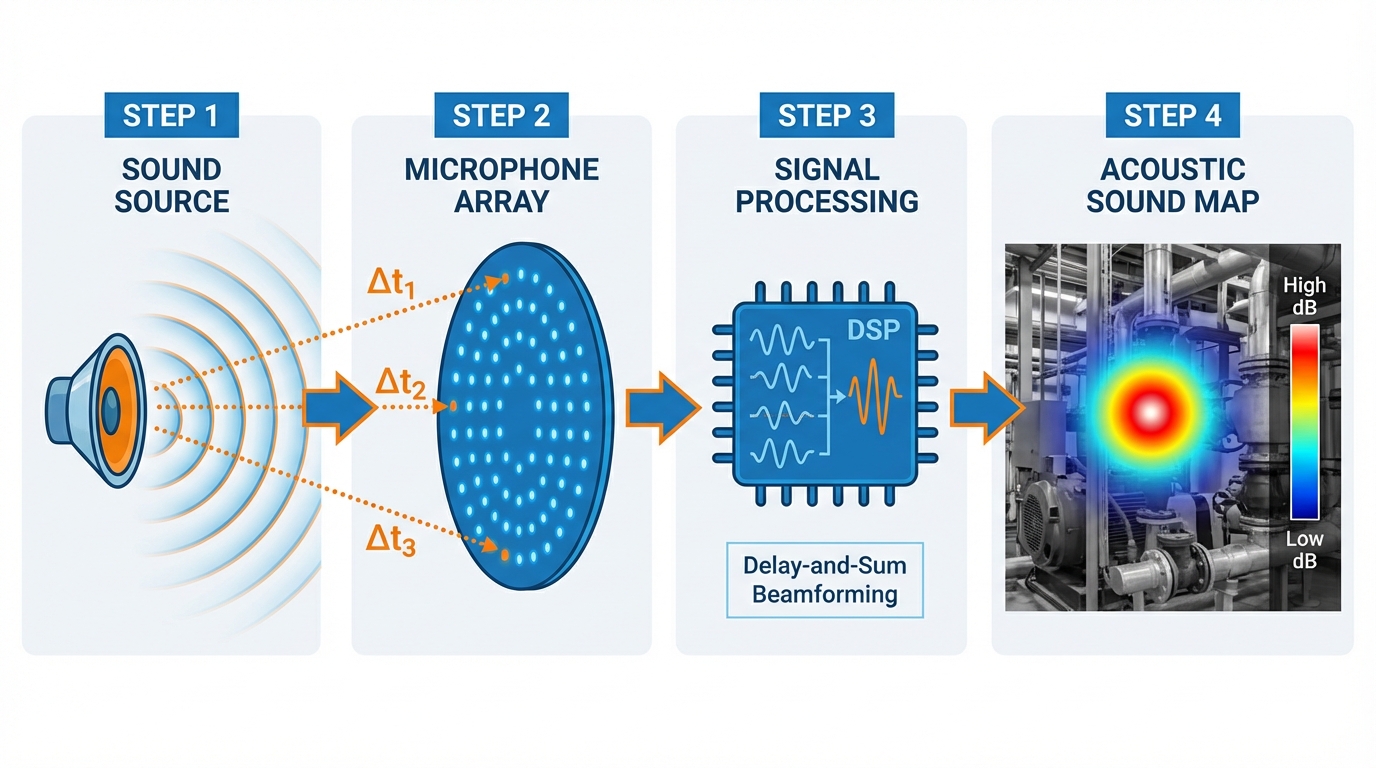
The key technology behind acoustic cameras is beamforming — a signal processing technique that combines signals from multiple microphones to "focus" on specific locations in space.
Here's a simplified explanation:
- A sound wave arrives at each microphone at slightly different times (because each microphone is at a different distance from the source)
- The software calculates the expected time delay for every possible source location in the field of view
- For each candidate location, it shifts and sums the microphone signals according to the calculated delays
- Locations where the shifted signals add up constructively are identified as sound sources
This process is repeated for every pixel in the image, producing a "sound map" that shows the spatial distribution of sound energy.
Beamforming vs. Acoustic Holography
There are two main acoustic imaging technologies:
| Feature | Beamforming | Acoustic Holography (NAH) |
|---|---|---|
| Best frequency range | Mid to high frequencies (>500 Hz) | Low frequencies (<2 kHz) |
| Measurement distance | Far-field (>1 meter) | Near-field (<30 cm from source) |
| Resolution | Limited by wavelength and array size | Higher resolution at low frequencies |
| Speed | Real-time capable | Requires careful scanning |
| Best for | Leak detection, general noise mapping | Engine NVH, vibration analysis |
Most modern acoustic cameras use beamforming as the primary method because it works in real time and doesn't require the camera to be positioned close to the source. Some advanced systems support both technologies for maximum flexibility.
The Role of the Video Camera
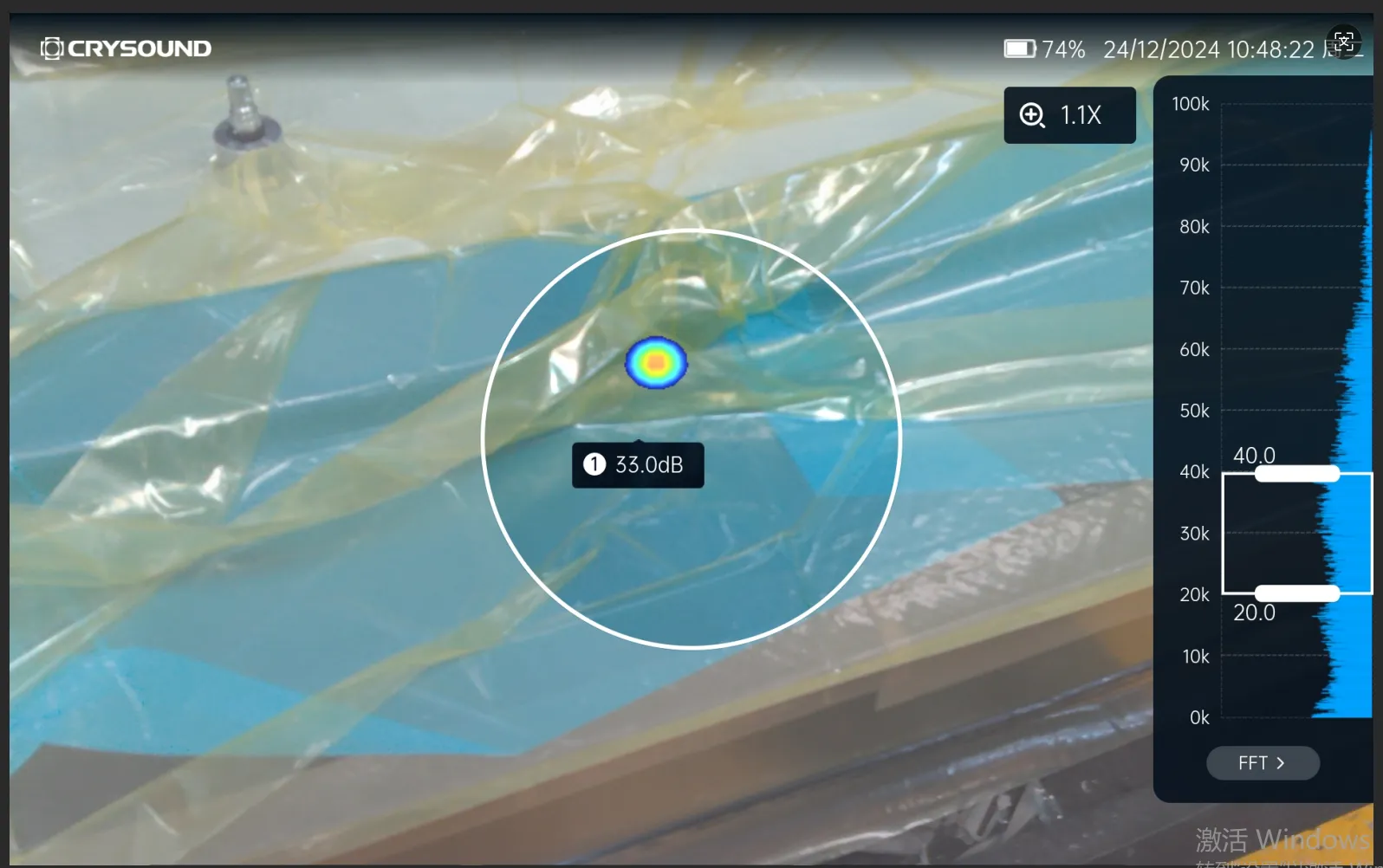
The microphone array generates a sound map; the video camera provides the visual reference. The software overlays the sound map onto the video feed as a color-coded heat map, allowing the user to instantly see which component, pipe, or connection is producing the sound.
High-end systems use depth cameras (such as Intel RealSense) to create 3D acoustic maps, enabling more accurate source localization on complex geometry.
Frequency Range: Why It Matters
Different applications require different frequency ranges:
| Application | Typical Frequency Range | Why |
|---|---|---|
| Compressed air leak detection | 20–50 kHz | Leaks produce high-frequency hissing |
| Partial discharge detection | 20–100 kHz | Electrical discharges emit ultrasonic signals |
| Mechanical fault detection | 1–20 kHz | Bearing wear, misalignment produce audible noise |
| Automotive NVH | 100 Hz–10 kHz | Road noise, wind noise, engine noise |
| Building acoustics | 50 Hz–8 kHz | Low-frequency structure-borne noise |
An acoustic camera with a frequency range of up to 100 kHz can handle virtually all industrial applications, including ultrasonic leak and partial discharge detection. Cameras limited to 20 kHz are suitable only for audible noise analysis.
Key Applications
1. Compressed Air Leak Detection
Compressed air is one of the most expensive energy sources in a factory. Studies show that 20–30% of compressed air is lost to leaks. An acoustic camera can scan an entire production line in minutes, identifying leaks that are invisible and inaudible to human ears.
Why acoustic cameras beat traditional methods:
- Ultrasonic leak detectors require you to check one point at a time; an acoustic camera scans an entire area at once
- Visual overlay pinpoints the exact location — no guessing
- Many systems can estimate leak rate and annual cost, helping you prioritize repairs
2. Electrical Partial Discharge Detection
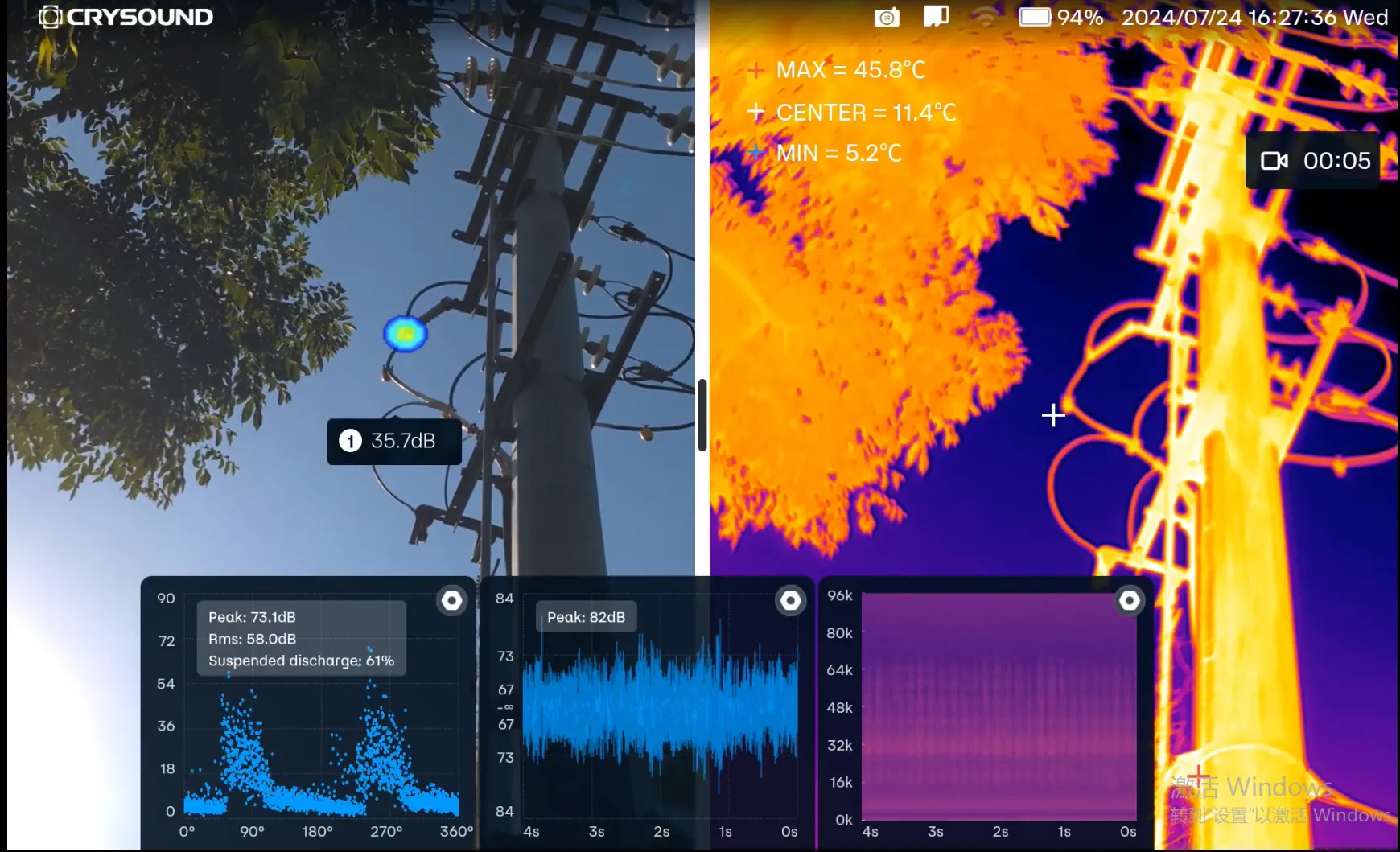
Partial discharge (PD) is an early warning sign of insulation failure in high-voltage equipment — transformers, switchgear, cables, and bus bars. Left undetected, PD leads to complete insulation breakdown and potentially catastrophic failure.
Acoustic cameras detect PD by capturing the ultrasonic emissions (typically 20–100 kHz) that accompany electrical discharge. The advantage over traditional PD detection methods:
- Non-contact: No need to de-energize equipment
- Real-time visualization: See exactly where the discharge is occurring
- Safe distance: Inspect live equipment from several meters away
3. Mechanical Fault Diagnosis
Worn bearings, misaligned shafts, loose components, and valve leaks all produce characteristic sound signatures. An acoustic camera can identify and locate these faults before they lead to unplanned downtime.
Common use cases:
- Motor and pump bearing wear detection
- Steam trap malfunction
- Valve leak identification
- Gearbox noise analysis
4. Automotive and Aerospace NVH Testing
This is where acoustic cameras originated. NVH engineers use them to:
- Identify wind noise sources on vehicle bodies
- Locate rattles and squeaks in interior trim
- Analyze tire/road noise contributions
- Map engine noise radiation patterns
- Validate sound package effectiveness
For NVH applications, large-aperture arrays (200+ microphones) provide the resolution needed to distinguish closely spaced sources.
5. Noise Compliance and Building Acoustics
Environmental noise regulations require manufacturers to identify and reduce noise emissions. Acoustic cameras help:
- Map factory noise sources for compliance reporting
- Identify noise paths in buildings (walls, windows, HVAC)
- Verify effectiveness of noise barriers and enclosures
6. UAV-Mounted Acoustic Inspection
A newer application: mounting acoustic cameras on drones for inspection of hard-to-reach infrastructure. Applications include:
- Power line and substation inspection
- Wind turbine blade inspection
- Pipeline corridor leak surveys
- Tall structure noise mapping
Types of Acoustic Cameras
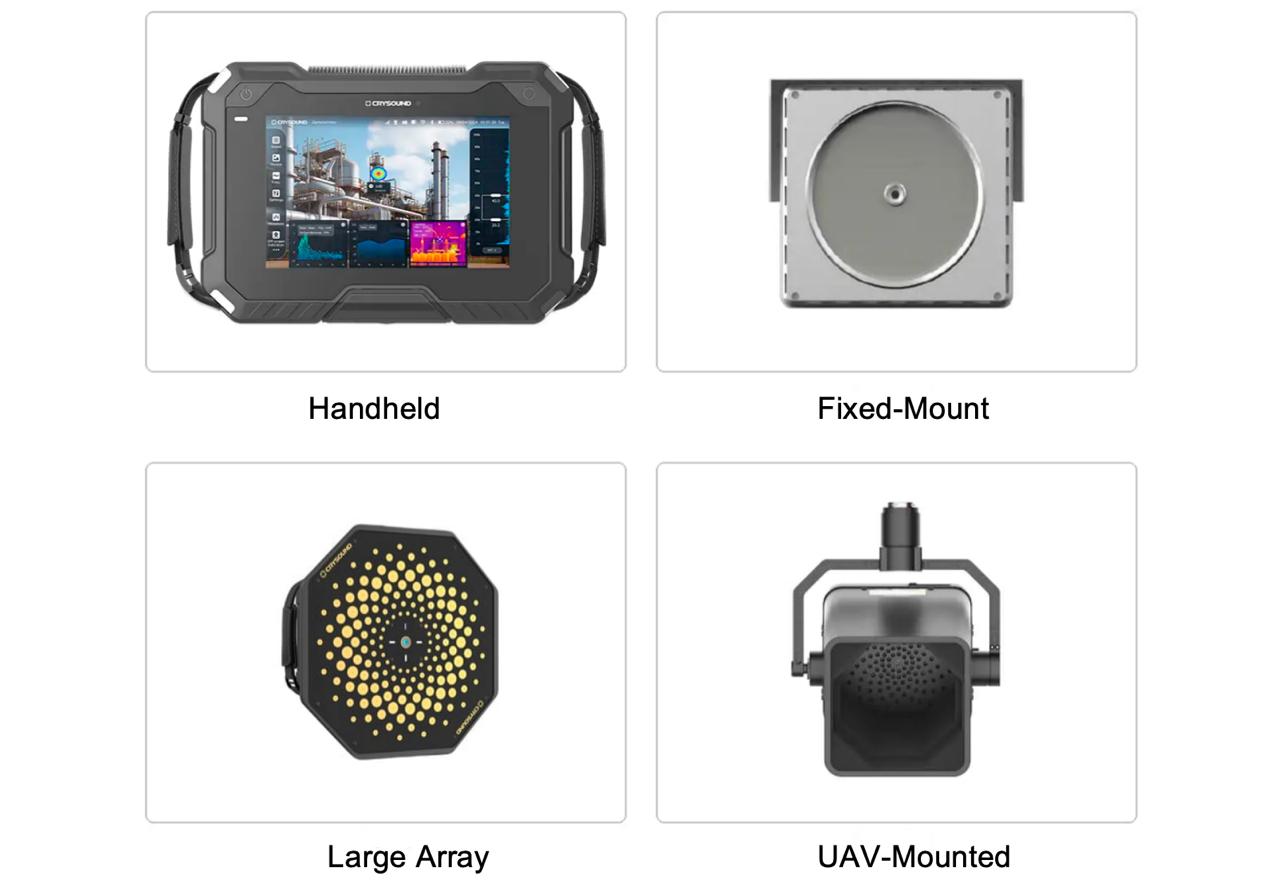
Handheld Acoustic Cameras
Portable, battery-powered devices for field use. Typically 64–128 microphones with a built-in display. Best for maintenance rounds, leak detection, and quick inspections.
Pros: Portable, easy to use, quick deployment
Cons: Limited microphone count, smaller array = lower resolution at distance
Fixed/Mounted Acoustic Cameras
Permanently installed for continuous monitoring. Used in power substations, data centers, and critical infrastructure. Can run 24/7 with automated alerts.
Pros: Continuous monitoring, automated alerting, no operator needed
Cons: Fixed field of view, higher installation cost
Large-Array Systems
200+ microphones on a larger frame. Used for NVH testing, pass-by noise measurement, and research applications. Often mounted on tripods or overhead structures.
Pros: Highest resolution, widest frequency range, best for complex analysis
Cons: Not portable, requires setup, higher cost
UAV-Mounted Systems
Lightweight acoustic arrays designed for drone mounting. Used for remote inspection of power lines, pipelines, and industrial facilities.
Pros: Access to hard-to-reach locations, large-area surveys
Cons: Flight time limits, vibration interference, regulatory requirements
How to Choose the Right Acoustic Camera
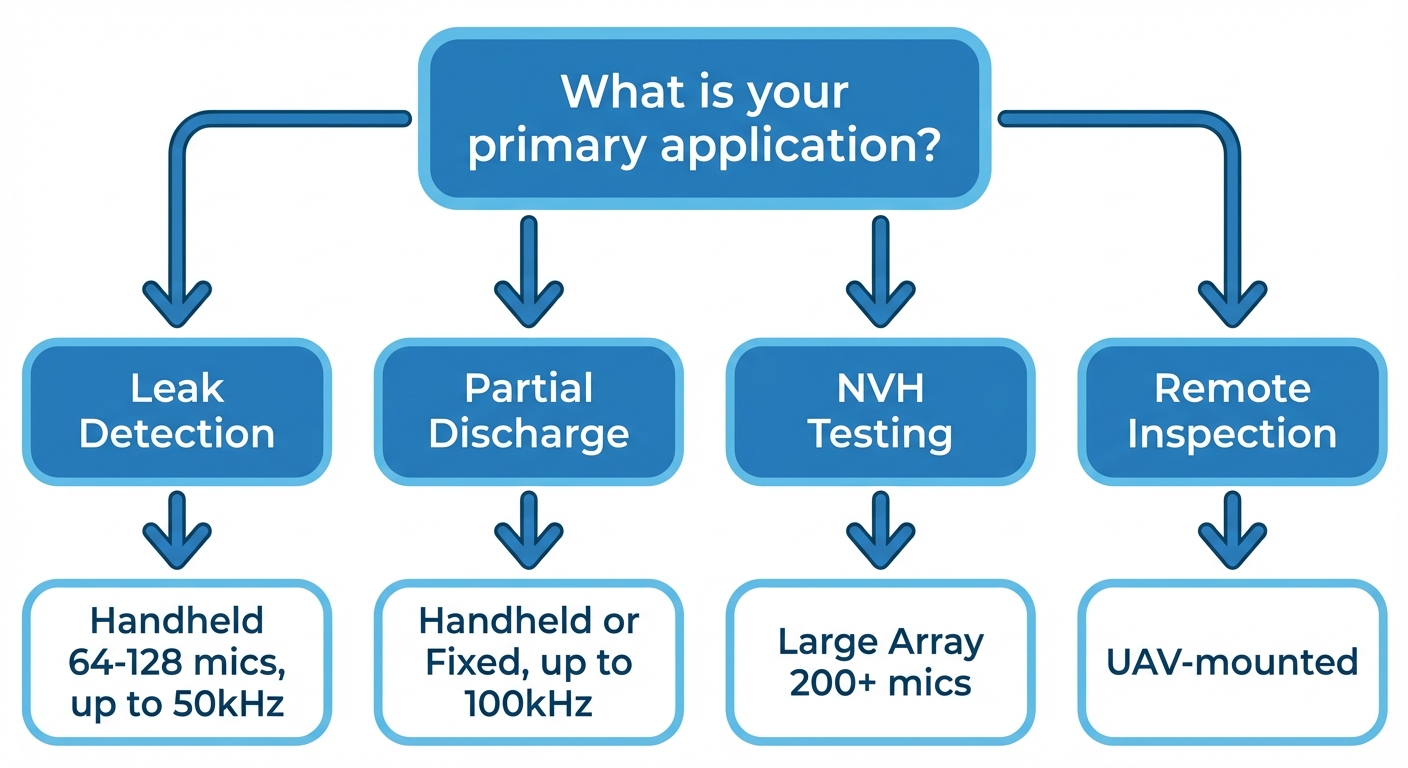
Step 1: Define Your Primary Application
Your application determines the minimum specifications:
| Application | Min. Microphones | Frequency Range | Form Factor |
|---|---|---|---|
| Compressed air leak detection | 64 | Up to 50 kHz | Handheld |
| Partial discharge detection | 64–128 | Up to 100 kHz | Handheld or fixed |
| Mechanical fault diagnosis | 64 | Up to 20 kHz | Handheld |
| NVH testing | 128–200+ | 100 Hz–20 kHz | Large array |
| Continuous monitoring | 64–128 | Application-dependent | Fixed |
| Drone inspection | 64–128 | Up to 50 kHz | UAV-mounted |
Step 2: Consider the Environment
- Noisy factory floor? You need more microphones and advanced algorithms to separate the target signal from background noise
- Outdoor use? Look for weather-resistant designs and wind noise rejection
- Hazardous area? Check for ATEX/IECEx certification
- Large distance? More microphones = better resolution at range
Step 3: Evaluate the Software
The hardware captures the data; the software turns it into actionable information. Key software features to look for:
- Real-time display: See the sound map live as you scan
- Frequency filtering: Isolate specific frequency bands to focus on particular issues
- Leak rate estimation: Quantify the cost of leaks in dollars or energy units
- Reporting: Generate professional reports with screenshots, measurements, and recommendations
- AI-assisted detection: Automatic identification of leak patterns and fault signatures
Step 4: Compare Specifications
Key specs to compare across manufacturers:
| Specification | What It Means | What to Look For |
|---|---|---|
| Microphone count | More mics = better resolution and sensitivity | 64 minimum; 128+ for demanding applications |
| Frequency range | Determines what you can detect | Up to 100 kHz for PD and ultrasonic leaks |
| Dynamic range | Ability to measure both quiet and loud sources | >70 dB for industrial environments |
| Angular resolution | Ability to separate nearby sources | Smaller is better; depends on frequency and distance |
| Frame rate | How quickly the sound map updates | >10 fps for real-time scanning |
| Weight and size | Portability | <2 kg for handheld daily-use devices |
| Battery life | Runtime for field use | >3 hours for a full shift of inspections |
| IP rating | Dust and water resistance | IP54 or higher for industrial environments |
CRYSOUND Acoustic Camera Solutions
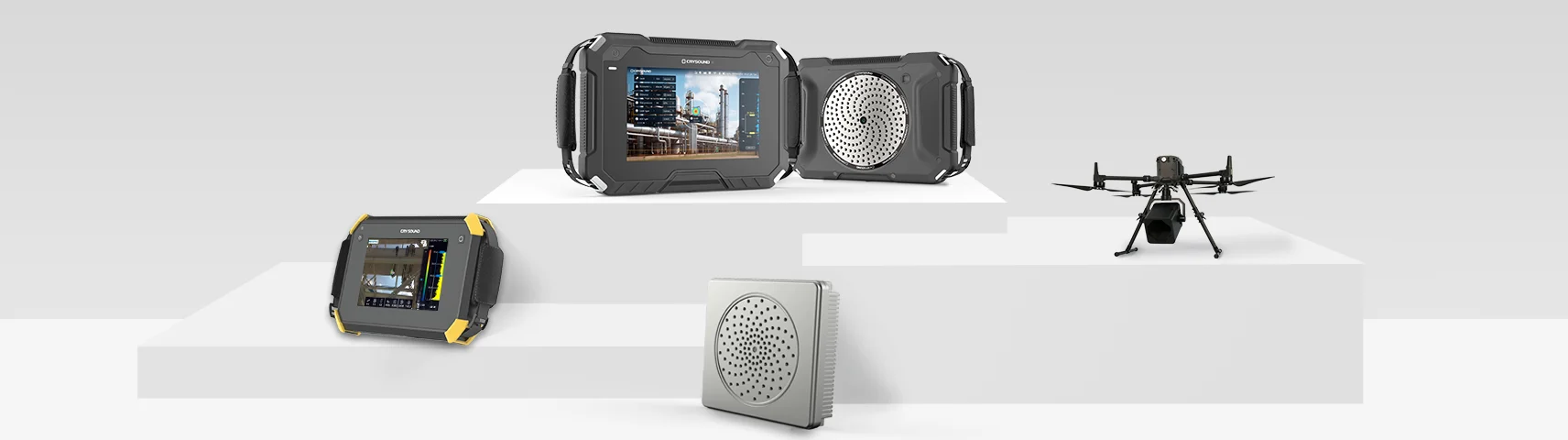
CRYSOUND offers one of the widest product lines in the acoustic camera market — covering handheld, fixed-mount, large-array, and UAV-mounted form factors from a single manufacturer.
Product Lineup
- CRY2624: 128-microphone handheld acoustic camera with ATEX certification — portable, field-ready, and safe for hazardous environments
- CRY8124: 200 MEMS microphones, frequency range up to 100 kHz — handles both audible noise analysis and ultrasonic applications (leak detection + partial discharge) in a single device
- CRY2623M: Fixed-mount version for 24/7 continuous monitoring of substations and critical infrastructure
- CRY8500 Series (SonoCAM Pi): Large spiral microphone array for NVH testing, pass-by noise measurement, and advanced acoustic research
- CRY2626G: Drone-mounted acoustic camera for remote inspection of power lines, pipelines, and wind turbines
Key Differentiator 1: Modular Sensor Expansion
Unlike most competitors that offer a fixed-function device, CRYSOUND's acoustic cameras support external sensor modules for expanded capabilities:
- Infrared thermal imaging module: Combines acoustic and thermal data in a single view — when inspecting power equipment, engineers can simultaneously see the acoustic signature of partial discharge and the thermal hot spot of overheating components. This dual-mode inspection is widely used in power utilities for comprehensive substation diagnostics.
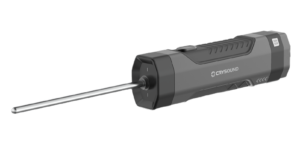
- IA3104 Contact Ultrasound Sensor: An external contact-type ultrasonic probe designed specifically for valve internal leak detection. The sensor couples directly to the metal surface of a valve, capturing high-frequency ultrasonic signals generated by internal leakage. Combined with intelligent analytics and guided workflows, it automates the full diagnostic process — from data acquisition to leak classification. This is critical for preventive maintenance of oil pipeline valves and natural gas network valves.
This modular approach means a single CRYSOUND acoustic camera can serve as a comprehensive inspection platform, rather than requiring separate instruments for each detection task.
Key Differentiator 2: Acoustic Link Mobile App
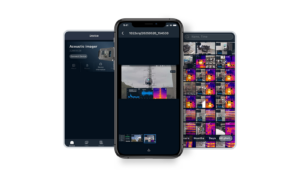
CRYSOUND's Acoustic Link is a companion mobile app that connects to the acoustic camera via Wi-Fi. It enables:
- On-device preview: View captured photos, videos, and inspection reports on your phone or tablet — no PC required
- Defect-specific visualization: Retrieve gas-leak acoustic maps, partial-discharge patterns, and thermal images directly in the app
- One-tap sharing: Save results locally and share via the system share sheet for instant communication with colleagues and customers
- Automated report generation: Generate and export professional inspection reports from the field, eliminating the need to return to the office for post-processing
For field inspection teams, this means faster turnaround from detection to documentation.
Key Differentiator 3: Complete Acoustic Ecosystem
Beyond acoustic cameras, CRYSOUND manufactures electroacoustic test systems (CRY6151B), acoustic test chambers, and calibration equipment — enabling complete acoustic testing solutions from a single vendor. With 28 years of experience and over 10,000 customers across 90+ countries, CRYSOUND brings deep domain expertise to every product.
Frequently Asked Questions
What is the difference between an acoustic camera and a sound level meter?
A sound level meter measures the overall sound pressure level at a single point. It tells you how loud it is, but not where the sound comes from. An acoustic camera shows both the location and the intensity of sound sources, making it far more useful for diagnosing and fixing noise problems.
How far away can an acoustic camera detect a leak?
Detection range depends on the leak size, background noise, microphone count, and frequency range. A typical handheld acoustic camera with 64–128 microphones can detect a 1mm compressed air leak from 10–30 meters away. Larger leaks can be detected from even greater distances.
Can an acoustic camera work in a noisy factory?
Yes. Modern acoustic cameras use beamforming algorithms that can isolate specific sound sources even in high-background-noise environments. The key is having enough microphones — more microphones provide better noise rejection and higher signal-to-noise ratio.
Do I need training to use an acoustic camera?
Basic operation is straightforward — point the camera, look at the screen, and identify the highlighted areas. Most users can start finding leaks within minutes. However, interpreting complex acoustic patterns (NVH analysis, partial discharge classification) benefits from training and experience.
What is the ROI of an acoustic camera?
For compressed air leak detection alone, the ROI is typically measured in months. A single quarter-inch air leak costs $2,500–$8,000 per year. Most industrial facilities have dozens to hundreds of leaks. An acoustic camera that helps you find and fix these leaks can pay for itself in the first survey.
Can acoustic cameras detect gas leaks other than compressed air?
Yes. Acoustic cameras can detect any pressurized gas leak that produces turbulent flow noise — including nitrogen, oxygen, hydrogen, natural gas, and refrigerants. The frequency characteristics may vary by gas type, but the detection principle is the same.
Need help choosing the right acoustic camera for your application? Contact CRYSOUND for a personalized recommendation based on your specific requirements.
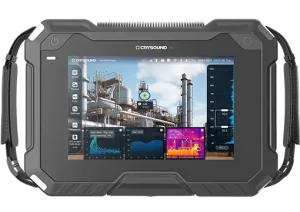
CRY8124 Advanced Acoustic Imaging Camera

CRY8125 Advanced Ex Acoustic Imaging Camera
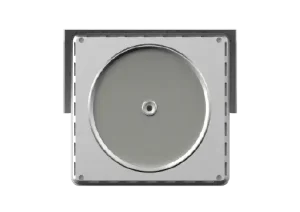
CRY2623M Fixed Acoustic Imaging Camera
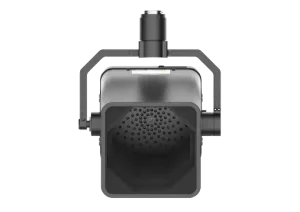
CRY2626G Drone-Mounted Acoustic Imaging Camera
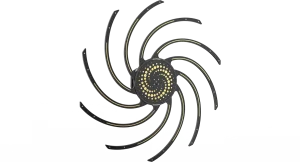
CRY8500 Series SonoCam Pi Acoustic Camera