1. Home
  2. Blogs
  3. How It Delivers Nanosecond-Level DAQ Synchronization

December 12, 2025

How It Delivers Nanosecond-Level DAQ Synchronization

In audio and NVH testing, keeping signals aligned in time is often harder than increasing channel count or resolution.

With a single chassis, synchronizing several dozen or even a hundred channels is no longer a big challenge. What really hurts is when multiple acquisition chassis are distributed across different locations and connected over a network, yet are still expected to maintain nanosecond-level—or at least sub-microsecond-level— synchronization. Otherwise, high-level analyses such as in-vehicle sound field reconstruction, array beamforming and localization, or structural modal testing will all suffer from misaligned time axes.

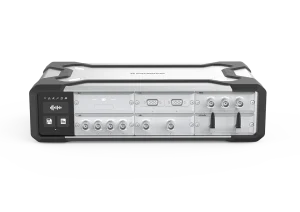
One of SonoDAQ’s core design goals is to make this kind of multi-device synchronization feel effortless: plug in the network cable and let the system take care of the rest, so that many units behave like a single instrument. The key enabler behind this is a carefully engineered timing architecture built around PTP and GPS.

Why Is Multi-Device Synchronization So Difficult?

In traditional architectures, multi-device sync is typically handled in a few ways:

  • Relying on the operating system clock plus software alignment
  • Using one device to output a clock or trigger and configuring all other devices as slaves
  • Applying a simple network time protocol such as NTP

These techniques are barely acceptable when synchronization requirements are on the order of tens of milliseconds or a few milliseconds. But when you push into the microsecond or even nanosecond domain, several fundamental problems appear:

  • Uncontrolled OS jitter: task scheduling, caching, and driver latency all make the apparent system time wander.
  • Network latency and jitter: different paths and switches introduce variable delays that are hard to fully compensate in software alone.
  • Long-term drift: even if devices are roughly aligned at startup, any small frequency error in the local oscillators will cause their time bases to slowly diverge over tens of minutes or hours.

SonoDAQ’s approach is to anchor every time-critical action to a common hardware time base, rather than relying on the operating system’s notion of time.

From Network Time to Hardware Time: PTP + PHC

The first step is to make sure every SonoDAQ unit shares the same absolute time.

(1) PTP / GPS as the upstream clock

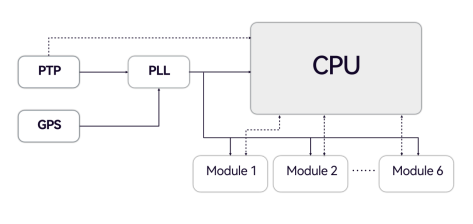
SonoDAQ can take a unified UTC reference either from IEEE 1588 PTP on the network or from an external GPS receiver. This reference is first fed into the on-board PTP Hardware Clock (PHC) as the local time base. In other words, PTP/GPS provides the world standard time, while the PHC is a local copy of that world time inside each acquisition chassis.

(2) Closed-loop correction every 1/128 s

A one-time alignment at startup is not enough. SonoDAQ continuously compares each local PHC against the reference clock at a period of 1/128 s:

  • It evaluates both phase and frequency error at the current instant.
  • It applies small, incremental corrections to the PHC, avoiding large jumps;
  • Over long operating times, this closed loop continuously suppresses errors caused by crystal temperature drift and aging.

As a result, every SonoDAQ’s PHC closely tracks the PTP/GPS reference and does not quietly drift away over time. At this point, all devices have been brought onto the same nanosecond-grade hardware time base — this is the absolute timing foundation for all subsequent synchronization mechanisms.

PLL + 10 PPS: Bringing the Unified Time into Every FPGA

Once a common PHC is established, we still need to convert it into a tangible hardware signal that every FPGA can feel.

From PHC / 1 PPS to 10 PPS

PTP / GPS usually provides a 1 PPS (one pulse per second) signal. On SonoDAQ this 1 PPS is reshaped and multiplied by an on-board PLL to generate a stable 10 PPS pulse, which is then distributed to each FPGA.
Nanosecond Across Mulit Chassis: Benefits of a Unified Time Base

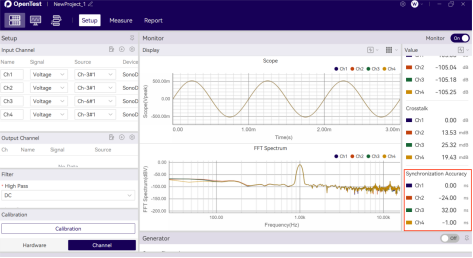
With this multi-layer timing architecture, SonoDAQ can provide nanosecond-scale alignment within a single chassis and sub-microsecond-level alignment across multiple chassis when deployed with an appropriate PTP/GPS reference and network topology.

For test engineers, these details ultimately translate into very tangible capabilities:

  • Full-vehicle NVH testing: in-vehicle and exterior microphones and vibration sensors can be acquired in sync along with speed, torque, and shaft angle signals, enabling more reliable order analysis and transfer-path analysis.
  • Multi-point structural modal testing: multiple chassis distributed across a large structure can capture excitation and responses with precise timing relationships, making high-order modal extraction and damping estimation more robust.
  • End-to-end delay measurements: a unified time stamp allows you to measure the true latency from stimulus output to response input, which helps tune and compensate complex audio signal chains.
Engineering Experience: A Transparent High-Precision Timing System

Although we have just walked through quite a bit of PTP, PHC, and 10 PPS plumbing, in practice engineers do not need to worry about any of this — SonoDAQ takes care of it automatically.

When you drag data from multiple SonoDAQ units onto the same plot in the software, what you see is already a single, seamlessly aligned time axis. That is exactly what we mean by nanosecond-level synchronization for practical data acquisition.

This is the original design intent behind SonoDAQ: to push the timing infrastructure to the limit, so that engineers can focus entirely on test strategies and data analysis.

To learn more about CRYSOUND SonoDAQ and OpenTest, please visit the CRYSOUND website or contact our team via the “Get in touch” form.
Get in touch

Are you seeking more information about CRYSOUND’s solutions or need a demo? Contact us via the form bleow and one of our sales or support engineers will connect with you.

Read more

ISO 3744 Sound Power Testing with OpenTest

Under regulations such as the EU Machinery Noise Directive, more and more products—from toys and power tools to IT equipment—are required to declare their sound power level on labels and in documentation, rather than simply claiming they are “quiet enough.”

For typical office devices like notebook computers, idle noise is often around 30 dB(A), while full-load operation can approach 40 dB(A). These figures are usually obtained from sound power measurements performed in accordance with ISO 3744 and related standards.

Sound Pressure vs. Sound Power

A noise source emits sound power, while what we measure with a microphone is sound pressure.

Sound pressure varies with room size, reverberation, and microphone distance, whereas sound power is the source’s own “noise energy” and does not change with installation or environment. That makes sound power a better metric for external product noise specification.

In simple terms:

  • Sound power is the cause – the energy emitted by the source (unit: W / dB);
  • Sound pressure is the effect – the sound pressure level we hear and measure (unit: Pa / dB).

ISO 3744 defines how to do this in an “essentially free field over a reflecting plane”: arrange microphones around the source on an enveloping measurement surface, measure the sound pressure levels on that surface, then apply specified corrections and calculations to obtain stable, comparable sound power levels.

Device Under Test: An Everyday Notebook Computer

Assume our DUT is a 17-inch office notebook. The goal is to determine its A-weighted sound power level under different operating conditions (idle, office load, full load), in order to:

  • Compare different cooling designs and fan control strategies;
  • Provide standardized data for product documentation or compliance;
  • Supply baseline data for sound quality engineering (for example, whether the fan noise is annoying).

The test environment is a semi-anechoic room with a reflecting floor. The notebook is placed on the reflective plane, and multiple microphone positions are arranged around it (using a hemispherical frame or a regular grid). Overall, the setup satisfies ISO 3744 requirements for the measurement surface and environment.

Measurement System: SonoDAQ Pro + OpenTest Sound Power Module

On the hardware side, we use SonoDAQ Pro together with measurement microphones, arranged around the notebook according to the standard.

OpenTest connects to SonoDAQ via the openDAQ protocol. In the channel setup interface, you select the channels to be used and configure parameters such as sensitivity and sampling rate.

From Standard to Platform: Why Use OpenTest for Sound Power?

OpenTest is CRYSOUND’s next-generation platform for acoustic and vibration testing. It supports three modes—Measure, Analysis, and Sequence—covering both R&D laboratories and repetitive production testing.

For sound power applications, OpenTest implements a sound-pressure-based solution fully compliant with ISO 3744 (engineering method), and also covering ISO 3745 (precision method) and ISO 3746 (survey method). You can flexibly select the test grade according to the test environment and accuracy requirements. The platform includes dedicated sound power report templates that generate standards-compliant reports directly, avoiding repeated manual work in Excel.

On the hardware side, OpenTest connects to multi-brand DAQ devices via openDAQ, ASIO, WASAPI, and NI-DAQmx, enabling unified management of CRYSOUND SonoDAQ, RME, NI and other systems. From a few channels for verification to large microphone arrays, everything can be handled within a single software platform.

Three Steps: Running a Standardized ISO 3744 Sound Power Workflow

Step 1: Parameter Setup and Environment Preparation

After creating a new project in OpenTest:

  1. In the channel setup view, select the microphone channels to be used and configure sensitivity, sampling rate, frequency weighting, and other parameters.
  2. Switch to Measure > Sound Power and set the measurement parameters:
    • Test method and measurement-surface-related parameters;
    • Microphone position layout;
    • Measurement time;
    • Other parameters corresponding to ISO 3744.

This step effectively turns the standard’s clauses into a reusable OpenTest scenario template.

Step 2: Measure Background Noise First, Then Operating Noise

According to ISO 3744, you must measure sound pressure levels on the same measurement surface with the device switched off and device running, in order to perform background noise corrections.

In OpenTest, this is implemented as two clear operations:

  • Acquire background noise
    Click the background-noise acquisition icon in the toolbar. OpenTest records ambient noise for the preset duration.
    • In the survey method, OpenTest updates LAeq for each channel once per second;In the engineering and precision methods, it updates the LAeq of each 1/3-octave band once per second.
  • Acquire operating noise
    After background acquisition, click the Test icon. OpenTest will:
    a. Record notebook operating noise for the preset duration;
    b. Update real-time sound pressure levels once per second;
    c. Automatically store the run as a data set for later replay and comparison.

Step 3: From Multiple Measurements to One Standardized Report

After completing multiple operating conditions (for example: idle, typical office work, full-load stress):

  • In the data set view, select the records you want to compare and overlay them to observe sound power differences under different conditions;
  • In the Data Selector, click the save icon to export the corresponding waveform files and CSV data tables for further processing or archiving;
  • Click Report in the toolbar, fill in project and device information, select the data sets to include, adjust charts and tables, and export an Excel report with one click.

The report includes measurement conditions, measurement surface, band or A-weighted sound power levels, background corrections, and other key information. It can be used directly for internal review or regulatory/customer submissions, following the same idea as other standardized sound power reporting solutions.

From a Single Notebook Test to a Reusable Sound Power Platform

Running an ISO 3744 sound power test on a notebook is just one example. More importantly:

  • The standardized OpenTest scenario can be cloned for printers, home appliances, power tools, and many other products;
  • Multi-channel microphone arrays and SonoDAQ hardware can be reused across projects within the same platform;
  • The test workflow and report format are “locked in” by the software, making it easier to hand over, review, and audit across teams.

If you are building or upgrading sound power testing capability, consider using ISO 3744 as the backbone and OpenTest as the platform that links environment, acquisition, analysis, and reporting into a repeatable chain—so each test is clearly traceable and more easily transformed from a one-off experiment into a lasting engineering asset.

Visit www.opentest.com to learn more about OpenTest features and hardware solutions, or contact the CRYSOUND team by filling out the “Get in touch” form below.

SonoDAQ for Sound & Vibration Testing

SonoDAQ is the next-generation high-performance data acquisition system, specifically designed for sound and vibration testing. It features a modular architecture, making data acquisition more efficient and precise. From industrial environments to laboratory measurements, SonoDAQ meets the demands of high-precision data acquisition and provides seamless support for multi-channel synchronized data collection.

Modular Design, Flexible to Adapt to Various Applications

SonoDAQ adopts a completely new modular design, allowing for flexible configuration based on different needs. Whether you require a basic 4-channel setup or a large-scale system with hundreds of channels, SonoDAQ can easily accommodate both. You can select modules according to your project requirements and expand the system at any time, avoiding unnecessary costs. This flexibility is particularly well-suited for dynamic and evolving testing environments.

High-Precision Synchronization Ensures the Accuracy of Test Results

In sound and vibration testing, data accuracy is crucial. SonoDAQ is equipped with a 32-bit ADC and a sampling rate of up to 204.8 kHz. It ensures time synchronization between channels with a time error of less than 100 ns through PTP (IEEE 1588) and GPS synchronization. This level of synchronization precision allows you to obtain reliable and consistent data results, even in multi-channel, large-scale distributed acquisition systems.

Flexible System Expansion with Multiple Network Topologies

Another highlight of SonoDAQ is its powerful distributed acquisition capability. With various network connection methods like daisy chain and star topology, multiple devices can be easily integrated into the same acquisition system. Leveraging PTP (Precision Time Protocol) and GPS synchronization technology, SonoDAQ ensures nanosecond-level synchronization, providing data consistency across devices, whether for small-scale laboratory tests or large-scale field data collection. You can choose different system topologies based on your specific needs, offering flexibility for complex testing scenarios.

Innovative Structural Design, the Ideal Choice for Field Applications

SonoDAQ’s frame is made using 5000t aluminum extrusion technology combined with carbon fiber-reinforced plastic, offering exceptional sturdiness while significantly reducing the device’s weight. Additionally, SonoDAQ supports PoE power supply and hot-swappable batteries, ensuring efficient operation even in harsh environments and meeting the demands of long-duration continuous acquisition. Whether in the laboratory or on industrial sites, SonoDAQ delivers stable performance.

Extensive Signal Compatibility, Expanding Your Testing Boundaries

SonoDAQ supports a variety of signal inputs, including IEPE sensors, CAN bus, digital I/O, and other interface protocols. This allows it to meet a wide range of testing needs, from vibration monitoring to motor noise analysis. Whether you’re conducting basic data acquisition or advanced signal analysis, SonoDAQ provides the precision and flexibility you require.

Enhance Testing Efficiency, Making Data Acquisition Simpler

With the accompanying OpenTest software, SonoDAQ allows you to monitor and analyze collected signals in real-time. OpenTest offers an intuitive interface and powerful data analysis features, making it easier to process and present test data. Additionally, SonoDAQ supports open protocols like ASIO and OpenDAQ, facilitating integration with other testing tools or software.

SonoDAQ will help streamline your testing process, improve data acquisition efficiency, and provide precise measurements in various complex testing environments. Whether it’s noise testing, vibration analysis, or complex sound power measurements, SonoDAQ is your ideal choice. Choose SonoDAQ today and bring revolutionary changes to your testing work!

SonoDAQ is ready to transform your testing process — don’t wait to experience its power. Contact us now! Please fill out the ‘Get in touch’ form below, and we’ll get back to you shortly!

SonoDAQ Pro: Flexible Sound and Vibration DAQ System

In sound and vibration testing, flexibility is a decisive factor—especially when test requirements evolve rapidly. SonoDAQ, with its modular, scalable architecture, helps users easily manage everything from simple tests with a single device to complex, large-scale, multi-channel data acquisition. Whether in laboratory environments or industrial sites, SonoDAQ provides efficient, accurate data acquisition solutions, maximizing the adaptability and scalability of the system.

Easy Testing with One Device, Scalable Expansion with Multiple Devices

When testing requirements are modest, such as road tests or basic vibration testing, SonoDAQ Pro can easily meet the required number of channels with a single device. In this case, users only need one device to perform high-precision data acquisition, which is efficient and helps avoid unnecessary upfront hardware investment.

However, as testing needs increase, especially in scenarios that require numerous sensors or synchronized multi-channel acquisition, SonoDAQ offers flexible expansion solutions. Users can connect multiple SonoDAQ Pro units in a daisy-chain or star topology to achieve large-scale data acquisition. For example, when conducting NVH testing or sound and vibration testing for large equipment, users can add more devices as needed, scaling up to hundreds of channels while ensuring high-precision synchronization across all devices.

This scalability allows customers to avoid purchasing entirely new acquisition systems each time. By simply cascading existing SonoDAQ Pro units, they can easily cover more complex testing needs and avoid the common issues of device redundancy and high costs seen in traditional systems.

Flexible Configuration to Meet Various Needs

Even without large-scale acquisition needs, SonoDAQ remains highly flexible. With its modular design, users can easily adjust and reconfigure the system according to changing test requirements. For instance, if only temperature or strain signals are required, users can simply select the corresponding module and insert it into the chassis, without purchasing a new mainframe.

This design makes SonoDAQ suitable for everything from simple laboratory tests to complex field tests. Users can expand the system as needed, without worrying about future expansion limits. Whether it’s basic data acquisition or advanced signal analysis, SonoDAQ provides accurate, flexible data acquisition solutions, significantly enhancing testing efficiency and cost-effectiveness.

Flexibility Brought by Modular Design

The modular design of SonoDAQ is the core of its flexibility. Users can select different input modules, output modules, sensor interface modules, and more based on project requirements, and easily plug-and-play or upgrade them as needed. Whether it’s adding more sensor channels or expanding with new functional modules, users can quickly implement changes by swapping modules, without affecting the normal operation of the existing system. This design ensures long-term device usability and enables SonoDAQ to adapt to ever-changing test requirements.

When future requirements change, such as testing additional signal types (e.g., temperature, pressure, strain), SonoDAQ Pro can easily meet these new testing needs by simply swapping modules, allowing the overall system to continue running efficiently without the need for a full system overhaul.

For example, an automotive manufacturer needs to perform NVH testing. Initially, they may only need 4–8 channels for in-car noise testing. In this case, engineers can use a single SonoDAQ Pro device to complete routine testing tasks. When they need to expand the testing scope and add more sensors (such as measuring vibration, strain, or temperature at different locations), they can simply daisy-chain multiple SonoDAQ Pro devices together. Through synchronization technology, they can ensure data consistency across all devices without redesigning the system or changing existing test procedures.

Beyond automotive NVH, the same scalable architecture can be applied to aerospace components, industrial machinery, and even high-channel-count consumer electronics testing.

Expand as Needed, Effortlessly Tackle Any Testing Challenge

The flexible expansion capability of SonoDAQ allows it to scale from simple single-channel testing to large-scale multi-channel data acquisition. Whether it’s for in-vehicle testing, industrial monitoring, or scientific research, SonoDAQ provides accurate, reliable data acquisition solutions. Its modular design and flexible system topology not only meet current needs but also enable quick adaptation to evolving testing scenarios in the future. Choosing SonoDAQ means moving away from fixed hardware configurations and instead adjusting the system based on needs, ensuring smooth, repeatable execution of every test.

SonoDAQ is ready to transform your testing process—from simple single-device setups to large-scale, multi-channel systems. Contact us now: fill out the “Get in touch” form below, and our team will get back to you shortly.