PIONEER THE NEW SOUNDWAVE
CRYSOUND Global New Product Launch
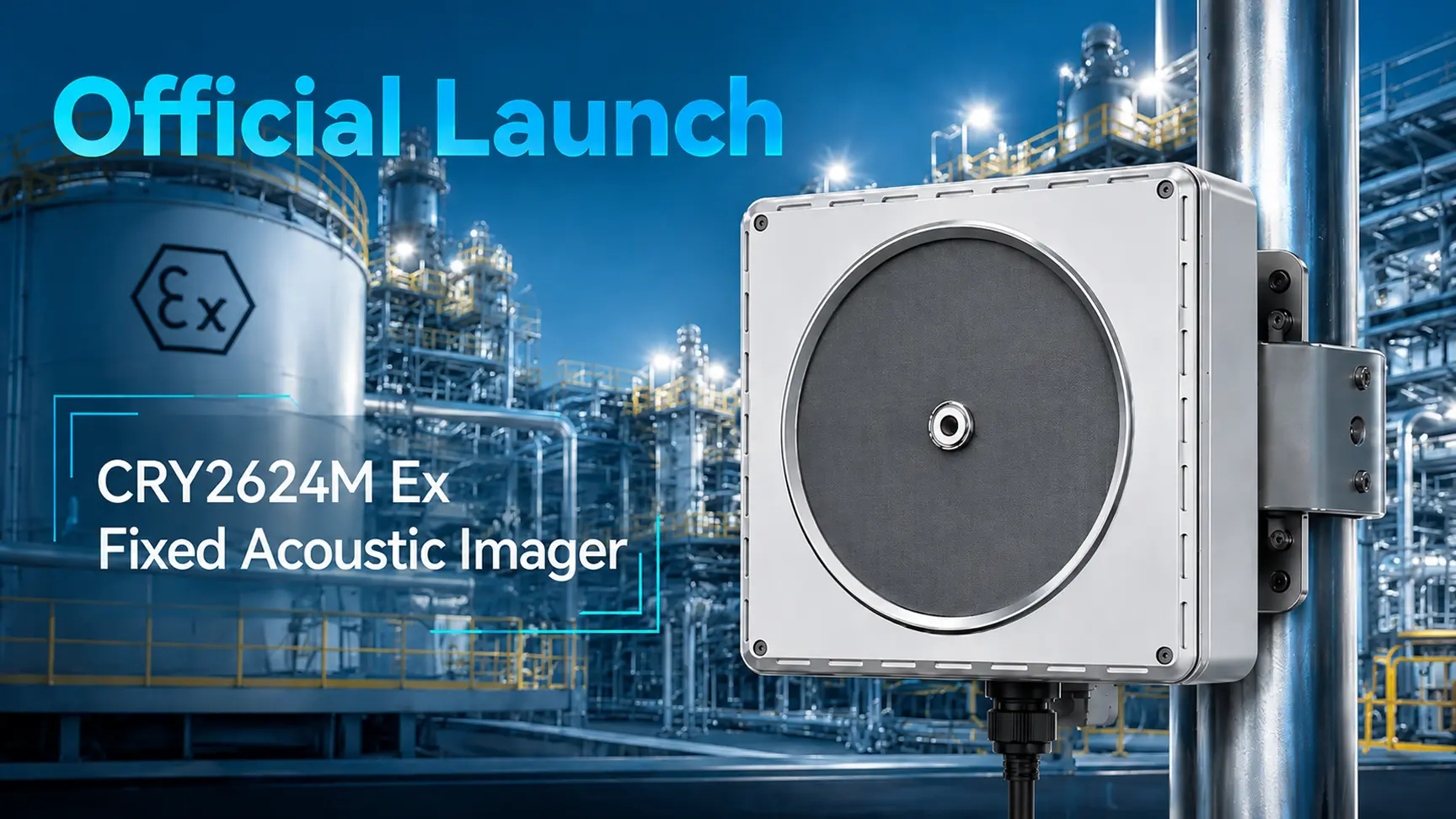
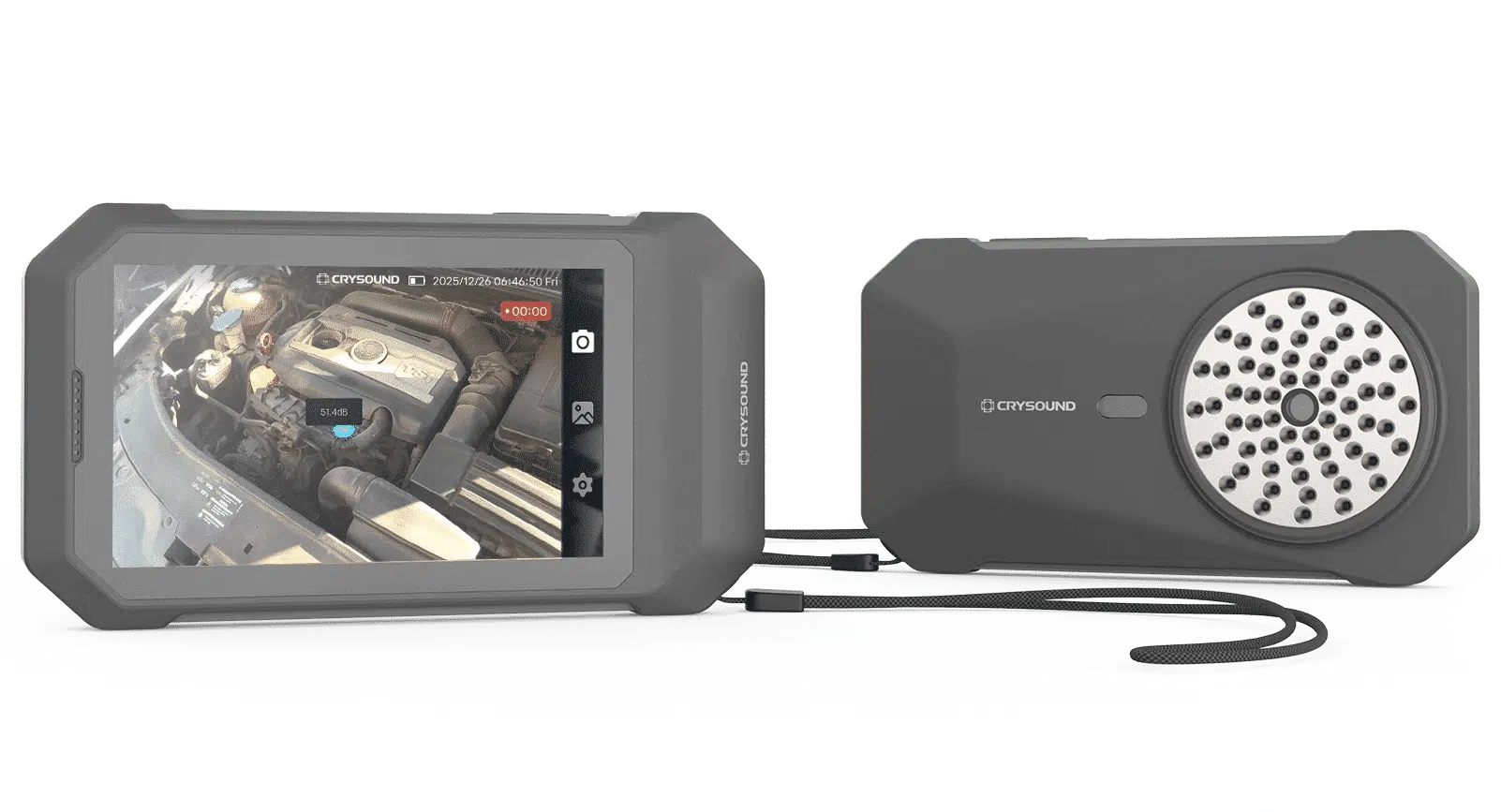
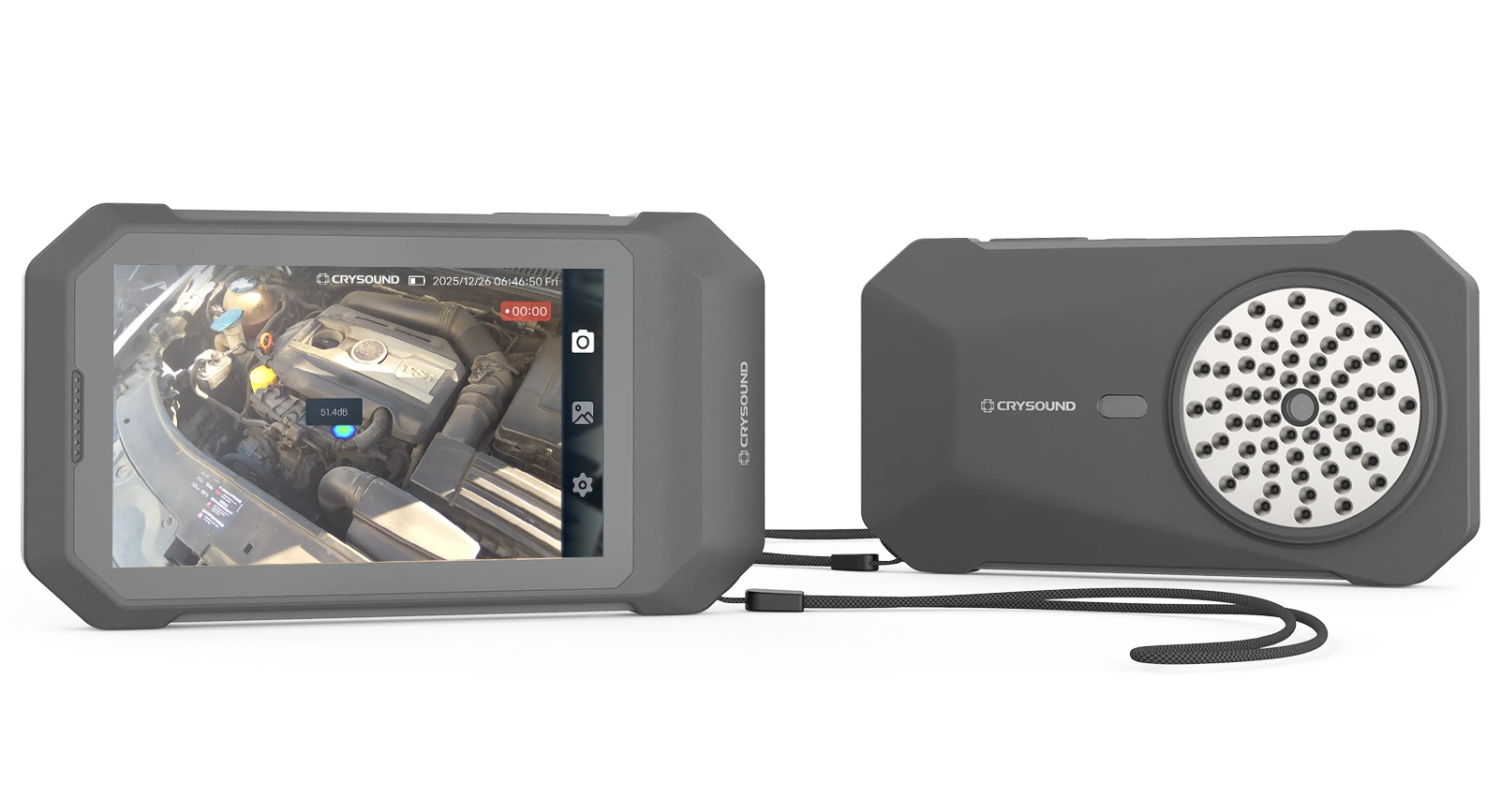
CRY8125 Ex Advanced Acoustic Imaging Camera
Measure Sound Better
Solutions
Gas Leak Detection
Noise and Vibration Test
Electroacoustic Test
Blog
Overview of Common Interfaces for Measurement Microphones
From the outside, a measurement microphone looks deceptively simple. But in real-world engineering, its interface options are surprisingly diverse: Lemo, BNC, Microdot, 10-32 UNF, M5, SMB… Many newcomers to acoustics ask questions like:
- Why can’t microphone interfaces be standardized?
- Why are cables often not interchangeable between microphones?
- What power and signal schemes are hidden behind different connectors?
This article provides a structured overview of common measurement microphone interfaces, looking at physical connectors, powering methods, cable characteristics, and typical application-driven selection.
Main Physical Interfaces for Measurement Microphones
Below is a connector-by-connector summary, including the typical powering approach for each.
Lemo (5-pin, 7-pin): The Classic Solution for Externally Polarized Microphones
Lemo is a precision circular multi-pin connector and is the most common choice for externally polarized measurement microphones. The Lemo B series is widely used (e.g., 0B, 1B, 2B), and most standard measurement microphones adopt the Lemo 1B interface.
Key Characteristics
A multi-pin connector can carry multiple signals simultaneously, such as:
- Microphone output (analog signal)
- External polarization high voltage (typically 200 V)
- Preamplifier power supply
- Calibration/identification signals
Additional benefits:
- Very reliable mechanical locking
- Well-suited for lab environments, metrology, and semi-anechoic chamber measurements where stability and traceability matter
Notes on External Polarization
- Common polarization voltage is 200 V; some systems support switching between 0 V / 200 V
- Polarization voltage stability affects microphone sensitivity; in engineering practice, sensitivity variation is often treated as approximately proportional to voltage variation
- The preamplifier is typically powered separately (up to 120 V) but delivered via the same multi-pin connector
- Maximum output voltage can reach 50 Vp
- Includes pins for charge injection methods
- Separate output and ground paths help achieve lower noise

In metrology labs, type testing, acoustic calibration, and high-precision semi-anechoic chamber work, the combination of “externally polarized microphone + Lemo multi-pin connector” is essentially a standard configuration.
BNC: The Most Common External Connector for IEPE Microphones
Names like IEPE / ICP / CCP refer to the same general technology route: constant-current powering, where power and signal are transmitted on the same line (Constant Current Powering). In this system, the most common physical connector is the coaxial BNC.
Interface and Powering Characteristics
- Coaxial structure, ideal for analog voltage transmission
- Bayonet lock (quick and reliable plug/unplug)
- Supports longer cable runs with good noise immunity
- Low cost and highly universal
Typical IEPE Powering Parameters
- Constant current: 2–20 mA (common settings include 2 mA, 4 mA, 8 mA, etc.)
- Compliance voltage (supply capability): typically 18–24 V
- Maximum output voltage: generally around 8 Vp
If the constant current is too low or the compliance voltage is insufficient, the maximum output signal swing is limited—directly affecting the maximum measurable SPL and the linear measurement range.

In everyday testing such as engineering noise measurements, NVH, and environmental noise work, “IEPE microphone + BNC” has become the de facto standard.
Microdot (10-32 UNF / M5): Lightweight Connectivity for Small Microphones
Microdot is a threaded miniature coax connector widely used for small sensors (compact measurement microphones, accelerometers, etc.). It commonly uses a 10-32 UNF thread.
What “10-32 UNF” Really Means
This is simply an imperial fine-thread standard:
- Nominal diameter: 0.19 inch ≈ 4.826 mm
- Pitch: 1/32 inch ≈ 0.7938 mm
Because 10-32 UNF is the typical thread used on Microdot connectors, the term “10-32 UNF” is often used informally to refer to the Microdot interface itself.
What about M5?
M5 is a metric thread standard:
- Nominal diameter: 5 mm
- Pitch: 0.8 mm
Its dimensions are close to 10-32 UNF, and when tolerances are not extremely strict it can serve as a substitute—commonly seen in accelerometers or vibration microphones.
Interface Characteristics
- Very compact; ideal for lightweight setups
- Threaded locking provides strong mechanical stability
- Commonly paired with IEPE powering
- Best for short runs and high-speed signal transmission

When microphones must be placed in tight spaces, or where sensor mass/size is critical, Microdot is a common choice for compact, high-density installations.
SMB (SubMiniature B): For High-Density Multi-Channel or Internal Connections
SMB is a small “push-on” coaxial connector.
Interface Characteristics
- Compact size supports high channel density
- Push-on structure enables fast connection
- Better high-frequency performance than BNC
- More suitable for semi-permanent internal wiring

SMB is often best viewed as an engineering connector used inside equipment, rather than a field-plugging standard.
Extended Interface Function: TEDS and Smart Identification
In multi-channel and integrated systems, TEDS (Transducer Electronic Data Sheet) is increasingly common.
By integrating a small memory chip into the sensor or cable, TEDS can store:
- Model and serial number
- Sensitivity
- Calibration date and other parameters
Compatible front-end hardware or acquisition software can automatically read TEDS to:
- Identify the sensor type on each channel
- Load sensitivity and calibration coefficients automatically
- Reduce manual entry errors
- Save calibration time and labor
At the connector level, TEDS is typically implemented by using certain pins in multi-pin Lemo connectors, or via overlay methods in specific BNC-based solutions. When planning an interface system, it’s wise to consider early on whether TEDS support is required.
Why Are There So Many Interfaces?
Connector diversity is best explained from three perspectives:
Different Polarization and Powering Schemes
- Externally polarized microphones (≈ 200 V polarization) → better suited to multi-pin connectors like Lemo
- Prepolarized + IEPE systems → better suited to coaxial connectors like BNC / Microdot / SMB
Different Scenarios and Priorities
- Laboratory / metrology: high stability, multiple signals in one cable, secure locking → Lemo
- Field engineering / environmental measurement: convenient wiring, strong universality → BNC + IEPE
- Miniaturization / high-density arrays: size and channel density first → Microdot / SMB
Long Product Lifecycles and Backward Compatibility
- Measurement systems often have lifecycles of 10–20 years or more
- To avoid forcing users to replace large numbers of cables and front-end systems, manufacturers typically continue existing interface ecosystems
- Under long lifecycle constraints, “full unification” is often impractical and offers limited engineering return
Typical Application Mapping (Quick Reference)
- Engineering noise, NVH, vibration/noise tests: BNC / Microdot
Easy wiring, many channels, low maintenance cost - Precision lab measurement, type testing, metrology calibration: Lemo 7-pin / 5-pin
Supports polarization HV and multiple signals; suitable for traceable high-precision measurement - Acoustic arrays, multi-channel acquisition card systems: Microdot / SMB
High channel density, compact wiring, easier system integration - Long-term environmental noise monitoring systems: BNC / customized protected connectors
Focus on weather resistance, waterproofing, salt fog resistance, and stable long-distance transmission
Conclusion
The variety of measurement microphone interfaces is mainly the result of trade-offs between technology routes, application requirements, and historical compatibility—not simply a “lack of standards”.
You are welcome to learn more about microphone functions and hardware solutions on our website and use the “Get in touch” form to contact the CRYSOUND team.
Bluetooth 5.0 Unicast Mechanism and Connection Strategy
How does your phone instantly and accurately connect to your earphones instead of someone else’s in a room full of Bluetooth devices? Why does your smart fitness band sync data exclusively to your phone app after a workout? This dedicated “one-to-one” connection relies on the Bluetooth 5.0 unicast mechanism. Its intelligence goes far beyond simple pairing—it lies in how it maintains a stable, efficient, and private wireless link with extremely low power consumption.
Core Philosophy of Connection Strategy: Precision and Energy Efficiency
Unlike Classic Bluetooth, which focuses on establishing a persistently online data channel, the Bluetooth 5.0 Low Energy (LE) unicast mode adopts a “wake-on-demand, instantaneous communication” design philosophy. It no longer maintains a continuous connection link but instead achieves efficient communication through a precise timing synchronization mechanism.
After devices pair (e.g., a phone and a fitness band), they do not stay in a constantly connected state. Instead, they negotiate and establish a “connection interval,” waking up synchronously only at predetermined moments to complete microsecond-level data exchange before immediately entering a deep sleep state. This mechanism allows devices to remain in an ultra-low power state for over 99% of the time, providing the core support for the long battery life (months to years) of IoT devices.

Connection: Dynamic Coordination Under Precise Timing
The establishment and maintenance of a Bluetooth 5.0 unicast connection rely on a precise timing coordination mechanism. The connection establishment process is as follows:

- Advertising and Scanning Phase: The peripheral device (e.g., earphone) sends advertising packets containing identity information at fixed intervals. The central device (e.g., phone) continuously scans on the advertising channels, searching for the target device.
- Connection Initiation Phase: The central device sends a connection request to the peripheral, which includes initial communication timing and suggested connection interval parameters.
- Connection Parameter Negotiation: This is the core of connection optimization. Beyond the connection interval, two other key parameters are negotiated:
- Slave Latency: When the slave device (e.g., fitness band) has no data to send, it can skip waking up for a specified number of connection interval cycles, thereby extending its sleep time.
- Supervision Timeout: A threshold for judging the connection state. If no valid communication occurs within this timeout period, the connection is considered lost, triggering reconnection or disconnection procedures.
- Connection Establishment and Maintenance: The master and slave devices switch to data channels, synchronizing their sleep and wake cycles according to the previously negotiated timing. This enables ultra-low power consumption while ensuring stable communication.
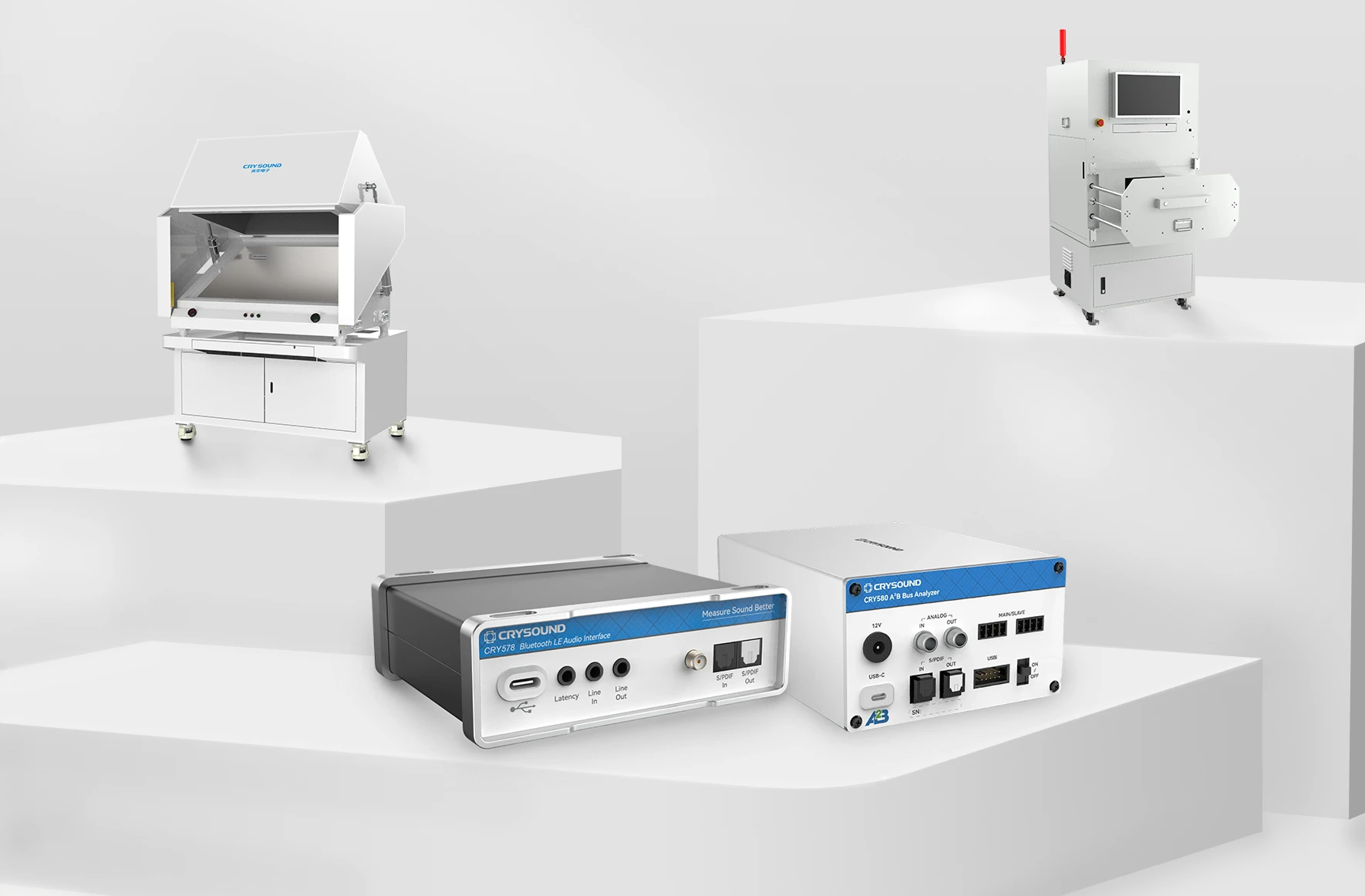
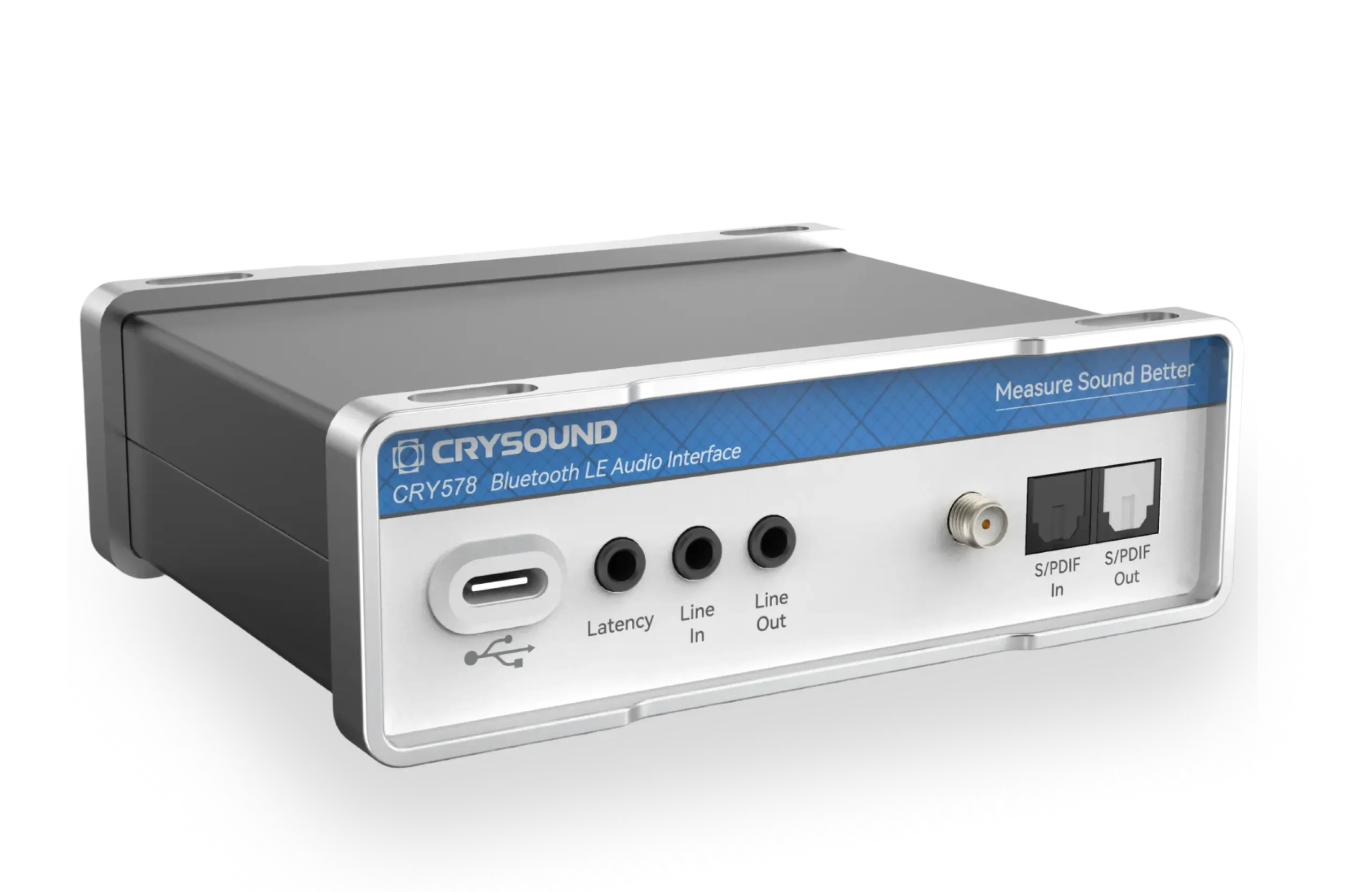
New Product: CRY578 Bluetooth LE Audio Interface Empowering BLE Testing

With the introduction of the new high-performance, low-complexity LC3 codec by the LE Audio standard, Bluetooth Low Energy (BLE) technology can now achieve stable transmission of high-quality stereo audio while maintaining its ultra-low power characteristics. Compared to traditional solutions, the LC3 codec can reduce bandwidth requirements by approximately 50% at the same audio quality or improve audio quality at the same bandwidth, effectively addressing the pain point of balancing low power consumption with high audio fidelity.
In response to this technological trend, our newly launched CRY578 Bluetooth LE Audio Interface comprehensively supports audio performance testing for both Classic Bluetooth (BR/EDR) and Bluetooth Low Energy (BLE), covering core metrics such as frequency response, distortion, and audio latency. It is suitable for the R&D and quality inspection phases of various Bluetooth audio products, including TWS earphones, smart speakers, and wearable devices.
For detailed specifications, application cases, or to inquire about trial opportunities for the CRY578, please fill out the “Get in touch” form below.
The Age of Embodied Intelligence: From Hearing the World to Understanding Space
As smart devices continue to evolve, conversations about AI often revolve around visual perception, language models, or generative capabilities. Yet as devices become more immersive and more deeply embedded in our physical world, expectations are shifting—from machines that can see to machines that can truly hear.
Many people still equate “hearing” with basic voice recognition, assuming it’s a solved problem. But as immersive audio and spatial experiences become core features of modern devices, sound is quietly emerging as the next major input channel for intelligent systems.
We often ignore the ambient sounds around us—airflow from a computer, a washing machine spinning on the balcony, traffic rumbling outside the window. But if you close your eyes for a moment and focus, sound reveals far more than we usually notice. It travels through darkness, bypasses visual occlusion, and even reflects the shape of a space.
For machines, this makes sound an invaluable source of environmental intelligence: footsteps, running water, engine noises—these carry information about people, objects, and events.
This is where embodied intelligence comes into play: it enables devices not only to process speech, but also to understand the acoustic world.

From Hearing to Orientation: Why IMUs Are Essential for Spatial Awareness
Understanding external sounds is only one half of embodied intelligence. To truly comprehend space, a device must also understand itself—its orientation, posture, and movement in the environment.
● Hearing tells you what is happening.
● Self-orientation tells you where you are relative to what you hear.
Imagine hearing a car approaching from your right. Without knowing which direction your head is turned, your brain cannot accurately determine where the car actually is. Machines face the same problem: auditory perception must be paired with spatial perception.
Humans rely on the vestibular system inside the inner ear to estimate head movement and spatial orientation. Devices, on the other hand, rely on the IMU (Inertial Measurement Unit)—a tiny module that integrates gyroscopes, accelerometers, and sensor fusion algorithms to establish direction and posture.
Today, IMUs power everything from spatial audio and gesture control to AR/VR head tracking and audiovisual synchronization.

Now imagine watching a movie or exploring an AR world: when you turn your head, you naturally expect the sound field to update instantly. If the IMU drifts or responds slowly, you may notice that:
● Sound lags behind your head movement.
● The perceived sound direction becomes inaccurate.
● Audio starts “wobbling” due to noisy readings.
Even slight errors can break immersion, making the experience feel unnatural or even uncomfortable. This is why IMU accuracy and stability are critical—and why IMU testing has become a key part of the manufacturing process for AR/VR devices and advanced wearables.
Making Perception Reliable: CRYSOUND’s IMU Testing Framework
To ensure a consistent user experience, IMUs must undergo precise and standardized testing before devices leave the factory. Leveraging years of expertise in acoustic measurement, CRYSOUND has developed a comprehensive IMU performance testing framework designed to replicate “real-world head movements” inside the lab.
At the core of this system is a three-axis motion platform capable of simulating the following motions: yaw (turning the head left or right), pitch (nodding up and down), and roll (tilting the head sideways).
These cover the exact motion ranges most critical for spatial audio. Powered by high-precision servo motors, the platform achieves an absolute positioning accuracy of ±0.05° and repeatability of ±0.06°, enabling highly realistic motion reproduction.

The testing workflow is fully automated: the operator simply places the device inside an RF-shielded chamber, and the system takes care of:
● Establishing Bluetooth connection
● Executing motion sequences
● Collecting raw IMU data
● Performing pass/fail analysis
With efficient motion control and stable wireless communication, a full six-posture test for typical headphone products can be completed in about one minute per device—ideal for high-volume production lines.
Although these processes happen behind the scenes, they directly shape the end-user experience: audio that moves naturally with your head, without delay, drift, or jitter—allowing immersion to feel seamless and real.
As cloud computing and on-device processing continue to advance, the next generation of smart devices will increasingly differentiate themselves not by raw computing power, but by depth of perception. Sound perception and spatial orientation will form the backbone of that evolution.
Combining auditory sensing with directional awareness—using IMUs to empower AI—marks a major step toward truly embodied intelligence. Only when a device can hear the environment, interpret spatial relationships, and understand its own motion can it genuinely “exist” in the physical world.
If you’d like to learn more about how CRYSOUND’s IMU and acoustic testing solutions can support your AR/VR, headphone, or wearable projects, please fill out the “Get in touch” form on our website, and our team will get back to you shortly.