

From the outside, a measurement microphone looks deceptively simple. But in real-world engineering, its interface options are surprisingly diverse: Lemo, BNC, Microdot, 10-32 UNF, M5, SMB… Many newcomers to acoustics ask questions like:
- Why can’t microphone interfaces be standardized?
- Why are cables often not interchangeable between microphones?
- What power and signal schemes are hidden behind different connectors?
This article provides a structured overview of common measurement microphone interfaces, looking at physical connectors, powering methods, cable characteristics, and typical application-driven selection.
Main Physical Interfaces for Measurement Microphones
Below is a connector-by-connector summary, including the typical powering approach for each.
Lemo (5-pin, 7-pin): The Classic Solution for Externally Polarized Microphones
Lemo is a precision circular multi-pin connector and is the most common choice for externally polarized measurement microphones. The Lemo B series is widely used (e.g., 0B, 1B, 2B), and most standard measurement microphones adopt the Lemo 1B interface.
Key Characteristics
A multi-pin connector can carry multiple signals simultaneously, such as:
- Microphone output (analog signal)
- External polarization high voltage (typically 200 V)
- Preamplifier power supply
- Calibration/identification signals
Additional benefits:
- Very reliable mechanical locking
- Well-suited for lab environments, metrology, and semi-anechoic chamber measurements where stability and traceability matter
Notes on External Polarization
- Common polarization voltage is 200 V; some systems support switching between 0 V / 200 V
- Polarization voltage stability affects microphone sensitivity; in engineering practice, sensitivity variation is often treated as approximately proportional to voltage variation
- The preamplifier is typically powered separately (up to 120 V) but delivered via the same multi-pin connector
- Maximum output voltage can reach 50 Vp
- Includes pins for charge injection methods
- Separate output and ground paths help achieve lower noise
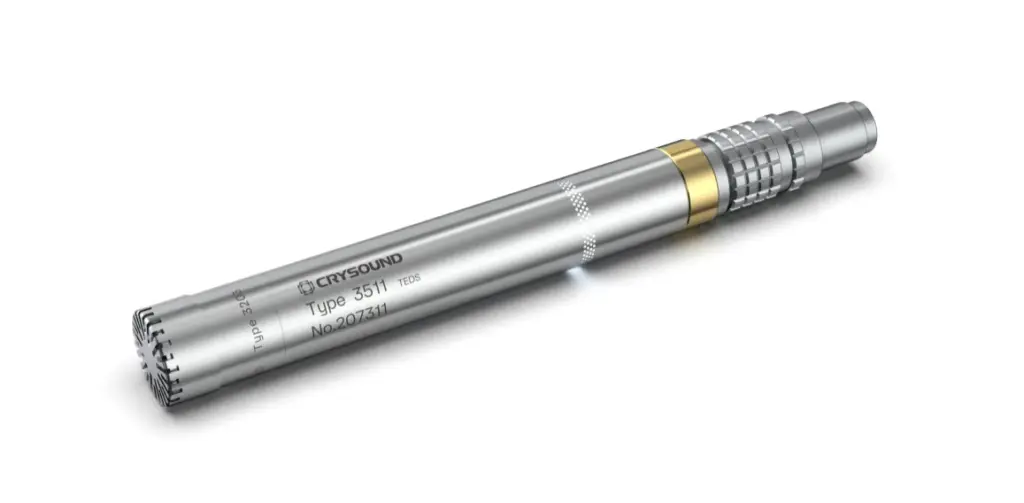
In metrology labs, type testing, acoustic calibration, and high-precision semi-anechoic chamber work, the combination of “externally polarized microphone + Lemo multi-pin connector” is essentially a standard configuration.
BNC: The Most Common External Connector for IEPE Microphones
Names like IEPE / ICP / CCP refer to the same general technology route: constant-current powering, where power and signal are transmitted on the same line (Constant Current Powering). In this system, the most common physical connector is the coaxial BNC.
Interface and Powering Characteristics
- Coaxial structure, ideal for analog voltage transmission
- Bayonet lock (quick and reliable plug/unplug)
- Supports longer cable runs with good noise immunity
- Low cost and highly universal
Typical IEPE Powering Parameters
- Constant current: 2–20 mA (common settings include 2 mA, 4 mA, 8 mA, etc.)
- Compliance voltage (supply capability): typically 18–24 V
- Maximum output voltage: generally around 8 Vp
If the constant current is too low or the compliance voltage is insufficient, the maximum output signal swing is limited—directly affecting the maximum measurable SPL and the linear measurement range.
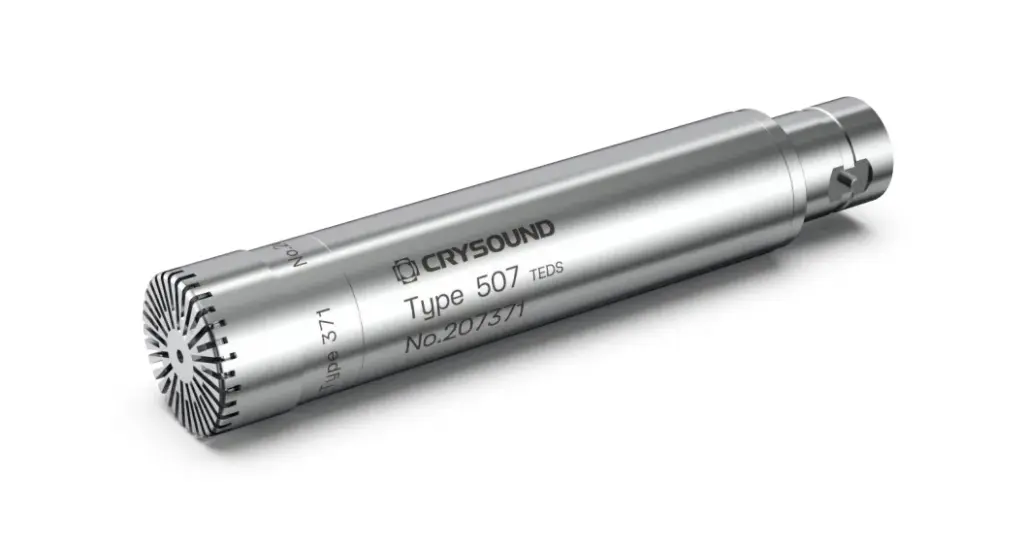
In everyday testing such as engineering noise measurements, NVH, and environmental noise work, “IEPE microphone + BNC” has become the de facto standard.
Microdot (10-32 UNF / M5): Lightweight Connectivity for Small Microphones
Microdot is a threaded miniature coax connector widely used for small sensors (compact measurement microphones, accelerometers, etc.). It commonly uses a 10-32 UNF thread.
What “10-32 UNF” Really Means
This is simply an imperial fine-thread standard:
- Nominal diameter: 0.19 inch ≈ 4.826 mm
- Pitch: 1/32 inch ≈ 0.7938 mm
Because 10-32 UNF is the typical thread used on Microdot connectors, the term “10-32 UNF” is often used informally to refer to the Microdot interface itself.
What about M5?
M5 is a metric thread standard:
- Nominal diameter: 5 mm
- Pitch: 0.8 mm
Its dimensions are close to 10-32 UNF, and when tolerances are not extremely strict it can serve as a substitute—commonly seen in accelerometers or vibration microphones.
Interface Characteristics
- Very compact; ideal for lightweight setups
- Threaded locking provides strong mechanical stability
- Commonly paired with IEPE powering
- Best for short runs and high-speed signal transmission
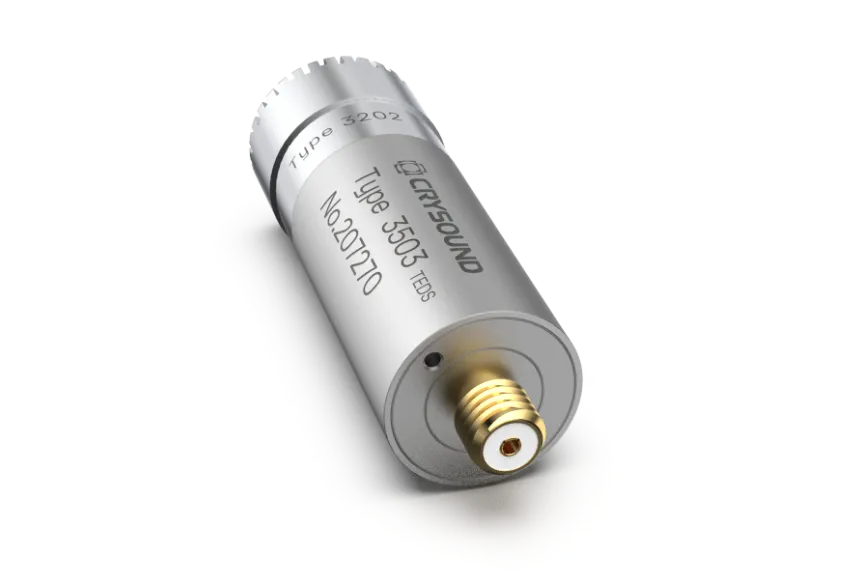
When microphones must be placed in tight spaces, or where sensor mass/size is critical, Microdot is a common choice for compact, high-density installations.
SMB (SubMiniature B): For High-Density Multi-Channel or Internal Connections
SMB is a small “push-on” coaxial connector.
Interface Characteristics
- Compact size supports high channel density
- Push-on structure enables fast connection
- Better high-frequency performance than BNC
- More suitable for semi-permanent internal wiring
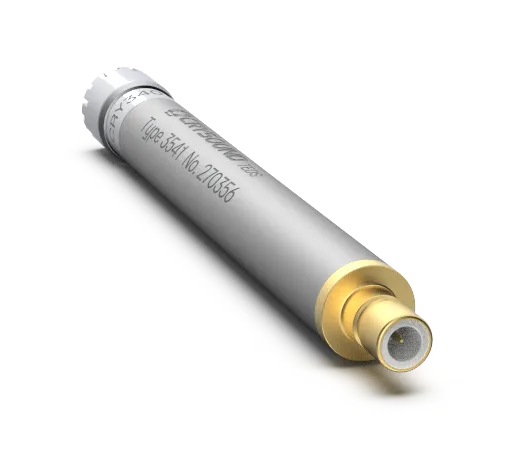
SMB is often best viewed as an engineering connector used inside equipment, rather than a field-plugging standard.
Extended Interface Function: TEDS and Smart Identification
In multi-channel and integrated systems, TEDS (Transducer Electronic Data Sheet) is increasingly common.
By integrating a small memory chip into the sensor or cable, TEDS can store:
- Model and serial number
- Sensitivity
- Calibration date and other parameters
Compatible front-end hardware or acquisition software can automatically read TEDS to:
- Identify the sensor type on each channel
- Load sensitivity and calibration coefficients automatically
- Reduce manual entry errors
- Save calibration time and labor
At the connector level, TEDS is typically implemented by using certain pins in multi-pin Lemo connectors, or via overlay methods in specific BNC-based solutions. When planning an interface system, it’s wise to consider early on whether TEDS support is required.
Why Are There So Many Interfaces?
Connector diversity is best explained from three perspectives:
Different Polarization and Powering Schemes
- Externally polarized microphones (≈ 200 V polarization) → better suited to multi-pin connectors like Lemo
- Prepolarized + IEPE systems → better suited to coaxial connectors like BNC / Microdot / SMB
Different Scenarios and Priorities
- Laboratory / metrology: high stability, multiple signals in one cable, secure locking → Lemo
- Field engineering / environmental measurement: convenient wiring, strong universality → BNC + IEPE
- Miniaturization / high-density arrays: size and channel density first → Microdot / SMB
Long Product Lifecycles and Backward Compatibility
- Measurement systems often have lifecycles of 10–20 years or more
- To avoid forcing users to replace large numbers of cables and front-end systems, manufacturers typically continue existing interface ecosystems
- Under long lifecycle constraints, “full unification” is often impractical and offers limited engineering return
Typical Application Mapping (Quick Reference)
- Engineering noise, NVH, vibration/noise tests: BNC / Microdot
Easy wiring, many channels, low maintenance cost - Precision lab measurement, type testing, metrology calibration: Lemo 7-pin / 5-pin
Supports polarization HV and multiple signals; suitable for traceable high-precision measurement - Acoustic arrays, multi-channel acquisition card systems: Microdot / SMB
High channel density, compact wiring, easier system integration - Long-term environmental noise monitoring systems: BNC / customized protected connectors
Focus on weather resistance, waterproofing, salt fog resistance, and stable long-distance transmission
Conclusion
The variety of measurement microphone interfaces is mainly the result of trade-offs between technology routes, application requirements, and historical compatibility—not simply a “lack of standards”.
You are welcome to learn more about microphone functions and hardware solutions on our website and use the “Get in touch” form to contact the CRYSOUND team.