

As smart devices continue to evolve, conversations about AI often revolve around visual perception, language models, or generative capabilities. Yet as devices become more immersive and more deeply embedded in our physical world, expectations are shifting—from machines that can see to machines that can truly hear.
Many people still equate “hearing” with basic voice recognition, assuming it’s a solved problem. But as immersive audio and spatial experiences become core features of modern devices, sound is quietly emerging as the next major input channel for intelligent systems.
We often ignore the ambient sounds around us—airflow from a computer, a washing machine spinning on the balcony, traffic rumbling outside the window. But if you close your eyes for a moment and focus, sound reveals far more than we usually notice. It travels through darkness, bypasses visual occlusion, and even reflects the shape of a space.
For machines, this makes sound an invaluable source of environmental intelligence: footsteps, running water, engine noises—these carry information about people, objects, and events.
This is where embodied intelligence comes into play: it enables devices not only to process speech, but also to understand the acoustic world.
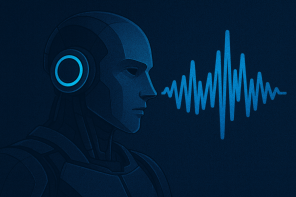
From Hearing to Orientation: Why IMUs Are Essential for Spatial Awareness
Understanding external sounds is only one half of embodied intelligence. To truly comprehend space, a device must also understand itself—its orientation, posture, and movement in the environment.
● Hearing tells you what is happening.
● Self-orientation tells you where you are relative to what you hear.
Imagine hearing a car approaching from your right. Without knowing which direction your head is turned, your brain cannot accurately determine where the car actually is. Machines face the same problem: auditory perception must be paired with spatial perception.
Humans rely on the vestibular system inside the inner ear to estimate head movement and spatial orientation. Devices, on the other hand, rely on the IMU (Inertial Measurement Unit)—a tiny module that integrates gyroscopes, accelerometers, and sensor fusion algorithms to establish direction and posture.
Today, IMUs power everything from spatial audio and gesture control to AR/VR head tracking and audiovisual synchronization.
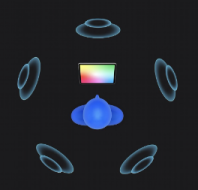
Now imagine watching a movie or exploring an AR world: when you turn your head, you naturally expect the sound field to update instantly. If the IMU drifts or responds slowly, you may notice that:
● Sound lags behind your head movement.
● The perceived sound direction becomes inaccurate.
● Audio starts “wobbling” due to noisy readings.
Even slight errors can break immersion, making the experience feel unnatural or even uncomfortable. This is why IMU accuracy and stability are critical—and why IMU testing has become a key part of the manufacturing process for AR/VR devices and advanced wearables.
Making Perception Reliable: CRYSOUND’s IMU Testing Framework
To ensure a consistent user experience, IMUs must undergo precise and standardized testing before devices leave the factory. Leveraging years of expertise in acoustic measurement, CRYSOUND has developed a comprehensive IMU performance testing framework designed to replicate “real-world head movements” inside the lab.
At the core of this system is a three-axis motion platform capable of simulating the following motions: yaw (turning the head left or right), pitch (nodding up and down), and roll (tilting the head sideways).
These cover the exact motion ranges most critical for spatial audio. Powered by high-precision servo motors, the platform achieves an absolute positioning accuracy of ±0.05° and repeatability of ±0.06°, enabling highly realistic motion reproduction.

The testing workflow is fully automated: the operator simply places the device inside an RF-shielded chamber, and the system takes care of:
● Establishing Bluetooth connection
● Executing motion sequences
● Collecting raw IMU data
● Performing pass/fail analysis
With efficient motion control and stable wireless communication, a full six-posture test for typical headphone products can be completed in about one minute per device—ideal for high-volume production lines.
Although these processes happen behind the scenes, they directly shape the end-user experience: audio that moves naturally with your head, without delay, drift, or jitter—allowing immersion to feel seamless and real.
As cloud computing and on-device processing continue to advance, the next generation of smart devices will increasingly differentiate themselves not by raw computing power, but by depth of perception. Sound perception and spatial orientation will form the backbone of that evolution.
Combining auditory sensing with directional awareness—using IMUs to empower AI—marks a major step toward truly embodied intelligence. Only when a device can hear the environment, interpret spatial relationships, and understand its own motion can it genuinely “exist” in the physical world.
If you’d like to learn more about how CRYSOUND’s IMU and acoustic testing solutions can support your AR/VR, headphone, or wearable projects, please fill out the “Get in touch” form on our website, and our team will get back to you shortly.